

Montre ses amygdales
Weidenkätzchen + Fliegen + Ameisen
HFF Horses.
Greylag goose
Egret and trunk
Small bird
Poni
MICKEY MOUSE
Pouillot véloce
Mesange bleue
Sitelle torchepot
The Family and the Sun
Schwebfliegenweide
Ein Trio beim Mähen ; )
"Uupps-Jetzt hat mich ein Vogelschiss getroffen!"
Roter Kamm
Lemsdale Kune kunes
Flughund mit Krokusallergie:)
"Was gibts hier zu meckern? Der Zaun ist ...
Vogelnest (PiP)
Hermelin
Gd Cormoran
Biopark Valencia, 127
Biopark Valencia, 120
Biopark Valencia, 119
Rollier à long brin
Giftg, aber schön - Toxic, but beautiful
Martin-Pêcheur
Voir ce petit oiseau en haut à droite
Frühjahr-Zicklein
Hocheck, Oberaudorf ... (2 x PiP)
Rollier à long brin
Zeisiginvasion
Nicely Covered
... die Kaputze wollte er nicht aufsetzen ... :-)
Hippopotame
Mycteria ibis
Biopark Valencia, 115
Biopark Valencia, 110
Biopark Valencia, 109
Explorer of beautiful frames named Archie - 3
It's kinda chilly out here for a little lizard

See also...
Keywords
Authorizations, license
-
Visible by: Everyone -
All rights reserved
-
758 visits
Alpendohlen
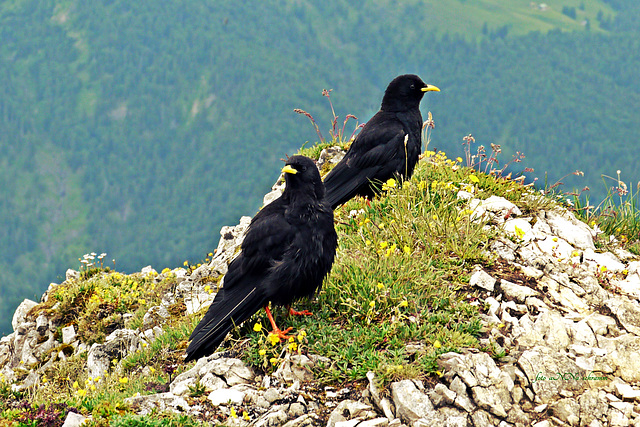

Alpen-Dohlen am Hinteren Sonnwendjoch
s.a. >>>> Video >>> Alpendohlen
______
Die Alpendohle (Pyrrhocorax graculus) ist eine Vogelart aus der Familie der Rabenvögel *(Corvidae).
www.youtube.com/watch?v=7qQ86TT36tI
Der 34 bis 38 cm große Vogel ist ein mittelgroßer Vertreter seiner Familie und zeichnet sich durch schwarzes Gefieder, rote Beine und einen gelben Schnabel aus.
Die Paare sind monogam und halten meist bis zum Tod eines Partners
Grundsätzlich ist die Alpendohle oberhalb der Waldgrenze anzutreffen, kommt aber vereinzelt und vor allem im Winter auch in tieferen Lagen vor. Wenige Vogelarten brüten in ähnlich großen Höhen: Die Brutgebiete reichen in den Schweizer Alpen bis auf 3800 m, im Atlas bis auf 3900 m. In Kaschmir bewegen sich die Vorkommen im Sommer zwischen 3500 und 5000 m. Eine Ausnahme stellt in dieser Hinsicht der Balkan dar, wo die Vögel vielerorts zwischen 500 und 1400 m brüten. Auf Nahrungssuche sind Alpendohlen am Mount Everest auch schon auf über 8200 m beobachtet worden. Ebenfalls von Everest-Expeditionen stammen Berichte von Sichtungen in Flughöhen über 9500 m.
The Alpine Chough is an omnivore. Like the Alpine crow, it eats mainly invertebrates and fruits, but shows greater opportunism in the diet and readily absorbs other types of food. In spring and summer arthropods and their larvae, snails and earthworms dominate the food spectrum of the species, against fall stone fruits, berries and pome fruits gain in importance, provided they exist in sufficient quantity. Even then, numerous locusts make up a large part of the food. In winter, berries and coniferous seeds are the food source of Alpine Chough. Wherever it reaches human waste, it becomes the main food source in winter. In addition, the Alpine Chough eats all year round bird eggs, carrion or small vertebrates, provided they can get hold of them. She eats grit regularly and often takes snow in winter.
Even in flight, they capture a considerable part of their food. The animals fly at low altitude against the wind to catch grasshoppers and other insects from the air. Especially in winter, the species is found frequently in mountain villages, at ski stations and in mountain stations, where it pulls the supply of human food leftovers. Above all, such food hides the Alpine chough regularly, to bring them back later and eat. Mostly the food pieces are in rock clefts.
(Wiki)
de.wikipedia.org/wiki/Alpendohle
Translate into English
s.a. >>>> Video >>> Alpendohlen
______
Die Alpendohle (Pyrrhocorax graculus) ist eine Vogelart aus der Familie der Rabenvögel *(Corvidae).
www.youtube.com/watch?v=7qQ86TT36tI
Der 34 bis 38 cm große Vogel ist ein mittelgroßer Vertreter seiner Familie und zeichnet sich durch schwarzes Gefieder, rote Beine und einen gelben Schnabel aus.
Die Paare sind monogam und halten meist bis zum Tod eines Partners
Grundsätzlich ist die Alpendohle oberhalb der Waldgrenze anzutreffen, kommt aber vereinzelt und vor allem im Winter auch in tieferen Lagen vor. Wenige Vogelarten brüten in ähnlich großen Höhen: Die Brutgebiete reichen in den Schweizer Alpen bis auf 3800 m, im Atlas bis auf 3900 m. In Kaschmir bewegen sich die Vorkommen im Sommer zwischen 3500 und 5000 m. Eine Ausnahme stellt in dieser Hinsicht der Balkan dar, wo die Vögel vielerorts zwischen 500 und 1400 m brüten. Auf Nahrungssuche sind Alpendohlen am Mount Everest auch schon auf über 8200 m beobachtet worden. Ebenfalls von Everest-Expeditionen stammen Berichte von Sichtungen in Flughöhen über 9500 m.
The Alpine Chough is an omnivore. Like the Alpine crow, it eats mainly invertebrates and fruits, but shows greater opportunism in the diet and readily absorbs other types of food. In spring and summer arthropods and their larvae, snails and earthworms dominate the food spectrum of the species, against fall stone fruits, berries and pome fruits gain in importance, provided they exist in sufficient quantity. Even then, numerous locusts make up a large part of the food. In winter, berries and coniferous seeds are the food source of Alpine Chough. Wherever it reaches human waste, it becomes the main food source in winter. In addition, the Alpine Chough eats all year round bird eggs, carrion or small vertebrates, provided they can get hold of them. She eats grit regularly and often takes snow in winter.
Even in flight, they capture a considerable part of their food. The animals fly at low altitude against the wind to catch grasshoppers and other insects from the air. Especially in winter, the species is found frequently in mountain villages, at ski stations and in mountain stations, where it pulls the supply of human food leftovers. Above all, such food hides the Alpine chough regularly, to bring them back later and eat. Mostly the food pieces are in rock clefts.
(Wiki)
de.wikipedia.org/wiki/Alpendohle
Bergfex, Ulrich John, ColRam, Engelbert and 20 other people have particularly liked this photo
- Keyboard shortcuts:
Jump to top
RSS feed- Latest comments - Subscribe to the comment feeds of this photo
- ipernity © 2007-2026
- Help & Contact
|
Club news
|
About ipernity
|
History |
ipernity Club & Prices |
Guide of good conduct
Donate | Group guidelines | Privacy policy | Terms of use | Statutes | In memoria -
Facebook
X

Bonne semaine.
aNNa schramm club has replied to Malik Raoulda clubChez nous , Chocard à bec jaune
aNNa schramm club has replied to neira-Dan clubaNNa schramm club has replied to Borowww.ipernity.com/group/oiseaux_monde
aNNa schramm club has replied to José Manuel PoloaNNa schramm club has replied to José Manuel PoloaNNa schramm club has replied to Armando Taborda clubaNNa schramm club has replied to Karl Hartwig Schütz clubaNNa schramm club has replied to Keith Burton clubaNNa schramm club has replied to Boarischa Krautmo clubCheers, Herb
Sign-in to write a comment.