


Pays de la Loire

A collection of photos taken over the years. They just all have in common, that they were taken in "Pays de la Loire" in western France.
Le Mans - Saint-Julien du Mans
| |
|
|
An existing celtic settlement was conquered by the Romans 56bC and named Suindinum. Saint Julien du Mans, to whom the cathedral is dedicated, was the first bishop here upto 348. He was followed by Saint Liborius du Mans, who died here in 397 and was buried next to his predecessor inside the existing cathedral.
In 835 Saint Liborius´s relics were exhumed and - on order of Emperor Louis the Pious - transferred to Paderborn (900kms northeast), where Louis´ father Emperor Charlemagne had founded a diocese in 799. This young diocese suffered, as it had no saint of its own.
From this "translation" arose a "brotherhood" between Le Mans and Paderborn, considered to be the oldest "twinning contract" still in force.
The "Cathédrale Saint-Julien du Mans" was erected over a very long period. It has a Romanesque nave and a Gothic choir. The first nave of the cathedral was erected from 1100 on. Following a fire in 1134, a rebuilding programme was begun, following a different, more complex blueprint. This was partly funded by Henry II of England (aka "Henry Plantagenet", "Henry Curtmantle"), whose father, Geoffroy of Anjou (aka "the Handsome", "le Bel") was buried here in 1151.
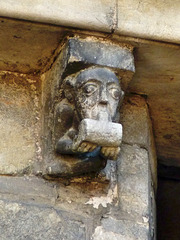
Under the roof of the Romanesque nave are some nice corbels. Here is a musician, playing the dolo.
Le Mans - Saint-Julien du Mans
| |
|
An existing celtic settlement was conquered by the Romans 56bC and named Suindinum. Saint Julien du Mans, to whom the cathedral is dedicated, was the first bishop here upto 348. He was followed by Saint Liborius du Mans, who died here in 397 and was buried next to his predecessor inside the existing cathedral.
In 835 Saint Liborius´s relics were exhumed and - on order of Emperor Louis the Pious - transferred to Paderborn (900kms northeast), where Louis´ father Emperor Charlemagne had founded a diocese in 799. This young diocese suffered, as it had no saint of its own.
From this "translation" arose a "brotherhood" between Le Mans and Paderborn, considered to be the oldest "twinning contract" still in force.
The "Cathédrale Saint-Julien du Mans" was erected over a very long period. It has a Romanesque nave and a Gothic choir. The first nave of the cathedral was erected from 1100 on. Following a fire in 1134, a rebuilding programme was begun, following a different, more complex blueprint. This was partly funded by Henry II of England (aka "Henry Plantagenet", "Henry Curtmantle"), whose father, Geoffroy of Anjou (aka "the Handsome", "le Bel") was buried here in 1151.
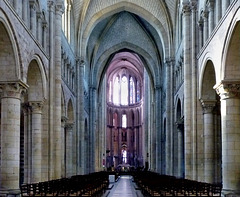
Early morning in the nave, facing east to the Gothic choir. The blaze on the construction site in 1134 had destroyed whatever was completed. The nave seen today was erected 1137 - 1158. Construction works of the choir started 1217.
www.cathedraledumans.fr
Le Mans - Saint-Julien du Mans
| |
|
An existing celtic settlement was conquered by the Romans 56bC and named Suindinum. Saint Julien du Mans, to whom the cathedral is dedicated, was the first bishop here upto 348. He was followed by Saint Liborius du Mans, who died here in 397 and was buried next to his predecessor inside the existing cathedral.
In 835 Saint Liborius´s relics were exhumed and - on order of Emperor Louis the Pious - transferred to Paderborn (900kms northeast), where Louis´ father Emperor Charlemagne had founded a diocese in 799. This young diocese suffered, as it had no saint of its own.
From this "translation" arose a "brotherhood" between Le Mans and Paderborn, considered to be the oldest "twinning contract" still in force.
The "Cathédrale Saint-Julien du Mans" was erected over a very long period. It has a Romanesque nave and a Gothic choir. The first nave of the cathedral was erected from 1100 on. Following a fire in 1134, a rebuilding programme was begun, following a different, more complex blueprint. This was partly funded by Henry II of England (aka "Henry Plantagenet", "Henry Curtmantle"), whose father, Geoffroy of Anjou (aka "the Handsome", "le Bel") was buried here in 1151.
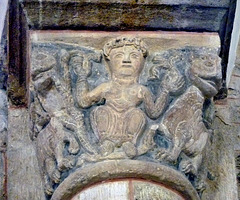
The Romanesque nave has some interesting capitals. Here is a "Master of the Beasts", who is obviously feeding the lions. The left lion nibbles a snake, while the vegetarian colleague on the right gets an apple.
Le Mans - Saint-Julien du Mans
| |
|
|
An existing celtic settlement was conquered by the Romans 56bC and named Suindinum. Saint Julien du Mans, to whom the cathedral is dedicated, was the first bishop here upto 348. He was followed by Saint Liborius du Mans, who died here in 397 and was buried next to his predecessor inside the existing cathedral.
In 835 Saint Liborius´s relics were exhumed and - on order of Emperor Louis the Pious - transferred to Paderborn (900kms northeast), where Louis´ father Emperor Charlemagne had founded a diocese in 799. This young diocese suffered, as it had no saint of its own.
From this "translation" arose a "brotherhood" between Le Mans and Paderborn, considered to be the oldest "twinning contract" still in force.
The "Cathédrale Saint-Julien du Mans" was erected over a very long period. It has a Romanesque nave and a Gothic choir. The first nave of the cathedral was erected from 1100 on. Following a fire in 1134, a rebuilding programme was begun, following a different, more complex blueprint. This was partly funded by Henry II of England (aka "Henry Plantagenet", "Henry Curtmantle"), whose father, Geoffroy of Anjou (aka "the Handsome", "le Bel") was buried here in 1151.
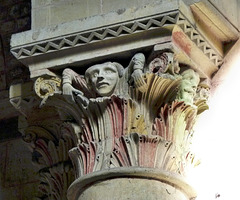
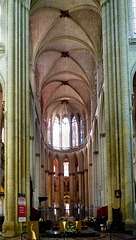
There is a clear border between the nave, the transept and the choir.
The construction of the (new) Romanesque nave started in 1136, the construction of the Gothic choir 1217. The transept, connecting both was the youngest part of the cathedral. It dates back to 14th century. The further east to choir and transept, the more "elegant" are the capitals of the nave.
Le Mans - Saint-Julien du Mans
| |
|
An existing celtic settlement was conquered by the Romans 56bC and named Suindinum. Saint Julien du Mans, to whom the cathedral is dedicated, was the first bishop here upto 348. He was followed by Saint Liborius du Mans, who died here in 397 and was buried next to his predecessor inside the existing cathedral.
In 835 Saint Liborius´s relics were exhumed and - on order of Emperor Louis the Pious - transferred to Paderborn (900kms northeast), where Louis´ father Emperor Charlemagne had founded a diocese in 799. This young diocese suffered, as it had no saint of its own.
From this "translation" arose a "brotherhood" between Le Mans and Paderborn, considered to be the oldest "twinning contract" still in force.
The "Cathédrale Saint-Julien du Mans" was erected over a very long period. It has a Romanesque nave and a Gothic choir. The first nave of the cathedral was erected from 1100 on. Following a fire in 1134, a rebuilding programme was begun, following a different, more complex blueprint. This was partly funded by Henry II of England (aka "Henry Plantagenet", "Henry Curtmantle"), whose father, Geoffroy of Anjou (aka "the Handsome", "le Bel") was buried here in 1151.
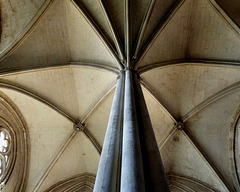
The construction of the Gothic ambulatory choir started in 1217.
Le Mans - Saint-Julien du Mans
| |
|
An existing celtic settlement was conquered by the Romans 56bC and named Suindinum. Saint Julien du Mans, to whom the cathedral is dedicated, was the first bishop here upto 348. He was followed by Saint Liborius du Mans, who died here in 397 and was buried next to his predecessor inside the existing cathedral.
In 835 Saint Liborius´s relics were exhumed and - on order of Emperor Louis the Pious - transferred to Paderborn (900kms northeast), where Louis´ father Emperor Charlemagne had founded a diocese in 799. This young diocese suffered, as it had no saint of its own.
From this "translation" arose a "brotherhood" between Le Mans and Paderborn, considered to be the oldest "twinning contract" still in force.
The "Cathédrale Saint-Julien du Mans" was erected over a very long period. It has a Romanesque nave and a Gothic choir. The first nave of the cathedral was erected from 1100 on. Following a fire in 1134, a rebuilding programme was begun, following a different, more complex blueprint. This was partly funded by Henry II of England (aka "Henry Plantagenet", "Henry Curtmantle"), whose father, Geoffroy of Anjou (aka "the Handsome", "le Bel") was buried here in 1151.
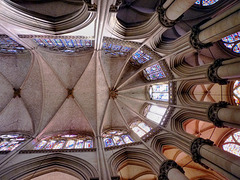
The construction of the Gothic ambulatory choir started in 1217.
Le Mans - Saint-Julien du Mans
| |
|
|
An existing celtic settlement was conquered by the Romans 56bC and named Suindinum. Saint Julien du Mans, to whom the cathedral is dedicated, was the first bishop here upto 348. He was followed by Saint Liborius du Mans, who died here in 397 and was buried next to his predecessor inside the existing cathedral.
In 835 Saint Liborius´s relics were exhumed and - on order of Emperor Louis the Pious - transferred to Paderborn (900kms northeast), where Louis´ father Emperor Charlemagne had founded a diocese in 799. This young diocese suffered, as it had no saint of its own.
From this "translation" arose a "brotherhood" between Le Mans and Paderborn, considered to be the oldest "twinning contract" still in force.
The "Cathédrale Saint-Julien du Mans" was erected over a very long period. It has a Romanesque nave and a Gothic choir. The first nave of the cathedral was erected from 1100 on. Following a fire in 1134, a rebuilding programme was begun, following a different, more complex blueprint. This was partly funded by Henry II of England (aka "Henry Plantagenet", "Henry Curtmantle"), whose father, Geoffroy of Anjou (aka "the Handsome", "le Bel") was buried here in 1151.
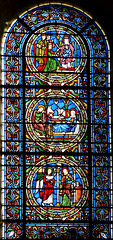
The construction of the Gothic ambulatory choir started in 1217. The oldest stained glass windows here date back to 1230/1240. The choir, that is about as long as the nave, was consecrated on April 24, 1254.
To compare: Sainte-Chapelle in Paris was erected 1244 - 1248.
Le Mans - Saint-Julien du Mans
| |
|
|
An existing celtic settlement was conquered by the Romans 56bC and named Suindinum. Saint Julien du Mans, to whom the cathedral is dedicated, was the first bishop here upto 348. He was followed by Saint Liborius du Mans, who died here in 397 and was buried next to his predecessor inside the existing cathedral.
In 835 Saint Liborius´s relics were exhumed and - on order of Emperor Louis the Pious - transferred to Paderborn (900kms northeast), where Louis´ father Emperor Charlemagne had founded a diocese in 799. This young diocese suffered, as it had no saint of its own.
From this "translation" arose a "brotherhood" between Le Mans and Paderborn, considered to be the oldest "twinning contract" still in force.
The "Cathédrale Saint-Julien du Mans" was erected over a very long period. It has a Romanesque nave and a Gothic choir. The first nave of the cathedral was erected from 1100 on. Following a fire in 1134, a rebuilding programme was begun, following a different, more complex blueprint. This was partly funded by Henry II of England (aka "Henry Plantagenet", "Henry Curtmantle"), whose father, Geoffroy of Anjou (aka "the Handsome", "le Bel") was buried here in 1151.
The construction of the Gothic ambulatory choir started in 1217. The choir, that is about as long as the nave, was consecrated on April 24, 1254.
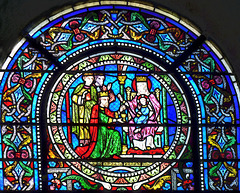
The oldest stained glass windows here date back to 1230/1240. Here are the Annunciation, the Nativity and the Adoration of the Magi.
Le Mans - Saint-Julien du Mans
| |
|
An existing celtic settlement was conquered by the Romans 56bC and named Suindinum. Saint Julien du Mans, to whom the cathedral is dedicated, was the first bishop here upto 348. He was followed by Saint Liborius du Mans, who died here in 397 and was buried next to his predecessor inside the existing cathedral.
In 835 Saint Liborius´s relics were exhumed and - on order of Emperor Louis the Pious - transferred to Paderborn (900kms northeast), where Louis´ father Emperor Charlemagne had founded a diocese in 799. This young diocese suffered, as it had no saint of its own.
From this "translation" arose a "brotherhood" between Le Mans and Paderborn, considered to be the oldest "twinning contract" still in force.
The "Cathédrale Saint-Julien du Mans" was erected over a very long period. It has a Romanesque nave and a Gothic choir. The first nave of the cathedral was erected from 1100 on. Following a fire in 1134, a rebuilding programme was begun, following a different, more complex blueprint. This was partly funded by Henry II of England (aka "Henry Plantagenet", "Henry Curtmantle"), whose father, Geoffroy of Anjou (aka "the Handsome", "le Bel") was buried here in 1151.
The construction of the Gothic ambulatory choir started in 1217. The choir, that is about as long as the nave, was consecrated on April 24, 1254.
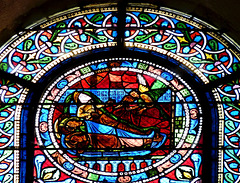
The oldest stained glass windows here date back to 1230/1240. Here is the Adoration of the Magi (for an overview see previous upload).
Le Mans - Saint-Julien du Mans
| |
|
An existing celtic settlement was conquered by the Romans 56bC and named Suindinum. Saint Julien du Mans, to whom the cathedral is dedicated, was the first bishop here upto 348. He was followed by Saint Liborius du Mans, who died here in 397 and was buried next to his predecessor inside the existing cathedral.
In 835 Saint Liborius´s relics were exhumed and - on order of Emperor Louis the Pious - transferred to Paderborn (900kms northeast), where Louis´ father Emperor Charlemagne had founded a diocese in 799. This young diocese suffered, as it had no saint of its own.
From this "translation" arose a "brotherhood" between Le Mans and Paderborn, considered to be the oldest "twinning contract" still in force.
The "Cathédrale Saint-Julien du Mans" was erected over a very long period. It has a Romanesque nave and a Gothic choir. The first nave of the cathedral was erected from 1100 on. Following a fire in 1134, a rebuilding programme was begun, following a different, more complex blueprint. This was partly funded by Henry II of England (aka "Henry Plantagenet", "Henry Curtmantle"), whose father, Geoffroy of Anjou (aka "the Handsome", "le Bel") was buried here in 1151.
The construction of the Gothic ambulatory choir started in 1217. The choir, that is about as long as the nave, was consecrated on April 24, 1254.
The oldest stained glass windows here date back to 1230/1240. Here is the Dream of the Magi.
Le Mans - Cité Plantagenêt
| |
|
An existing celtic settlement was conquered by the Romans 56bC and named Suindinum. Saint Julien du Mans was the first bishop here upto 348. At that time, the first cathedral was built, a predecessor of the medieval cathedral "Saint-Julien du Mans", dedicated to the first bishop.
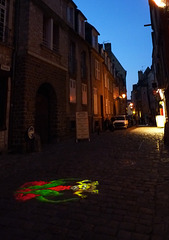
Many half timbered houses from the medieval times line the small cobblestone roads south of the cathedral. This is the "old town" of Le Mans, called "Cité Plantagenêt". It is interesting to walk here in summer over the day, but when night falls, this area can get really spooky, as then a "Nuit des Chimères" begins.
It may begin with a little sign on the cobblestones..
www.nuitdeschimeres.com
Le Mans - Nuit des Chimères
| |
|
An existing celtic settlement was conquered by the Romans 56bC and named Suindinum. Saint Julien du Mans was the first bishop here upto 348. At that time, the first cathedral was built, a predecessor of the medieval cathedral "Saint-Julien du Mans", dedicated to the first bishop.
Many half timbered houses from the medieval times line the small cobblestone roads south of the cathedral. This is the "old town" of Le Mans, called "Cité Plantagenêt". It is interesting to walk here in summer over the day, but when night falls, this area can get really spooky, as then a "Nuit des Chimères" begins.
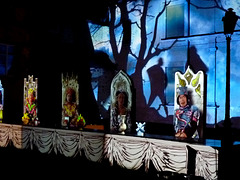
Soft music is in the air, when a nightly banquet is held in a courtyard. Eleanor of Aquitaine (aka "Aliénor"), her Henry, her son Richard and his wife Berengaria (aka "Bérengère") are entertained by troubadours with very strange stories.
www.nuitdeschimeres.com/
Le Mans - Nuit des Chimères
| |
|
|
An existing celtic settlement was conquered by the Romans 56bC and named Suindinum. Saint Julien du Mans was the first bishop here upto 348. At that time, the first cathedral was built, a predecessor of the medieval cathedral "Saint-Julien du Mans", dedicated to the first bishop.
Many half timbered houses from the medieval times line the small cobblestone roads south of the cathedral. This is the "old town" of Le Mans, called "Cité Plantagenêt". It is interesting to walk here in summer over the day, but when night falls, this area can get really spooky, as then a "Nuit des Chimères" begins.
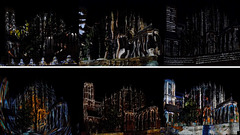
Angels hold heavenly instruments and gave à concert on the western façade of thé cathédral. Weird stories are told, proved by medieval documents and from time to time winged dragons cross the scenery.
www.nuitdeschimeres.com
Le Mans - Nuit des Chimères
| |
|
An existing celtic settlement was conquered by the Romans 56bC and named Suindinum. Saint Julien du Mans was the first bishop here upto 348. At that time, the first cathedral was built, a predecessor of the medieval cathedral "Saint-Julien du Mans", dedicated to the first bishop.
Many half timbered houses from the medieval times line the small cobblestone roads south of the cathedral. This is the "old town" of Le Mans, called "Cité Plantagenêt". It is interesting to walk here in summer over the day, but when night falls, this area can get really spooky, as then a "Nuit des Chimères" begins.
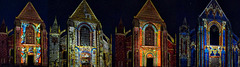
The fantastic Gothic choir of the cathedral suddenly started to move - and changed the identity. The cathedral became a forest, a book, a construction site, a painting of Robert Delaunay...
www.nuitdeschimeres.com/

Benet - Sainte-Eulalie
| |
|
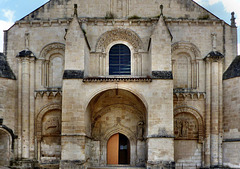
A Benedictian piory existed here since the 11th century. A large church for the convent was erected from the 12th century on. Of this church only the western facade survived. Though weathered and vandalized the facade still has many elements of the Romanesque church. When the church got rebuilt, after the naves had collapsed, in the 15th century large buttresses were needed, to stabilize the structure.
During the French Revolution served as a Temple of Reason and was later used as a saltpeter factory, what means explosive gunpowder (sulfur + charcoal + saltpeter was produced here .
Benet is a small town, west of Niort, in the Vendée, the deprtament where in 1793 the "War in the Vendée", an uprise against the young republic, was fought. The counterrevolutionary rebellion ended, when tens of thousands of civilians were massacred by the Republican army.
Benet - Sainte-Eulalie
| |
|
|
A Benedictian piory existed here since the 11th century. A large church for the convent was erected from the 12th century on. Of this church only the western facade survived. Though weathered and vandalized the facade still has many elements of the Romanesque church. When the church got rebuilt, after the naves had collapsed, in the 15th century large buttresses were needed, to stabilize the structure.
During the French Revolution served as a Temple of Reason and was later used as a saltpeter factory, what means explosive gunpowder (sulfur + charcoal + saltpeter was produced here.
Benet is a small town, west of Niort, in the Vendée, the deprtament where in 1793 the "War in the Vendée", an uprise against the young republic, was fought. The counterrevolutionary rebellion ended, when tens of thousands of civilians were massacred by the Republican army.
A closer look onto Sainte-Eulalie´s facade. The carvings are known as a "bible de pierre", a bible from stone, as the archivolts around the windows depict many biblical scenes.
To the left the shape of the horseman can be seen.

Benet - Sainte-Eulalie
| |
|
A Benedictian piory existed here since the 11th century. A large church for the convent was erected from the 12th century on. Of this church only the western facade survived. Though weathered and vandalized the facade still has many elements of the Romanesque church. When the church got rebuilt, after the naves had collapsed, in the 15th century large buttresses were needed, to stabilize the structure.
During the French Revolution served as a Temple of Reason and was later used as a saltpeter factory, what means explosive gunpowder (sulfur + charcoal + saltpeter was produced here.
Benet is a small town, west of Niort, in the Vendée, the deprtament where in 1793 the "War in the Vendée", an uprise against the young republic, was fought. The counterrevolutionary rebellion ended, when tens of thousands of civilians were massacred by the Republican army.
A closer look onto Sainte-Eulalie´s facade.
Only the shape of the horseman can be seen. Such an equestrian statue, depicting "a king" was of course a "feast" for furious revolutionaries. So they did not leave much. It is widely believed, that such statues depict Constantin the Great. Over all they are pretty rare, but in Western France are quite a few..

Benet - Sainte-Eulalie
| |
|
A Benedictian piory existed here since the 11th century. A large church for the convent was erected from the 12th century on. Of this church only the western facade survived. Though weathered and vandalized the facade still has many elements of the Romanesque church. When the church got rebuilt, after the naves had collapsed, in the 15th century large buttresses were needed, to stabilize the structure.
During the French Revolution served as a Temple of Reason and was later used as a saltpeter factory, what means explosive gunpowder (sulfur + charcoal + saltpeter was produced here.
Benet is a small town, west of Niort, in the Vendée, the deprtament where in 1793 the "War in the Vendée", an uprise against the young republic, was fought. The counterrevolutionary rebellion ended, when tens of thousands of civilians were massacred by the Republican army.
A closer look onto Sainte-Eulalie´s facade.
The archivolt around the central window makes clear, why this is known
as a "bible de pierre", a bible from stone. Many biblical scenes can be found here. The carving style is delicate and elaborate. It reminds on works in the Charente (eg Fenioux).
Jump to top
RSS feed- Latest items - Subscribe to the latest items added to this album
- ipernity © 2007-2026
- Help & Contact
|
Club news
|
About ipernity
|
History |
ipernity Club & Prices |
Guide of good conduct
Donate | Group guidelines | Privacy policy | Terms of use | Statutes | In memoria -
Facebook
X
