


Pays de la Loire

A collection of photos taken over the years. They just all have in common, that they were taken in "Pays de la Loire" in western France.
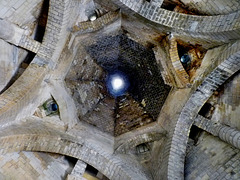
Fontevraud Abbey
| |
|
Robert d'Arbrissel (1045 – 1116) started as an itinerant preacher, was exiled to Paris. Then was an archpriest fighting lay investiture and clerical concubinage. His reforming zeal aroused such enmity that he was compelled to leave the diocese.
He became a hermit. His piety and eloquence attracted many followers, for whom in 1096 he founded the monastery of La Roé.
Robert left the convent and, living in the utmost destitution, worked again as an itinerant preacher. His eloquence drew crowds and provoked the church hierarchy. So in 1100, he was requested to give up the nomadic life and to settle down with his followers. Robert founded the "double monastery" Fontevraud Abbey.
He could bear the sedentary life only for a short while. He appointed Hersende de Champagne (Heloisa´s mum?) to lead the convent and hit the road again. In 1116 he died in the Priory of Orsan.
From the very beginning the convent had a strong support from the aristocracy, above all from the House of Plantagenet, who had chosen this abbey as a burial place. Eleanor of Aquitaine, one of the most powerful ladies of medieval times, joined the convent, when she retired from the political powergame in 1200.
The convent was successful and existed upto the French Revolution.
In 1804 Napoleon signed a decree, transforming the abbey (once model of the "ideal city") into a prison. Holding upto 2000 prisoners, the prison was known to be of the "toughest in France".
Standing in the kitchen looking up (into the chimneys). All the whitish bricks seen here were surely blackened with soot, when the cooks were roasting pork and beef over the fire. Stews simmering over the fire..
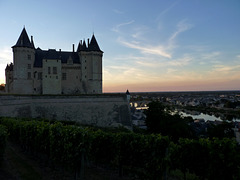
Saumur - Château
| |
|
|
Saumur late afternoon.
The "Château de Saumur" built as a fortified stronghold in the 10th century against Norman raids. Overlooking the Loire river it got transformed in a "château" and changed hands several times. The castle was used as an army barracks in the 17th century. Under Napoleon I it was (just like Fontevraud Abbey) converted into a prison. Marquis de Sade was imprisoned here for a short time. In 1906 the City of Saumur acquired the castle and began a restoration program to house a museum.
Here is the website:
www.chateau-saumur.com/
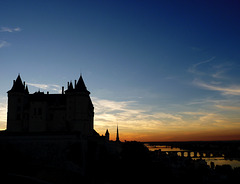
Saumur - Château
| |
|
|
Saumur early evening.
The "Château de Saumur" built as a fortified stronghold in the 10th century against Norman raids. Overlooking the Loire river it got transformed in a "château" and changed hands several times. The castle was used as an army barracks in the 17th century. Under Napoleon I it was (just like Fontevraud Abbey) converted into a prison. Marquis de Sade was imprisoned here for a short time. In 1906 the City of Saumur acquired the castle and began a restoration program to house a museum.
Here is the website:
www.chateau-saumur.com/
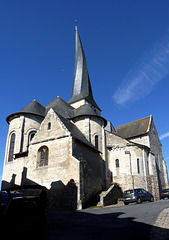
Le Vieil-Baugé - Saint-Symphorien
| |
|
|
The nave is clearly the oldest part (~1060), transepts and tower were completed around a century later. After the Abbey of Saint-Serge d'Angers took over the place as a priory, the building process started again and the choir and the radiant chapels (not to be seen from here) were added.
The gothic chapels date to the 15th and 16th century. In 1804 the nave collapsed, the rebuilding took more than 20 years. After that, the tower got renovated, the twisted spire was completed end of the 19th century.
Baugé - Château
| |
|
|
|
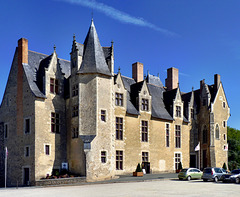
A strong fortress existed here since 1007, but René of Anjou (aka "Bon Roi René", "René I of Naples", "René de Sicile"), who inherited the ruins, commissioned this château, as he was in a need of a proper hunting lodge in the area.
Today the château houses a museum and the tourist office.
Fougeré - Saint-Étienne
| |
|
|
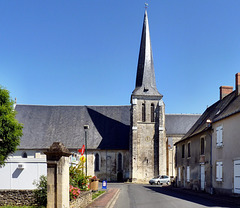
The nave was erected in the 12th century, but the structure got modified and enlarged on different occasions later. The twisted spire is of course younger. These spires must have been very popular. I had just seen one in Le Vieil-Baugé and learned here, that there are five "twisters" in the area.
Fougeré - Saint-Étienne
| |
|
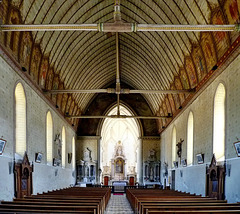
The nave was erected in the 12th century. Very experienced carpenters created the wooden vaulting in the 16th century. The nave opens to a Gothic "Plantagenet" choir.
Fougeré - Saint-Étienne
| |
|
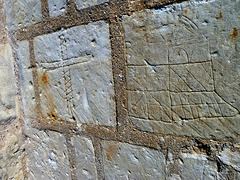
The nave was erected in the 12th century and the carved graffiti may date back to that time, what I doubt. Information given locally claims, that they were carved by "crusaders". Seen is a large cross and a castle.
Angers - Maison d'Adam
| |
|
|
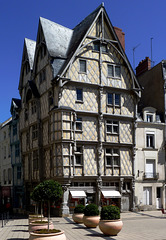
Angers, the historical capital of Anjou, inherited by Henry II of England (aka "Henry Plantagenet", "Curtmantle", "Court-manteau", FitzEmpress), Eleanor of Aquitaine´s second husband, in 1151. At that tme Angers was part of the vast "Angevin Empire". In 1204 the region was conquered by Philip II of France.
During the 15th century, under the rule of well travelled René of Anjou (aka "Bon Roi René"), a patron of arts, the city developed into a intelectual centre.
The half-timbered "Maison d'Adam" in the medieval center of the city dates back to around 1500.

Le Mans - Saint-Julien du Mans
| |
|
|
A celtic settlement, was conquered here by the Romans 56bC and named Suindinum.
Saint Julien du Mans, to whom the cathedral is dedicated, was the first bishop here upto 348. He was followed by Saint Liborius du Mans, who died here in 397 and was buried next to his predecessor inside the existing cathedral.
In 835 Saint Liborius´s relics were exhumed and - on order of Emperor Louis the Pious - transferred to Paderborn (900kms northeast), where Louis´ father Emperor Charlemagne had founded a diocese in 799. This young diocese suffered, as it had no saint of its own.
From this "translation" arose a "brotherhood" between Le Mans and Paderborn, considered to be the oldest "twinning contract" still in force. The relics arrived in Paderborn in 836. To commemorate this, a festival ("Liborifest") is held in Paderborn ever since.
The "Cathédrale Saint-Julien du Mans" was erected over a very long period. It has a Romanesque nave - and a Gothic choir, with elegant flying buttresses, seen here.
www.cathedraledumans.fr
Le Mans - Saint-Julien du Mans
| |
|
|
An existing celtic settlement was conquered by the Romans 56bC and named Suindinum. Saint Julien du Mans, to whom the cathedral is dedicated, was the first bishop here upto 348. He was followed by Saint Liborius du Mans, who died here in 397 and was buried next to his predecessor inside the existing cathedral.
In 835 Saint Liborius´s relics were exhumed and - on order of Emperor Louis the Pious - transferred to Paderborn (900kms northeast), where Louis´ father Emperor Charlemagne had founded a diocese in 799. This young diocese suffered, as it had no saint of its own.
From this "translation" arose a "brotherhood" between Le Mans and Paderborn, considered to be the oldest "twinning contract" still in force. The relics arrived in Paderborn in 836. To commemorate this, a festival ("Liborifest") is held in Paderborn ever since.
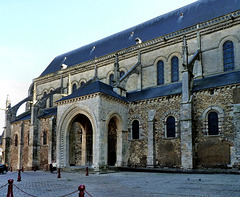
The "Cathédrale Saint-Julien du Mans" was erected over a very long period. It has a Romanesque nave - and a Gothic choir. Seen here is the nave - and , protected by a porch, the side portal.
Le Mans - Saint-Julien du Mans
| |
|
|
An existing celtic settlement was conquered by the Romans 56bC and named Suindinum. Saint Julien du Mans, to whom the cathedral is dedicated, was the first bishop here upto 348. He was followed by Saint Liborius du Mans, who died here in 397 and was buried next to his predecessor inside the existing cathedral.
In 835 Saint Liborius´s relics were exhumed and - on order of Emperor Louis the Pious - transferred to Paderborn (900kms northeast), where Louis´ father Emperor Charlemagne had founded a diocese in 799. This young diocese suffered, as it had no saint of its own.
From this "translation" arose a "brotherhood" between Le Mans and Paderborn, considered to be the oldest "twinning contract" still in force.
The "Cathédrale Saint-Julien du Mans" was erected over a very long period. It has a Romanesque nave and a Gothic choir. The first nave of the cathedral was erected from 1100 on. Following a fire in 1134, a rebuilding programme was begun, following a different, more complex blueprint. This was partly funded by Henry II of England (aka "Henry Plantagenet", "Henry Curtmantle"), whose father, Geoffroy of Anjou (aka "the Handsome", "le Bel") was buried here in 1151.
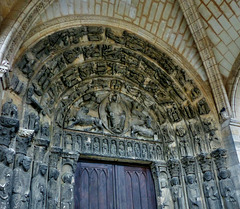
The nave has a sculptured side portal seen here.
www.cathedraledumans.fr
Le Mans - Saint-Julien du Mans
| |
|
|
An existing celtic settlement was conquered by the Romans 56bC and named Suindinum. Saint Julien du Mans, to whom the cathedral is dedicated, was the first bishop here upto 348. He was followed by Saint Liborius du Mans, who died here in 397 and was buried next to his predecessor inside the existing cathedral.
In 835 Saint Liborius´s relics were exhumed and - on order of Emperor Louis the Pious - transferred to Paderborn (900kms northeast), where Louis´ father Emperor Charlemagne had founded a diocese in 799. This young diocese suffered, as it had no saint of its own.
From this "translation" arose a "brotherhood" between Le Mans and Paderborn, considered to be the oldest "twinning contract" still in force.
The "Cathédrale Saint-Julien du Mans" was erected over a very long period. It has a Romanesque nave and a Gothic choir. The first nave of the cathedral was erected from 1100 on. Following a fire in 1134, a rebuilding programme was begun, following a different, more complex blueprint. This was partly funded by Henry II of England (aka "Henry Plantagenet", "Henry Curtmantle"), whose father, Geoffroy of Anjou (aka "the Handsome", "le Bel") was buried here in 1151.
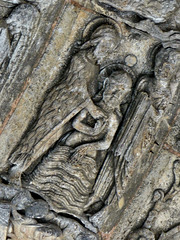
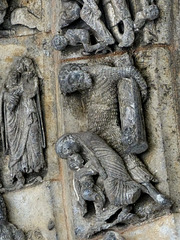
The nave has a sculptured side portal. Here is a detail of one of the archivolts: the baptism of Jesus
Le Mans - Saint-Julien du Mans
| |
|
|
An existing celtic settlement was conquered by the Romans 56bC and named Suindinum. Saint Julien du Mans, to whom the cathedral is dedicated, was the first bishop here upto 348. He was followed by Saint Liborius du Mans, who died here in 397 and was buried next to his predecessor inside the existing cathedral.
In 835 Saint Liborius´s relics were exhumed and - on order of Emperor Louis the Pious - transferred to Paderborn (900kms northeast), where Louis´ father Emperor Charlemagne had founded a diocese in 799. This young diocese suffered, as it had no saint of its own.
From this "translation" arose a "brotherhood" between Le Mans and Paderborn, considered to be the oldest "twinning contract" still in force.
The "Cathédrale Saint-Julien du Mans" was erected over a very long period. It has a Romanesque nave and a Gothic choir. The first nave of the cathedral was erected from 1100 on. Following a fire in 1134, a rebuilding programme was begun, following a different, more complex blueprint. This was partly funded by Henry II of England (aka "Henry Plantagenet", "Henry Curtmantle"), whose father, Geoffroy of Anjou (aka "the Handsome", "le Bel") was buried here in 1151.
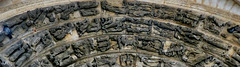
The nave has a sculptured side portal. Here is a detail of one of the archivolts: the Massacre of the Innocents
Le Mans - Saint-Julien du Mans
| |
|
|
An existing celtic settlement was conquered by the Romans 56bC and named Suindinum. Saint Julien du Mans, to whom the cathedral is dedicated, was the first bishop here upto 348. He was followed by Saint Liborius du Mans, who died here in 397 and was buried next to his predecessor inside the existing cathedral.
In 835 Saint Liborius´s relics were exhumed and - on order of Emperor Louis the Pious - transferred to Paderborn (900kms northeast), where Louis´ father Emperor Charlemagne had founded a diocese in 799. This young diocese suffered, as it had no saint of its own.
From this "translation" arose a "brotherhood" between Le Mans and Paderborn, considered to be the oldest "twinning contract" still in force.
The "Cathédrale Saint-Julien du Mans" was erected over a very long period. It has a Romanesque nave and a Gothic choir. The first nave of the cathedral was erected from 1100 on. Following a fire in 1134, a rebuilding programme was begun, following a different, more complex blueprint. This was partly funded by Henry II of England (aka "Henry Plantagenet", "Henry Curtmantle"), whose father, Geoffroy of Anjou (aka "the Handsome", "le Bel") was buried here in 1151.
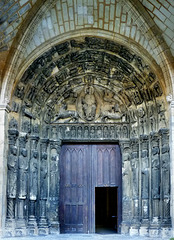
The nave has a sculptured side portal. The four archivolts have many scenes from the bible - and are a resting place for the pigeons.
Le Mans - Saint-Julien du Mans
| |
|
An existing celtic settlement was conquered by the Romans 56bC and named Suindinum. Saint Julien du Mans, to whom the cathedral is dedicated, was the first bishop here upto 348. He was followed by Saint Liborius du Mans, who died here in 397 and was buried next to his predecessor inside the existing cathedral.
In 835 Saint Liborius´s relics were exhumed and - on order of Emperor Louis the Pious - transferred to Paderborn (900kms northeast), where Louis´ father Emperor Charlemagne had founded a diocese in 799. This young diocese suffered, as it had no saint of its own.
From this "translation" arose a "brotherhood" between Le Mans and Paderborn, considered to be the oldest "twinning contract" still in force.
The "Cathédrale Saint-Julien du Mans" was erected over a very long period. It has a Romanesque nave and a Gothic choir. The first nave of the cathedral was erected from 1100 on. Following a fire in 1134, a rebuilding programme was begun, following a different, more complex blueprint. This was partly funded by Henry II of England (aka "Henry Plantagenet", "Henry Curtmantle"), whose father, Geoffroy of Anjou (aka "the Handsome", "le Bel") was buried here in 1151.
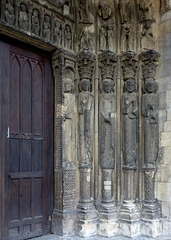
The nave has a sculptured side portal. The doors are flanked by jamb statues. Here are the statues of the right side. This side was better weather-protected over the centuries, so the saints here are better conserved that their colleagues of the left side.
Le Mans - Saint-Julien du Mans
| |
|
An existing celtic settlement was conquered by the Romans 56bC and named Suindinum. Saint Julien du Mans, to whom the cathedral is dedicated, was the first bishop here upto 348. He was followed by Saint Liborius du Mans, who died here in 397 and was buried next to his predecessor inside the existing cathedral.
In 835 Saint Liborius´s relics were exhumed and - on order of Emperor Louis the Pious - transferred to Paderborn (900kms northeast), where Louis´ father Emperor Charlemagne had founded a diocese in 799. This young diocese suffered, as it had no saint of its own.
From this "translation" arose a "brotherhood" between Le Mans and Paderborn, considered to be the oldest "twinning contract" still in force.
The "Cathédrale Saint-Julien du Mans" was erected over a very long period. It has a Romanesque nave and a Gothic choir. The first nave of the cathedral was erected from 1100 on. Following a fire in 1134, a rebuilding programme was begun, following a different, more complex blueprint. This was partly funded by Henry II of England (aka "Henry Plantagenet", "Henry Curtmantle"), whose father, Geoffroy of Anjou (aka "the Handsome", "le Bel") was buried here in 1151.
The nave has a sculptured side portal. The doors are flanked by jamb statues.
Le Mans - Saint-Julien du Mans
| |
|
An existing celtic settlement was conquered by the Romans 56bC and named Suindinum. Saint Julien du Mans, to whom the cathedral is dedicated, was the first bishop here upto 348. He was followed by Saint Liborius du Mans, who died here in 397 and was buried next to his predecessor inside the existing cathedral.
In 835 Saint Liborius´s relics were exhumed and - on order of Emperor Louis the Pious - transferred to Paderborn (900kms northeast), where Louis´ father Emperor Charlemagne had founded a diocese in 799. This young diocese suffered, as it had no saint of its own.
From this "translation" arose a "brotherhood" between Le Mans and Paderborn, considered to be the oldest "twinning contract" still in force.
The "Cathédrale Saint-Julien du Mans" was erected over a very long period. It has a Romanesque nave and a Gothic choir. The first nave of the cathedral was erected from 1100 on. Following a fire in 1134, a rebuilding programme was begun, following a different, more complex blueprint. This was partly funded by Henry II of England (aka "Henry Plantagenet", "Henry Curtmantle"), whose father, Geoffroy of Anjou (aka "the Handsome", "le Bel") was buried here in 1151.
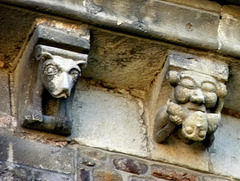
Under the roof of the Romanesque nave are some nice corbels.
Jump to top
RSS feed- Latest items - Subscribe to the latest items added to this album
- ipernity © 2007-2026
- Help & Contact
|
Club news
|
About ipernity
|
History |
ipernity Club & Prices |
Guide of good conduct
Donate | Group guidelines | Privacy policy | Terms of use | Statutes | In memoria -
Facebook
X
