


Languedoc-Roussillon -South

A collection of photos, that were taken in the departments Aude (11) and Pyrénées-Orientales (66) and parts of Hérault,
(34), the southern part of the Languedoc-Roussillon in France.
(34), the southern part of the Languedoc-Roussillon in France.

Saint-Martin-des-Puits - Saint-Martin
| |
|
|
It is known, that the Abbaye Sainte-Marie de Lagrasse (11kms north) had a priory here since 1093, but this church is probably older than that.
The small church was obviously erected in two stages. Some scholars see mozzarabic influences, dating it to the very early 11th centuries, while other scholars see Visogothic traces, dating it back to the 8th/9th century.
Most interesting and difficult to date is this hors-shoe arch. The capitals on the sides do not really fit. The frescoes on the back were done within the 12th century - and not in a good condition any more. Some people have compared them to works in the Vall de Boí (about 300kms southwest).
Saint-Martin-des-Puits - Saint-Martin
| |
|
It is known, that the Abbaye Sainte-Marie de Lagrasse (11kms north) had a priory here since 1093, but this church is probably older than that.
The small church was obviously erected in two stages. Some scholars see mozzarabic influences, dating it to the very early 11th centuries, while other scholars see Visogothic traces, dating it back to the 8th/9th century.
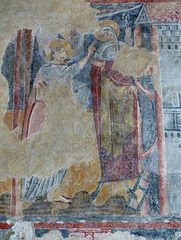
Only a small part of the frescoe, dated to the 12th century did survive. They must have covered the eastern walls of the church completely. This could be the Annunciation. Gabriel to the left, Mary to the right. The letters M A (R) next to her head. Who is the small person further right under the B?
Some people have compared them to works in the Vall de Boí (about 300kms southwest).
Saint-Martin-des-Puits - Saint-Martin
| |
|
It is known, that the Abbaye Sainte-Marie de Lagrasse (11kms north) had a priory here since 1093, but this church is probably older than that.
The small church was obviously erected in two stages. Some scholars see mozzarabic influences, dating it to the very early 11th centuries, while other scholars see Visogothic traces, dating it back to the 8th/9th century.
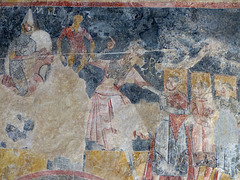
Only a small part of the frescoe, dated to the 12th century did survive. They must have covered the eastern walls of the church completely. It is belived, that this frescor depicts Shadrach, Meshach, and Abednego, the three young men thrown into a furnace by Nebuchadnezzar´s soldiers, when they refused to bow down to the king's image. - Daniel 3:15 - 25.
They have rectangular nimbuses!
Some people have compared the frescoes to works in the Vall de Boí (about 300kms southwest).
Château de Termes
| |
|
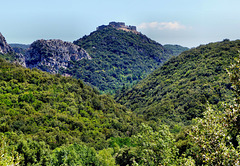
When the Albigensian Crusades began, Ramon (Raymond) de Termes, being a vassal of Trencavel, Viscount of Carcassonne, fought the crusade. In 1210 Simon de Montfort decided to force the castle of Termes into submission. The defenders resisted for four months. Finally, however, it was the shortage of water and dysentery which forced the besieged to surrender in November 1210. Ramon de Termes was taken prisoner and died later in a prison in Carcassonne.
In 1228 the castle became a royal French fortress. Over four centuries the castle was occupied by a French garnison securing the border.
When the border was moved further south in the 17th century, the castle lost its function. It was taken over by brigands who pillaged the surrounding country. To stop this, it was demolished by royal decree. Between 1653 and 1654 the walls were blown up with gunpowder.
The site was forgotten until the first conservation measures were taken in the mid-20th century.
www.castle.chateau-termes.com/index.html
Château de Termes
| |
|
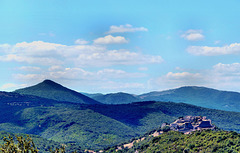
When the Albigensian Crusades began, Ramon (Raymond) de Termes, being a vassal of Trencavel, Viscount of Carcassonne, fought the crusade. In 1210 Simon de Montfort decided to force the castle of Termes into submission. The defenders resisted for four months. Finally, however, it was the shortage of water and dysentery which forced the besieged to surrender in November 1210. Ramon de Termes was taken prisoner and died later in a prison in Carcassonne.
In 1228 the castle became a royal French fortress. Over four centuries the castle was occupied by a French garnison securing the border.
When the border was moved further south in the 17th century, the castle lost its function. It was taken over by brigands who pillaged the surrounding country. To stop this, it was demolished by royal decree. Between 1653 and 1654 the walls were blown up with gunpowder.
The site was forgotten until the first conservation measures were taken in the mid-20th century.
www.castle.chateau-termes.com/index.html
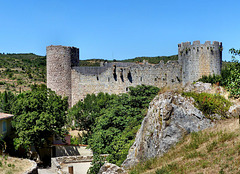
Villerouge-Termenès - Château
| |
|
|
The château towers over the small village Villerouge-Termenès since the early 12th century. The Lords of the castle were the archbishops of Narbonne. In 1107 Pope Pascal II had to confirm the archbishop as rightful owner of Villerouge, as Pierre de Peyrepertuse had occupied the village and given the castle as dowry to his daughter when she married Olivier de Termes.
In 1227 Pope Honorius III had to step in, when Simon de Montfort´s vasall Alain de Roucy, whom Simon had given the Château de Termes (previous uploads) during the Albingensian Crusade, threatened to take over Villerouge also.
In 1321, after an "inquisition" led by Jacques Fournier (future Pope Benedict XII), Guilhem Bélibaste (aka "Guilielmus Belibasta"), the last known Occitan Cathar perfectus, was burnt alive here.
Guilhem Bélibaste became a perfectus while in hiding in Catalonia. As only perfectii could transmit the religion, by a ceremony of laying on of hands, his death was the end of the Cathar religion.
chateauvillerouge.wix.com/termenes !
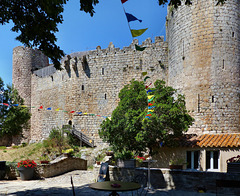
Villerouge-Termenès - Château
| |
|
|
The château towers over the small village Villerouge-Termenès, that since the early 12th century. The Lords of the castle were the archbishops of Narbonne upto the French Revolution. The castle, that was not in good conditions, was sold and families lived here until the 1980s, when it was taken over by the community and a restauration process started. Meanwhile the castle hosts a museum and a "medieval restaurant".
On the foot of the château´s massive walls the "La Taverne De Villerouge" offers a shady court to sip cold drinks.
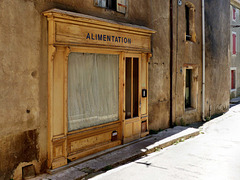
Fabrezan - Alimentation
| |
|
Fabrezan lost about half of its population within a century. Today about 1200 people live here, not enough to keep this little shop going.
New supermarkets like Aldi and Lidl attract more and more customers - and so there is no future for small businesses and shops like this. - Fermeture définitive..
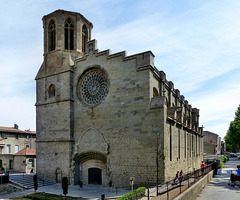
Carcassonne - Cathédrale Saint-Michel
| |
|
|
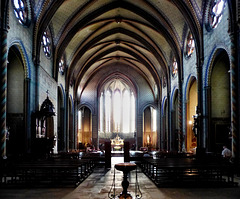
The Cathédrale Saint-Michel ("Carcassonne Cathedral") was built within the 13th century, commisioned by Louis IX, as a parish church in the typical style of gothique méridional. The preceding church of the parish had been gotten destroyed during a siege, when Raymond II Trencavel tried to reconquer Carcassonne in 1240.
When English troops led by Edward of Woodstock (aka "The Black Prince", "Prince noir") burnt down Carcassonne 1355, the parish church got severely damaged. When it got rebuilt a strong fortification was added to the construction.
What is now the Basilica of St. Nazaire and St. Celse, located in the citadel of Carcassonne ("Cité"), had been the cathedral for centuries, but in 1802 the "cathedra" was moved to the humble parish church, that now is the Cathédrale Saint-Michel.
Carcassonne - Cathédrale Saint-Michel
| |
|
|
The Cathédrale Saint-Michel ("Carcassonne Cathedral") was built within the 13th century, commisioned by Louis IX, as a parish church in the typical style of gothique méridional. The preceding church of the parish had been gotten destroyed during a siege, when Raymond II Trencavel tried to reconquer Carcassonne in 1240.
When English troops led by Edward of Woodstock (aka "The Black Prince", "Prince noir") burnt down Carcassonne 1355, the parish church got severely damaged. When it got rebuilt a strong fortification was added to the construction.
What is now the Basilica of St. Nazaire and St. Celse, located in the citadel of Carcassonne ("Cité"), had been the cathedral for centuries, but in 1802 the "cathedra" was moved to the humble former parish church, that now is the Cathédrale Saint-Michel.
Monastère de Prouilhe
| |
|
|
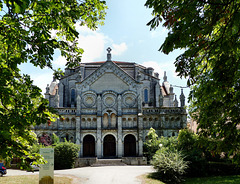
The monastery is known as the "cradle of the Dominicans". It was founded 1207 in Prouille, a hamlet between Fanjeaux and Bram.
Diego de Acebo, Bishop of Osma, and Dominic Gúzman (future "Saint Dominic") had settled here and tried to converse Cathars, often through Cathar-Catholic debates (see "Montréal").
The convent got established to serve as a refuge for women who had previously lived in Cathar areas but had converted to Catholicism. As well this was the base of operations for Dominic and his followers, preaching Catholicism. The convent´s most generous donor was Simon de Montfort, the leader of the Albigensian Crusade.
The monastery was sold after the French Revolution and got completely razed. Some stones and carvings from here can still be seen in homes in the towns around. Only one arch keystone of the medieval building remained here.
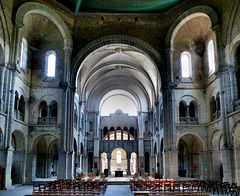
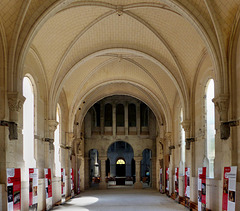
Father Henri Lacordaire, who re-established the Dominican Order in France again, decided to have the "cradle of the Dominicans" rebuilt mid 19th century. The reconstruction was done in the Roman-Byzantine style. As many churches of the 19th century, the large church started to crumble very early - and now needs permanent care.
www.domlife.org/800/ProuilleRenovationProject.htm
Monastère de Prouilhe
| |
|
|
The monastery is known as the "cradle of the Dominicans". It was founded 1207 in Prouille, a hamlet between Fanjeaux and Bram.
Diego de Acebo, Bishop of Osma, and Dominic Gúzman (future "Saint Dominic") had settled here and tried to converse Cathars, often through Cathar-Catholic debates (see "Montréal").
The convent got established to serve as a refuge for women who had previously lived in Cathar areas but had converted to Catholicism. As well this was the base of operations for Dominic and his followers, preaching Catholicism. The convent´s most generous donor was Simon de Montfort, the leader of the Albigensian Crusade.
The monastery was sold after the French Revolution and got completely razed. Some stones and carvings from here can still be seen in homes in the towns around. Only one arch keystone of the medieval building remained here.
Father Henri Lacordaire, who re-established the Dominican Order in France again, decided to have the "cradle of the Dominicans" rebuilt mid 19th century. The reconstruction was done in the Roman-Byzantine style. As many churches of the 19th century, the large church started to crumble very early - and now needs permanent care.
www.domlife.org/800/ProuilleRenovationProject.htm
Monastère de Prouilhe
| |
|
|
|
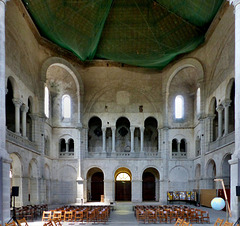
The monastery is known as the "cradle of the Dominicans". It was founded 1207 in Prouille, a hamlet between Fanjeaux and Bram.
Diego de Acebo, Bishop of Osma, and Dominic Gúzman (future "Saint Dominic") had settled here and tried to converse Cathars, often through Cathar-Catholic debates (see "Montréal").
The convent got established to serve as a refuge for women who had previously lived in Cathar areas but had converted to Catholicism. As well this was the base of operations for Dominic and his followers, preaching Catholicism. The convent´s most generous donor was Simon de Montfort, the leader of the Albigensian Crusade.
The monastery was sold after the French Revolution and got completely razed. Some stones and carvings from here can still be seen in homes in the towns around. Only one arch keystone of the medieval building remained here.
Father Henri Lacordaire, who re-established the Dominican Order in France again, decided to have the "cradle of the Dominicans" rebuilt mid 19th century. The reconstruction was done in the Roman-Byzantine style. As many churches of the 19th century, the large church started to crumble very early - and now needs permanent care.
www.domlife.org/800/ProuilleRenovationProject.htm
Monastère de Prouilhe
| |
|
The monastery is known as the "cradle of the Dominicans". It was founded 1207 in Prouille, a hamlet between Fanjeaux and Bram.
Diego de Acebo, Bishop of Osma, and Dominic Gúzman (future "Saint Dominic") had settled here and tried to converse Cathars, often through Cathar-Catholic debates (see "Montréal").
The convent got established to serve as a refuge for women who had previously lived in Cathar areas but had converted to Catholicism. As well this was the base of operations for Dominic and his followers, preaching Catholicism. The convent´s most generous donor was Simon de Montfort, the leader of the Albigensian Crusade.
The monastery was sold after the French Revolution and got completely razed. Some stones and carvings from here can still be seen in homes in the towns around. Only one arch keystone of the medieval building remained here.
Father Henri Lacordaire, who re-established the Dominican Order in France again, decided to have the "cradle of the Dominicans" rebuilt mid 19th century. The reconstruction was done in the Roman-Byzantine style. As many churches of the 19th century, the large church started to crumble very early - and now needs permanent care.
www.domlife.org/800/ProuilleRenovationProject.htm
Fanjeaux - La halle
| |
|
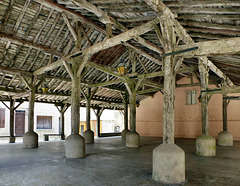
In medieval times Fanjeaux, located on a steep hill, was a pretty large village with a population of about 3000 (today 700). It was an important place during the Albigensian Crusade. Dominic Gúzman (future "Saint Dominic"), who preached against the Cathars had settled nearby and Simon de Montfort´s armee had the headquarters during the crusade here for five years.
In 1355, during the Hundred Years` War, troops led by Edward of Woodstock (aka "The Black Prince", "Prince noir") conquered and destroyed Fanjeaux, that got rebuilt and strongly fortified by a surrounding wall and 14 (!) towers.
Located in the center of Fanjeaux is this shady market-hall.
Fanjeaux - Notre-Dame de l’Assomption
| |
|
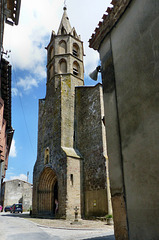
In medieval times Fanjeaux, located on a steep hill, was a pretty large village with a population of about 3000 (today 700). It was an important place during the Albigensian Crusade. Dominic Gúzman (future "Saint Dominic"), who preached against the Cathars had settled nearby and Simon de Montfort´s armee had the headquarters during the crusade here for five years.
In 1355, during the Hundred Years` War, troops led by Edward of Woodstock (aka "The Black Prince", "Prince noir") conquered and destroyed Fanjeaux, that got rebuilt and strongly fortified by a surrounding wall and 14 (!) towers.
The parish church was erected 1278 - 1281 in the style of "gothique méridional". Kept here is a piece of a burnt beam, connected to the "miracle de Fanjeaux" (= (miracle of Fanjeaux"), that - how a legend tells, happened right here.
After a disput between Cathar authorities and Dominic Gúzman and his followers it was decided by judges, to cast the book, containing Dominic´s arguments, and the book, containing the Cathar´s arguments,
into a fire and, if either of them was not burned, it would be held as containing the true faith.
The Cathar book was immediately consumed by the fire, but the one written by Dominic, not only escaped burning, but leaped from the fire.

Fanjeaux - Notre-Dame de l’Assomption
| |
|
In medieval times Fanjeaux, located on a steep hill, was a pretty large village with a population of about 3000 (today 700). It was an important place during the Albigensian Crusade. Dominic Gúzman (future "Saint Dominic"), who preached against the Cathars had settled nearby and Simon de Montfort´s armee had the headquarters during the crusade here for five years.
In 1355, during the Hundred Years` War, troops led by Edward of Woodstock (aka "The Black Prince", "Prince noir") conquered and destroyed Fanjeaux, that got rebuilt and strongly fortified by a surrounding wall and 14 (!) towers.
The parish church was erected 1278 - 1281 in the style of "gothique méridional". Kept here is a piece of a burnt beam, connected to the "miracle de Fanjeaux" (= (miracle of Fanjeaux"), that - how a legend tells, happened right here. I could not see the "relic", as the church was locked - but at least I could view the nave through the security glass of the door.
After a disput between Cathar authorities and Dominic Gúzman and his followers it was decided by judges, to cast the book, containing Dominic´s arguments, and the book, containing the Cathar´s arguments,
into a fire and, if either of them was not burned, it would be held as containing the true faith.
The Cathar book was immediately consumed by the fire, but the one written by Dominic, not only escaped burning, but leaped from the fire.
Lagrasse
| |
|
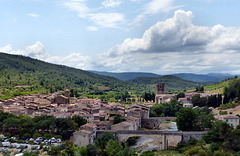
Lagrasse (pop. 550) is one of the "Plus Beaux Villages de France" ("The most beautiful villages of France"), so there are many tourists here - and large car parks (left) are needed.
The village developed around the famous abbey Sainte-Marie de Lagrasse (backdrop), that in its early times was under the protection of Charlemagne. The parish church (left) was erected from ~ 1350. It was consecrated in 1398. Seen from here are two bridges, that cross the river Orbieu. The round Pont-Vieux (aka "Pont de l’Abbaye") was erected in 1303.
Jump to top
RSS feed- Latest items - Subscribe to the latest items added to this album
- ipernity © 2007-2026
- Help & Contact
|
Club news
|
About ipernity
|
History |
ipernity Club & Prices |
Guide of good conduct
Donate | Group guidelines | Privacy policy | Terms of use | Statutes | In memoria -
Facebook
X
