

Languedoc-Roussillon -South

A collection of photos, that were taken in the departments Aude (11) and Pyrénées-Orientales (66) and parts of Hérault,
(34), the southern part of the Languedoc-Roussillon in France.
(34), the southern part of the Languedoc-Roussillon in France.

Montréal - Collégiale Saint-Vincent
| |
|
Montréal was in center of the "Pays Cathare" and in 1206 the town was the site of debates between Catholics and Cathars. The debates, initiated by Dominic of Osma (future "Saint Dominic"), were part of Pope Innocent III's program to convert the Cathars (back) to Catholicism. Dominic had no sucess. In 1209, during the Albigensian Crusade, Montréal was taken and razed by Simon de Montfort´s troops.
After the crusade Montréal (and large parts of the Languedoc) became "Domaine royal", what meant these were directly possessed by the kings of France.
In 1273 the erection of the new castle started - and probably the church seen here was built in a "Tolosan-Gothic" style at the same time. It was completed in 1318. From outside it looks a bit like a tiny cousin of Sainte-Cécile in Albi.
www.collegiale-montreal-aude.fr/index.htm
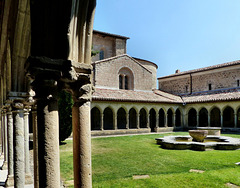
Saint-Hilaire - Abbaye de Saint-Hilaire
| |
|
|
An abbey, dedicated to Saint Saturnin, first bishop of Toulouse, is mentioned already in 825. In 870 the relics of Saint Hilaire, who had evangelized the region in the 6th century and was the first bishop of Carcassonne were "translated" to the abbey.
During the Albigensian Crusade the monks were accused of heresy - and the abbey got looted. It got re-established, but the plague and the Hundred Years' War caused more difficulties to the abbey and the village around it. The fortifications erected at that time did not prevent severe damages during the Wars of Religions.
After a period of decline, the abbey closed in 1748, since then the church served the parish of the village.
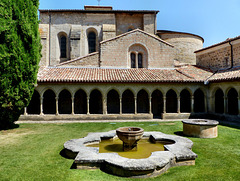
Saint-Hilaire - Abbaye de Saint-Hilaire
| |
|
An abbey, dedicated to Saint Saturnin, first bishop of Toulouse, is mentioned already in 825. In 870 the relics of Saint Hilaire, who had evangelized the region in the 6th century and was the first bishop of Carcassonne were "translated" to the abbey.
During the Albigensian Crusade the monks were accused of heresy - and the abbey got looted. It got re-established, but the plague and the Hundred Years' War caused more difficulties to the abbey and the village around it. The fortifications erected at that time did not prevent severe damages during the Wars of Religions.
After a period of decline, the abbey closed in 1748, since then the church served the parish of the village.
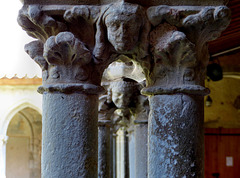
Saint-Hilaire - Abbaye de Saint-Hilaire
| |
|
An abbey, dedicated to Saint Saturnin, first bishop of Toulouse, is mentioned already in 825. In 870 the relics of Saint Hilaire, who had evangelized the region in the 6th century and was the first bishop of Carcassonne were "translated" to the abbey.
During the Albigensian Crusade the monks were accused of heresy - and the abbey got looted. It got re-established, but the plague and the Hundred Years' War caused more difficulties to the abbey and the village around it. The fortifications erected at that time did not prevent severe damages during the Wars of Religions.
After a period of decline, the abbey closed in 1748, since then the church served the parish of the village.
Saint-Hilaire - Abbaye de Saint-Hilaire
| |
|
An abbey, dedicated to Saint Saturnin, first bishop of Toulouse, is mentioned already in 825. In 870 the relics of Saint Hilaire, who had evangelized the region in the 6th century and was the first bishop of Carcassonne were "translated" to the abbey.
During the Albigensian Crusade the monks were accused of heresy - and the abbey got looted. It got re-established, but the plague and the Hundred Years' War caused more difficulties to the abbey and the village around it. The fortifications erected at that time did not prevent severe damages during the Wars of Religions.
After a period of decline, the abbey closed in 1748, since then the church served the parish of the village.
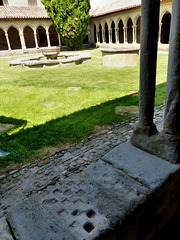
When the cloister was erected in the early 14th century, parts of older structures got reused. The chequered slab here was probably once part of a Romanesque building.
Saint-Hilaire - Abbaye de Saint-Hilaire
| |
|
|
An abbey, dedicated to Saint Saturnin, first bishop of Toulouse, is mentioned already in 825. In 870 the relics of Saint Hilaire, who had evangelized the region in the 6th century and was the first bishop of Carcassonne were "translated" to the abbey.
During the Albigensian Crusade the monks were accused of heresy - and the abbey got looted. It got re-established, but the plague and the Hundred Years' War caused more difficulties to the abbey and the village around it. The fortifications erected at that time did not prevent severe damages during the Wars of Religions.
After a period of decline, the abbey closed in 1748, since then the church served the parish of the village.
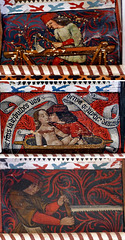
After a long restoration process, the former quarters of the abbot are open to the public again. The painted details between the beams of the wooden ceiling are dated to the late 15th century.
Saint-Hilaire - Abbaye de Saint-Hilaire
| |
|
An abbey, dedicated to Saint Saturnin, first bishop of Toulouse, is mentioned already in 825. In 870 the relics of Saint Hilaire, who had evangelized the region in the 6th century and was the first bishop of Carcassonne were "translated" to the abbey.
During the Albigensian Crusade the monks were accused of heresy - and the abbey got looted. It got re-established, but the plague and the Hundred Years' War caused more difficulties to the abbey and the village around it. The fortifications erected at that time did not prevent severe damages during the Wars of Religions.
After a period of decline, the abbey closed in 1748, since then the church served the parish of the village.
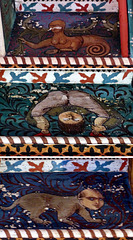
After a long restoration process, the former quarters of the abbot are open to the public again. The painted details between the beams of the wooden ceiling are dated to the late 15th century.
Saint-Hilaire - Abbaye de Saint-Hilaire
| |
|
|
An abbey, dedicated to Saint Saturnin, first bishop of Toulouse, is mentioned already in 825. In 870 the relics of Saint Hilaire, who had evangelized the region in the 6th century and was the first bishop of Carcassonne were "translated" to the abbey.
During the Albigensian Crusade the monks were accused of heresy - and the abbey got looted. It got re-established, but the plague and the Hundred Years' War caused more difficulties to the abbey and the village around it. The fortifications erected at that time did not prevent severe damages during the Wars of Religions.
After a period of decline, the abbey closed in 1748, since then the church served the parish of the village.
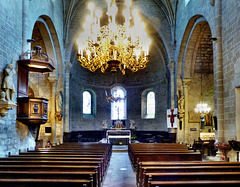
Most visitors enter the former abbey-church, built within the 12th century, to admire the wonderful "Sarcophagus of Saint Sernin" carved by the "Maître de Cabestany". The sarcophag is located in the right transept arm, but there is more to see.
Saint-Hilaire - Abbaye de Saint-Hilaire
| |
|
|
An abbey, dedicated to Saint Saturnin, first bishop of Toulouse, is mentioned already in 825. In 870 the relics of Saint Hilaire, who had evangelized the region in the 6th century and was the first bishop of Carcassonne were "translated" to the abbey.
During the Albigensian Crusade the monks were accused of heresy - and the abbey got looted. It got re-established, but the plague and the Hundred Years' War caused more difficulties to the abbey and the village around it. The fortifications erected at that time did not prevent severe damages during the Wars of Religions.
After a period of decline, the abbey closed in 1748, since then the church served the parish of the village.
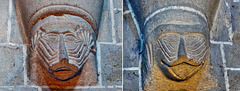
Most visitors enter the former abbey-church, built within the 12th century, to admire the "Sarcophagus of Saint Sernin" carved by the "Maître de Cabestany", but there is more to see.
Here are two corbels.
At first I had the impression to look into the wrinkled faces of apes. Then I doubted. Apes? Monkeys? Humans? As I found another monkey nearby - apes.
Saint-Hilaire - Abbaye de Saint-Hilaire
| |
|
|
|
An abbey, dedicated to Saint Saturnin, first bishop of Toulouse, is mentioned already in 825. In 870 the relics of Saint Hilaire, who had evangelized the region in the 6th century and was the first bishop of Carcassonne were "translated" to the abbey.
During the Albigensian Crusade the monks were accused of heresy - and the abbey got looted. It got re-established, but the plague and the Hundred Years' War caused more difficulties to the abbey and the village around it. The fortifications erected at that time did not prevent severe damages during the Wars of Religions.
After a period of decline, the abbey closed in 1748, since then the church served the parish of the village.
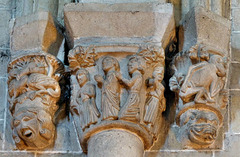
Most visitors enter the former abbey-church, built within the 12th century, to admire the "Sarcophagus of Saint Sernin" carved by the "Maître de Cabestany", but there is more to see.
Winged beasts on the left - a procession in the center - and a large monkey to the right.
Saint-Hilaire - Abbaye de Saint-Hilaire
| |
|
|
An abbey, dedicated to Saint Saturnin, first bishop of Toulouse, is mentioned already in 825. In 870 the relics of Saint Hilaire, who had evangelized the region in the 6th century and was the first bishop of Carcassonne were "translated" to the abbey.
During the Albigensian Crusade the monks were accused of heresy - and the abbey got looted. It got re-established, but the plague and the Hundred Years' War caused more difficulties to the abbey and the village around it. The fortifications erected at that time did not prevent severe damages during the Wars of Religions.
After a period of decline, the abbey closed in 1748, since then the church served the parish of the village.
Most visitors enter the former abbey-church, built within the 12th century, to admire the "Sarcophagus of Saint Sernin" carved by the "Maître de Cabestany".
The "Maître de Cabestany" is known under this name since the 1930s when a tympanum and other carvings were found in Cabestany (near Perpignan).
The carvings did have a very specific style and so the anonymous artist was named "Maître de Cabestany". Research started and so far more than 120 carvings of these origins, all carved within the second half of the 12th century, are known. The carvings are spread over an area between the Tuscany in Italy, Southern France - and Catalonia in Spain. This led to the theory, that the "Maître de Cabestany" may not be a single master-carver, but a studio, where carvers learned this style. Meanwhile there is a museum in Cabestany, to is dedicated to these works of art - and their creator(s).
www.maitre-de-cabestany.com/
The artistic style is very dynamic and creativ. The faces have almond eyes, a sharp nose, great ears and a triangular shape. The fingers of the hands are long, sometimes perspective.. ...
Here is an in-depth article about the Maître de Cabestany by Peter Hubert:
www.green-man-of-cercles.org/articles/the_maitre_de_cabes...
Saint-Hilaire - Abbaye de Saint-Hilaire
| |
|
An abbey, dedicated to Saint Saturnin, first bishop of Toulouse, is mentioned already in 825. In 870 the relics of Saint Hilaire, who had evangelized the region in the 6th century and was the first bishop of Carcassonne were "translated" to the abbey.
During the Albigensian Crusade the monks were accused of heresy - and the abbey got looted. It got re-established, but the plague and the Hundred Years' War caused more difficulties to the abbey and the village around it. The fortifications erected at that time did not prevent severe damages during the Wars of Religions.
After a period of decline, the abbey closed in 1748, since then the church served the parish of the village.
Most visitors enter the former abbey-church, built within the 12th century, to admire the "Sarcophagus of Saint Sernin" carved by the "Maître de Cabestany".
This is the front side.
Seen on the right side is Saint Sernin working as a missionary. He is stopped by the Romans. The animals near their feet stand for the paganism and barbarism.
Seen on the left side is the martyrdom of Saint Sernin. He is tied by a rope to a bull. Saint Sernin seems very relaxed and blesses the (christian) virgins, who watch the scene.
The "Maître de Cabestany" is known under this name since the 1930s when a tympanum and other carvings were found in Cabestany (near Perpignan).
The carvings did have a very specific style and so the anonymous artist was named "Maître de Cabestany". Research started and so far more than 120 carvings of these origins, all carved within the second half of the 12th century, are known. The carvings are spread over an area between the Tuscany in Italy, Southern France - and Catalonia in Spain. This led to the theory, that the "Maître de Cabestany" may not be a single master-carver, but a studio, where carvers learned this style. Meanwhile there is a museum in Cabestany, to is dedicated to these works of art - and their creator(s). - and of course a flickr-group.
www.maitre-de-cabestany.com/
The artistic style is very dynamic and creativ. The faces have almond eyes, a sharp nose, great ears and a triangular shape. The fingers of the hands are long, sometimes perspective.. ...
Here is an in-depth article about the Maître de Cabestany by Peter Hubert:
www.green-man-of-cercles.org/articles/the_maitre_de_cabes...
Saint-Hilaire - Abbaye de Saint-Hilaire
| |
|
An abbey, dedicated to Saint Saturnin, first bishop of Toulouse, is mentioned already in 825. In 870 the relics of Saint Hilaire, who had evangelized the region in the 6th century and was the first bishop of Carcassonne were "translated" to the abbey.
During the Albigensian Crusade the monks were accused of heresy - and the abbey got looted. It got re-established, but the plague and the Hundred Years' War caused more difficulties to the abbey and the village around it. The fortifications erected at that time did not prevent severe damages during the Wars of Religions.
After a period of decline, the abbey closed in 1748, since then the church served the parish of the village.
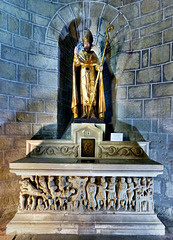
Most visitors enter the former abbey-church, built within the 12th century, to admire the "Sarcophagus of Saint Sernin" carved by the "Maître de Cabestany".
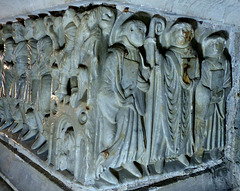
Depicted on the right side of the sarcophagus is Saint Sernin (center) holding a crozier. He is flanked by his disciples Saint-Honest (Bishop of Pamplona) and Saint-Papoul. They all hold books/bibles.
The "Maître de Cabestany" is known under this name since the 1930s when a tympanum and other carvings were found in Cabestany (near Perpignan).
The carvings did have a very specific style and so the anonymous artist was named "Maître de Cabestany". Research started and so far more than 120 carvings of these origins, all carved within the second half of the 12th century, are known. The carvings are spread over an area between the Tuscany in Italy, Southern France - and Catalonia in Spain. This led to the theory, that the "Maître de Cabestany" may not be a single master-carver, but a studio, where carvers learned this style. Meanwhile there is a museum in Cabestany, to is dedicated to these works of art - and their creator(s).
www.maitre-de-cabestany.com/
The artistic style is very dynamic and creativ. The faces have almond eyes, a sharp nose, great ears and a triangular shape. The fingers of the hands are long, sometimes perspective.. ...
Here is an in-depth article about the Maître de Cabestany by Peter Hubert:
www.green-man-of-cercles.org/articles/the_maitre_de_cabes...
Saint-Hilaire - Abbaye de Saint-Hilaire
| |
|
An abbey, dedicated to Saint Saturnin, first bishop of Toulouse, is mentioned already in 825. In 870 the relics of Saint Hilaire, who had evangelized the region in the 6th century and was the first bishop of Carcassonne were "translated" to the abbey.
During the Albigensian Crusade the monks were accused of heresy - and the abbey got looted. It got re-established, but the plague and the Hundred Years' War caused more difficulties to the abbey and the village around it. The fortifications erected at that time did not prevent severe damages during the Wars of Religions.
After a period of decline, the abbey closed in 1748, since then the church served the parish of the village.
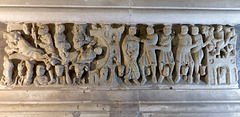
Most visitors enter the former abbey-church, built within the 12th century, to admire the "Sarcophagus of Saint Sernin", carved from a single block of Pyrenean marble, by the "Maître de Cabestany".
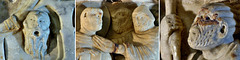
Here are three details of the sarcophag´s front side.
The "Maître de Cabestany" is known under this name since the 1930s when a tympanum and other carvings were found in Cabestany (near Perpignan).
The carvings did have a very specific style and so the anonymous artist was named "Maître de Cabestany". Research started and so far more than 120 carvings of these origins, all carved within the second half of the 12th century, are known. The carvings are spread over an area between the Tuscany in Italy, Southern France - and Catalonia in Spain. This led to the theory, that the "Maître de Cabestany" may not be a single master-carver, but a studio, where carvers learned this style. Meanwhile there is a museum in Cabestany, to is dedicated to these works of art - and their creator(s). - and of course a flickr-group.
www.maitre-de-cabestany.com/
The artistic style is very dynamic and creativ. The faces have almond eyes, a sharp nose, great ears and a triangular shape. The fingers of the hands are long, sometimes perspective.. ...
Here is an in-depth article about the Maître de Cabestany by Peter Hubert:
www.green-man-of-cercles.org/articles/the_maitre_de_cabes...

Alet-les-Bains - Abbaye Notre-Dame
| |
|
The Benedictine abbey was founded in the early 9th century. It prospered, but the times got difficult, when feudal wars arose in the area. After the Count of Carcassonne had devastated the abbey, the monks rebuilt it and erected a wall around the abbey and the adjoining village.
As the monks supported the Cathar side, when the Albigensian Crusade started against the heretics, the monks got excommunicated. Decades after Simon de Monfort´s troops had finally conquered the complete area and had wiped out what ever was Cathar, some monks were allowed back.
In 1318 Alet was promoted a diocese and the abbey church became a cathedral.
The abbey had avoided the devastation of the Albigensian crusade, but it did not escape plunder during the Wars of Religions. Huguenot troops took and looted Alet in 1573. The episcopal palace got demolished and the cathedral got destroyed. During an assault in 1577 an uncontrolled cannonball caused the roof of the cathedral to collapse.
The ruins were used as a quarry over the next centuries. First restaurations started in the 19th century.

Alet-les-Bains - Abbaye Notre-Dame
| |
|
|
The Benedictine abbey was founded in the early 9th century. It prospered, but the times got difficult, when feudal wars arose in the area. After the Count of Carcassonne had devastated the abbey, the monks rebuilt it and erected a wall around the abbey and the adjoining village.
As the monks supported the Cathar side, when the Albigensian Crusade started against the heretics, the monks got excommunicated. Decades after Simon de Monfort´s troops had finally conquered the complete area and had wiped out what ever was Cathar, some monks were allowed back.
In 1318 Alet was promoted a diocese and the abbey church became a cathedral.
The abbey had avoided the devastation of the Albigensian crusade, but it did not escape plunder during the Wars of Religions. Huguenot troops took and looted Alet in 1573. The episcopal palace got demolished and the cathedral got destroyed. During an assault in 1577 an uncontrolled cannonball caused the roof of the cathedral to collapse.
The ruins were used as a quarry over the next centuries. First restaurations started in the 19th century.

Alet-les-Bains - Abbaye Notre-Dame
| |
|
|
The Benedictine abbey was founded in the early 9th century. It prospered, but the times got difficult, when feudal wars arose in the area. After the Count of Carcassonne had devastated the abbey, the monks rebuilt it and erected a wall around the abbey and the adjoining village.
As the monks supported the Cathar side, when the Albigensian Crusade started against the heretics, the monks got excommunicated. Decades after Simon de Monfort´s troops had finally conquered the complete area and had wiped out what ever was Cathar, some monks were allowed back.
In 1318 Alet was promoted a diocese and the abbey church became a cathedral.
The abbey had avoided the devastation of the Albigensian crusade, but it did not escape plunder during the Wars of Religions. Huguenot troops took and looted Alet in 1573. The episcopal palace got demolished and the cathedral got destroyed. During an assault in 1577 an uncontrolled cannonball caused the roof of the cathedral to collapse.
The ruins were used as a quarry over the next centuries. First restaurations started in the 19th century.
The former side portal, flanked by two lions.
Alet-les-Bains - Abbaye Notre-Dame
| |
|
The Benedictine abbey was founded in the early 9th century. It prospered, but the times got difficult, when feudal wars arose in the area. After the Count of Carcassonne had devastated the abbey, the monks rebuilt it and erected a wall around the abbey and the adjoining village.
As the monks supported the Cathar side, when the Albigensian Crusade started against the heretics, the monks got excommunicated. Decades after Simon de Monfort´s troops had finally conquered the complete area and had wiped out what ever was Cathar, some monks were allowed back.
In 1318 Alet was promoted a diocese and the abbey church became a cathedral.
The abbey had avoided the devastation of the Albigensian crusade, but it did not escape plunder during the Wars of Religions. Huguenot troops took and looted Alet in 1573. The episcopal palace got demolished and the cathedral got destroyed. During an assault in 1577 an uncontrolled cannonball caused the roof of the cathedral to collapse.
The ruins were used as a quarry over the next centuries. First restaurations started in the 19th century.
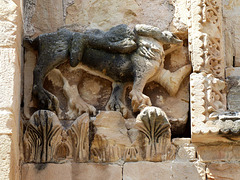
The very damaged Samson, tearing the lion apart, is located next to the window frame (see previous upload).
Jump to top
RSS feed- Latest items - Subscribe to the latest items added to this album
- ipernity © 2007-2026
- Help & Contact
|
Club news
|
About ipernity
|
History |
ipernity Club & Prices |
Guide of good conduct
Donate | Group guidelines | Privacy policy | Terms of use | Statutes | In memoria -
Facebook
X
