


Languedoc-Roussillon -South

A collection of photos, that were taken in the departments Aude (11) and Pyrénées-Orientales (66) and parts of Hérault,
(34), the southern part of the Languedoc-Roussillon in France.
(34), the southern part of the Languedoc-Roussillon in France.
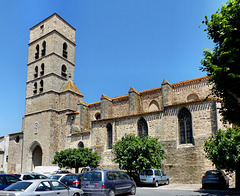
Montolieu - Saint-André
| |
|
The village is a "book village". A couple of antiquarian bookstores are even open on a sunday afternoon. The late Gothic parish church Saint-André, replaced an older church. The erection started with the laying of the first stone on the september 2, 1393.
Saint-Papoul - Abbaye de Saint-Papoul
| |
|
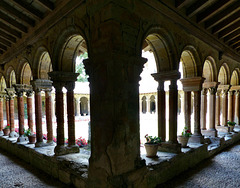
The abbey was founded within the 8th century. It is dedicated to Saint Papoul, a disciple of Saint Saturnin, missionary and first bishop of Toulouse. It was believed that Saint Papoul was martyred near the place, where the abbey is now.
Later a monk named Berenger (or Berengar) lived a pious life here. After he got canonized his relics attracted the first pilgrims to this place. In the aftermath of the crusade against the Cathars the papal organisation created new (smaller) dioceses to enable a stricter control. So (like Saint-Pons-de-Thomières) since 1317 the abbey church of Saint Papoul was promoted to a cathedral, holding a bishopric (upto 1801).
Saint Papoul is a quiet little village, that is one of my favourite places since a long time. Yes, there are the works of the "Maître de Cabestany", who is known under this name since the 1930s when a tympanum and other carvings were found in Cabestany (near Perpignan), but there is so much more.
The cloister..
www.abbaye-saint-papoul.fr/
Saint-Papoul - Abbaye de Saint-Papoul
| |
|
|
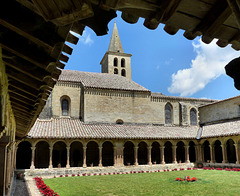
The abbey was founded within the 8th century. It is dedicated to Saint Papoul, a disciple of Saint Saturnin, missionary and first bishop of Toulouse. It was believed that Saint Papoul was martyred near the place, where the abbey is now.
Later a monk named Berenger (or Berengar) lived a pious life here. After he got canonized his relics attracted the first pilgrims to this place. In the aftermath of the crusade against the Cathars the papal organisation created new (smaller) dioceses to enable a stricter control. So (like Saint-Pons-de-Thomières) since 1317 the abbey church of Saint Papoul was promoted to a cathedral, holding a bishopric (upto 1801).
Saint Papoul is a quiet little village, that is one of my favourite places since a long time. Yes, there are the works of the "Maître de Cabestany", who is known under this name since the 1930s when a tympanum and other carvings were found in Cabestany (near Perpignan), but there is so much more.
The cloister..
Saint-Papoul - Abbaye de Saint-Papoul
| |
|
|
The abbey was founded within the 8th century. It is dedicated to Saint Papoul, a disciple of Saint Saturnin, missionary and first bishop of Toulouse. It was believed that Saint Papoul was martyred near the place, where the abbey is now.
Later a monk named Berenger (or Berengar) lived a pious life here. After he got canonized his relics attracted the first pilgrims to this place. In the aftermath of the crusade against the Cathars the papal organisation created new (smaller) dioceses to enable a stricter control. So (like Saint-Pons-de-Thomières) since 1317 the abbey church of Saint Papoul was promoted to a cathedral, holding a bishopric (upto 1801).
Saint Papoul is a quiet little village, that is one of my favourite places since a long time. Yes, there are the works of the "Maître de Cabestany", who is known under this name since the 1930s when a tympanum and other carvings were found in Cabestany (near Perpignan), but there is so much more.
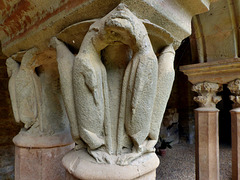
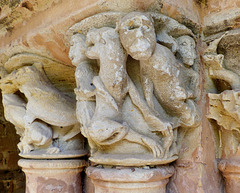
As the abbey was looted during the Hundred Years' War and Wars of Religion, most capitals of the cloister, created in the early 14th century, are vandalized and meanwhile very weathered. These sculptures today look like kissing penguins.
Saint-Papoul - Abbaye de Saint-Papoul
| |
|
The abbey was founded within the 8th century. It is dedicated to Saint Papoul, a disciple of Saint Saturnin, missionary and first bishop of Toulouse. It was believed that Saint Papoul was martyred near the place, where the abbey is now.
Later a monk named Berenger (or Berengar) lived a pious life here. After he got canonized his relics attracted the first pilgrims to this place. In the aftermath of the crusade against the Cathars the papal organisation created new (smaller) dioceses to enable a stricter control. So (like Saint-Pons-de-Thomières) since 1317 the abbey church of Saint Papoul was promoted to a cathedral, holding a bishopric (upto 1801).
Saint Papoul is a quiet little village, that is one of my favourite places since a long time. Yes, there are the works of the "Maître de Cabestany", who is known under this name since the 1930s when a tympanum and other carvings were found in Cabestany (near Perpignan), but there is so much more.
As the abbey was looted during the Hundred Years' War and Wars of Religion, most capitals of the cloister, created in the early 14th century, are vandalized and meanwhile very weathered.
A monkey
Saint-Papoul - Abbaye de Saint-Papoul
| |
|
The abbey was founded within the 8th century. It is dedicated to Saint Papoul, a disciple of Saint Saturnin, missionary and first bishop of Toulouse. It was believed that Saint Papoul was martyred near the place, where the abbey is now.
Later a monk named Berenger (or Berengar) lived a pious life here. After he got canonized his relics attracted the first pilgrims to this place. In the aftermath of the crusade against the Cathars the papal organisation created new (smaller) dioceses to enable a stricter control. So (like Saint-Pons-de-Thomières) since 1317 the abbey church of Saint Papoul was promoted to a cathedral, holding a bishopric (upto 1801).
Saint Papoul is a quiet little village, that is one of my favourite places since a long time. Yes, there are the works of the "Maître de Cabestany", who is known under this name since the 1930s when a tympanum and other carvings were found in Cabestany (near Perpignan), but there is so much more.
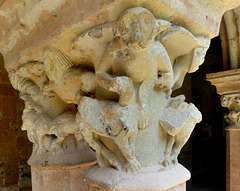
As the abbey was looted during the Hundred Years' War and Wars of Religion, most capitals of the cloister, created in the early 14th century, are vandalized and meanwhile very weathered.
Another monkey. Playing with lions?
Saint-Papoul - Abbaye de Saint-Papoul
| |
|
|
|
The abbey was founded within the 8th century. It is dedicated to Saint Papoul, a disciple of Saint Saturnin, missionary and first bishop of Toulouse. It was believed that Saint Papoul was martyred near the place, where the abbey is now.
Later a monk named Berenger (or Berengar) lived a pious life here. After he got canonized his relics attracted the first pilgrims to this place. In the aftermath of the crusade against the Cathars the papal organisation created new (smaller) dioceses to enable a stricter control. So (like Saint-Pons-de-Thomières) since 1317 the abbey church of Saint Papoul was promoted to a cathedral, holding a bishopric (upto 1801).
Saint Papoul is a quiet little village, that is one of my favourite places since a long time. Yes, there are the works of the "Maître de Cabestany", who is known under this name since the 1930s when a tympanum and other carvings were found in Cabestany (near Perpignan), but there is so much more.
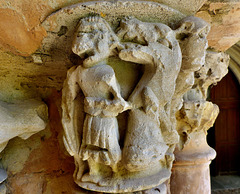
As the abbey was looted during the Hundred Years' War and Wars of Religion, most capitals of the cloister, created in the early 14th century, are vandalized and meanwhile very weathered.
Is the knight just about to kill the beast or does the dragon nibble on the knight´s head?
Saint-Papoul - Abbaye de Saint-Papoul
| |
|
The abbey was founded within the 8th century. It is dedicated to Saint Papoul, a disciple of Saint Saturnin, missionary and first bishop of Toulouse. It was believed that Saint Papoul was martyred near the place, where the abbey is now.
Later a monk named Berenger (or Berengar) lived a pious life here. After he got canonized his relics attracted the first pilgrims to this place. In the aftermath of the crusade against the Cathars the papal organisation created new (smaller) dioceses to enable a stricter control. So (like Saint-Pons-de-Thomières) since 1317 the abbey church of Saint Papoul was promoted to a cathedral, holding a bishopric (upto 1801).
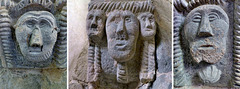
Saint Papoul is a quiet little village, that is one of my favourite places since a long time. Yes, there are the works of the "Maître de Cabestany", who is known under this name since the 1930s when a tympanum and other carvings were found in Cabestany (near Perpignan), but there is so much more. The range of different artistic styles and icons in Saint-Papoul is enormous.
There are the elegant (but vandalized) capitals of the early 14th century cloister (previous uploads), as well, as these roughly carved heads on the outer wall of the former abbey church / former cathedral.
Saint-Papoul - Abbaye de Saint-Papoul
| |
|
The abbey was founded within the 8th century. It is dedicated to Saint Papoul, a disciple of Saint Saturnin, missionary and first bishop of Toulouse. It was believed that Saint Papoul was martyred near the place, where the abbey is now.
Later a monk named Berenger (or Berengar) lived a pious life here. After he got canonized his relics attracted the first pilgrims to this place. In the aftermath of the crusade against the Cathars the papal organisation created new (smaller) dioceses to enable a stricter control. So since 1317 the abbey church of Saint Papoul was promoted to a cathedral, holding a bishopric (upto 1801).
Saint Papoul is a quiet little village, that is one of my favourite places since a long time. Yes, there are the works of the "Maître de Cabestany", who is known under this name since the 1930s when a tympanum and other carvings were found in Cabestany (near Perpignan), but there is so much more. The range of different artistic styles and icons in Saint-Papoul is enormous.
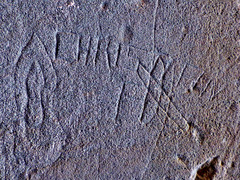
The abbey was looted during the Hundred Years' War and Wars of Religion and neglected over decades during the 19th century - so there are lots of graffiti. Maybe prilgrims following the Via Tolosana added a few. "Sole graffiti" (just like "horseshoe-graffiti") are often connected to medieval pilgrims. Here I am not sure. It could be a sole, but it could as well be ... something else.
Saint-Papoul - Abbaye de Saint-Papoul
| |
|
The abbey was founded within the 8th century. It is dedicated to Saint Papoul, a disciple of Saint Saturnin, missionary and first bishop of Toulouse. It was believed that Saint Papoul was martyred near the place, where the abbey is now.
Later a monk named Berenger (or Berengar) lived a pious life here. After he got canonized his relics attracted the first pilgrims to this place. In the aftermath of the crusade against the Cathars the papal organisation created new (smaller) dioceses to enable a stricter control. So since 1317 the abbey church of Saint Papoul was promoted to a cathedral, holding a bishopric (upto 1801).
Saint Papoul is a quiet little village, that is one of my favourite places since a long time. Yes, there are the works of the "Maître de Cabestany", who is known under this name since the 1930s when a tympanum and other carvings were found in Cabestany (near Perpignan), but there is so much more. The range of different artistic styles and icons in Saint-Papoul is enormous.
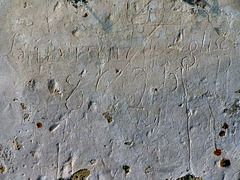
The abbey was looted during the Hundred Years' War and Wars of Religion and neglected over decades during the 19th century - so there are lots of graffiti. This one is younger, probably "written" into the soft plaster within the 19th century, but I can read "eglise"..
Saint-Papoul - Abbaye de Saint-Papoul
| |
|
The abbey was founded within the 8th century. It is dedicated to Saint Papoul, a disciple of Saint Saturnin, missionary and first bishop of Toulouse. It was believed that Saint Papoul was martyred near the place, where the abbey is now.
Later a monk named Berenger (or Berengar) lived a pious life here. After he got canonized his relics attracted the first pilgrims to this place. In the aftermath of the crusade against the Cathars the papal organisation created new (smaller) dioceses to enable a stricter control. So since 1317 the abbey church of Saint Papoul was promoted to a cathedral, holding a bishopric (upto 1801).
Saint Papoul is a quiet little village, that is one of my favourite places since a long time. Yes, there are the works of the "Maître de Cabestany", who is known under this name since the 1930s when a tympanum and other carvings were found in Cabestany (near Perpignan), but there is so much more. The range of different artistic styles and icons in Saint-Papoul is enormous.
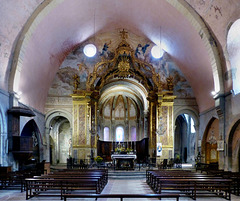
The former abbey church / cathedral got obviously a makeover during the time of baroque splendor, but apse and some of the side chapels stayed pretty untouched.
There the medieval capitals are still in place - and they again differ very much from that ones seen in the cloister or the rough carvings on the outside of the church.
Saint-Papoul - Abbaye de Saint-Papoul
| |
|
The abbey was founded within the 8th century. It is dedicated to Saint Papoul, a disciple of Saint Saturnin, missionary and first bishop of Toulouse. It was believed that Saint Papoul was martyred near the place, where the abbey is now.
Later a monk named Berenger (or Berengar) lived a pious life here. After he got canonized his relics attracted the first pilgrims to this place. In the aftermath of the crusade against the Cathars the papal organisation created new (smaller) dioceses to enable a stricter control. So since 1317 the abbey church of Saint Papoul was promoted to a cathedral, holding a bishopric (upto 1801).
Saint Papoul is a quiet little village, that is one of my favourite places since a long time. Yes, there are the works of the "Maître de Cabestany", who is known under this name since the 1930s when a tympanum and other carvings were found in Cabestany (near Perpignan), but there is so much more. The range of different artistic styles and icons in Saint-Papoul is enormous.
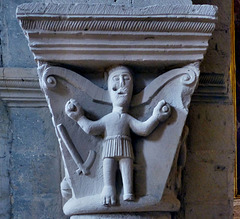
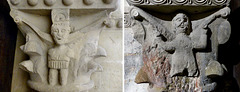
The Romanesque capitals of the former abbey church / cathedral have not only a very specific, rough and "simple" style. Some seem to be themed around injuries.
I have the impression, that this capital depicts a work accident - or injuries caused by working with the pickaxe (left). The person has lost his foot (there is a prothesis), he has scars all around his mouth and a deep wound in his cheek. He is in an upright position holding himself onto pegs (?) in the wall.
Saint-Papoul - Abbaye de Saint-Papoul
| |
|
The abbey was founded within the 8th century. It is dedicated to Saint Papoul, a disciple of Saint Saturnin, missionary and first bishop of Toulouse. It was believed that Saint Papoul was martyred near the place, where the abbey is now.
Later a monk named Berenger (or Berengar) lived a pious life here. After he got canonized his relics attracted the first pilgrims to this place. In the aftermath of the crusade against the Cathars the papal organisation created new (smaller) dioceses to enable a stricter control. So since 1317 the abbey church of Saint Papoul was promoted to a cathedral, holding a bishopric (upto 1801).
Saint Papoul is a quiet little village, that is one of my favourite places since a long time. Yes, there are the works of the "Maître de Cabestany", who is known under this name since the 1930s when a tympanum and other carvings were found in Cabestany (near Perpignan), but there is so much more. The range of different artistic styles and icons in Saint-Papoul is enormous.
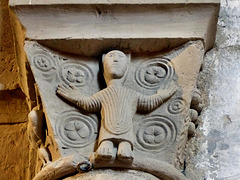
The Romanesque capitals of the former abbey church / cathedral have not only a very specific, rough and "simple" style.
The "work accident", seen previous, was obvious, as the person had lost a foot. These two capitals depict as well injured/crippled men. The person on the left has no feet and no arms. The man to the right has no legs (and hold himself on pegs, like seen on the previous upload).
Saint-Papoul - Abbaye de Saint-Papoul
| |
|
The abbey was founded within the 8th century. It is dedicated to Saint Papoul, a disciple of Saint Saturnin, missionary and first bishop of Toulouse. It was believed that Saint Papoul was martyred near the place, where the abbey is now.
Later a monk named Berenger (or Berengar) lived a pious life here. After he got canonized his relics attracted the first pilgrims to this place. In the aftermath of the crusade against the Cathars the papal organisation created new (smaller) dioceses to enable a stricter control. So since 1317 the abbey church of Saint Papoul was promoted to a cathedral, holding a bishopric (upto 1801).
Saint Papoul is a quiet little village, that is one of my favourite places since a long time. Yes, there are the works of the "Maître de Cabestany", who is known under this name since the 1930s when a tympanum and other carvings were found in Cabestany (near Perpignan), but there is so much more. The range of different artistic styles and icons in Saint-Papoul is enormous.
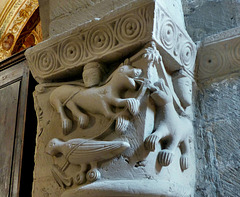
The Romanesque capitals of the former abbey church / cathedral have not only a very specific, rough and "simple" style.
A cleric, wearing a chasuble, in an adorante-gestus. He is surrounded by flowers.
Saint-Papoul - Abbaye de Saint-Papoul
| |
|
The abbey was founded within the 8th century. It is dedicated to Saint Papoul, a disciple of Saint Saturnin, missionary and first bishop of Toulouse. It was believed that Saint Papoul was martyred near the place, where the abbey is now.
Later a monk named Berenger (or Berengar) lived a pious life here. After he got canonized his relics attracted the first pilgrims to this place. In the aftermath of the crusade against the Cathars the papal organisation created new (smaller) dioceses to enable a stricter control. So since 1317 the abbey church of Saint Papoul was promoted to a cathedral, holding a bishopric (upto 1801).
Saint Papoul is a quiet little village, that is one of my favourite places since a long time. Yes, there are the works of the "Maître de Cabestany", who is known under this name since the 1930s when a tympanum and other carvings were found in Cabestany (near Perpignan), but there is so much more. The range of different artistic styles and icons in Saint-Papoul is enormous.
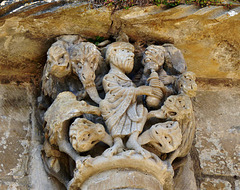
The Romanesque capitals of the former abbey church / cathedral have not only a very specific, rough and "simple" style.
What a menagerie!
One bird, two dogs (?), the head of a biting beast - and a stoic looking human in the right corner. Are the dogs fighting? For a vine?? Are they drinking from a little stream (that runs over the bird)? Or does the stream spring out of the dogs´ mouth? Or...
Saint-Papoul - Abbaye de Saint-Papoul
| |
|
|
|
The abbey was founded within the 8th century. It is dedicated to Saint Papoul, a disciple of Saint Saturnin, missionary and first bishop of Toulouse. It was believed that Saint Papoul was martyred near the place, where the abbey is now.
Later a monk named Berenger (or Berengar) lived a pious life here. After he got canonized his relics attracted the first pilgrims to this place. In the aftermath of the crusade against the Cathars the papal organisation created new dioceses to enable a stricter control. So since 1317 the abbey church of Saint Papoul was promoted to a cathedral, holding a bishopric (upto 1801).
Saint Papoul is a quiet little village, that is one of my favourite places since a long time. The range of different artistic styles and icons in Saint-Papoul is enormous. There are the elegant (but vandalized) capitals of the early 14th century cloister, there are roughly carved heads on the outer wall of the former abbey church, there are the enigmatic capitals of the church, that looks so clumsy - and there are two works of the "Maître de Cabestany".
The "Maître de Cabestany" is known under this name since the 1930s when a tympanum and other carvings were found in Cabestany (near Perpignan).
The carvings did have a very specific style and so the anonymous artist was named "Maître de Cabestany". Research started and so far more than 120 carvings of these origins, all carved within the second half of the 12th century, are known. The carvings are spread over an area between the Tuscany in Italy, Southern France - and Catalonia in Spain. This led to the theory, that the "Maître de Cabestany" may not be a single master-carver, but a studio, where carvers learned this style. Meanwhile there is a museum in Cabestany, to is dedicated to these works of art.
www.maitre-de-cabestany.com/
The artistic style is very dynamic and creativ. The faces have almond eyes, a sharp nose, great ears and a triangular shape. The fingers of the hands are long, sometimes perspective.. ...
Here is an in-depth article about the Maître de Cabestany by Peter Hubert:
www.green-man-of-cercles.org/articles/the_maitre_de_cabes...

Montréal - Collégiale Saint-Vincent
| |
|
Montréal was in the center of the "Pays Cathare" and in 1206 the site of debates between Catholics and Cathars. The debates, initiated by Dominic of Osma (future "Saint Dominic"), were part of Pope Innocent III's program to convert the Cathars (back) to Catholicism. Dominic had no sucess. In 1209, during the Albigensian Crusade, Montréal was taken and razed by Simon de Montfort´s troops.
After the crusade Montréal (and large parts of the Languedoc) became "Domaine royal", what meant these were directly possessed by the kings of France.
In 1273 the erection of the new castle started - and probably the church seen here was built in a "Tolosan-Gothic" style at the same time. It was completed in 1318. From outside it looks a bit like a tiny cousin of Sainte-Cécile in Albi.
www.collegiale-montreal-aude.fr/index.htm

Montréal - Collégiale Saint-Vincent
| |
|
|
Montréal was in center of the "Pays Cathare" and in 1206 the town was the site of debates between Catholics and Cathars. The debates, initiated by Dominic of Osma (future "Saint Dominic"), were part of Pope Innocent III's program to convert the Cathars (back) to Catholicism. Dominic had no sucess. In 1209, during the Albigensian Crusade, Montréal was taken and razed by Simon de Montfort´s troops.
After the crusade Montréal (and large parts of the Languedoc) became "Domaine royal", what meant these were directly possessed by the kings of France.
In 1273 the erection of the new castle started - and probably the church seen here was built in a "Tolosan-Gothic" style at the same time. It was completed in 1318. From outside it looks a bit like a tiny cousin of Sainte-Cécile in Albi.
www.collegiale-montreal-aude.fr/index.htm
Jump to top
RSS feed- Latest items - Subscribe to the latest items added to this album
- ipernity © 2007-2026
- Help & Contact
|
Club news
|
About ipernity
|
History |
ipernity Club & Prices |
Guide of good conduct
Donate | Group guidelines | Privacy policy | Terms of use | Statutes | In memoria -
Facebook
X
