


Ancient Heads and Faces


Corinth - Archaeological Museum of Ancient Corinth
| |
|
|
Corinth was founded in the Neolithic period, around 5000 BC.
It possessed a unique strategic position on the narrow Isthmus and so the city controlled trade routes between mainland Greece and Peloponnese. Powerful colonies like Syracuse and Corcyra were established across the sea. After a paved ship trackway was built, ships could cross the land, avoiding dangerous capes. In the 5th century BC, it fought against Persian invasion forces. During the Peloponnesian War Corinth joined Sparta to defeat Athens and so protect its economic dominance. Later, the city fought Sparta during the Corinthian War. In 146 BC, Roman commander Lucius Mummius attacked the defiant city. The Roman army completely destroyed Corinth and enslaved its citizens. For a century, the historic site remained a desolated ghost town. Julius Caesar refounded it as a Roman colony in 44 BC. Barbarian tribes looted Corinth later on. Under Byzantine rule, it served as a strong military center. The Ottoman Empire captured the city's fortress in 1458. A catastrophic earthquake completely ruined Old Corinth in the year 1858. Modern Corinth was successfully rebuilt six kilometers away from the ruins.
The Archaeological Museum of Ancient Corinth is located within the archaeological site of Ancient Corinth.
Head of Serapis
Marble, 2nd c AD

Mycenae - Archaeological Museum
| |
|
|
Mycene was inhabited already during neolithic and the early Bronze period. During the pre-classical period Mycenae was one of the most important cities in Greece. The Mycenaean culture (c. 1600 BC to c. 1100 BC) was named after it.
Over the centuries the population density increased, and by 1350 BC the citadel and the lower town had a population of 30,000 and covered an area of 32 hectares. At that time the fortifications on the acropolis and other surrounding hills were rebuilt in a style known as Cyclopean because the blocks of stone used were so massive that they were thought in later ages to be the work of the Cyclopes.
Within these walls successive monumental palaces were built. The final palace dates to the start of ca. 1390–1300 BC. Earlier palaces must have existed but they had been cleared away or built over. From 1200 BC onwards, Mycenae began to decline and lost its dominant position. Like all the palaces in southern Greece, the palace at Mycenae was destroyed. The settlement shrank, but the citadel and the lower town remained inhabited. During the Archaic period, a temple to Hera was built on the highest point.
In 480 BC 80 Mycenaeans took part in the Battle of Thermopylae. In 468 BC the Argives conquered Mycenae, deported the inhabitants and razed the walls. During the Hellenistic period, the city was resettled and a theatre was built. After that, the site was only resettled for a short time. In the 3rd century BC Mycenae was abandoned.
The excavations, which were begun in the 1870s by Heinrich Schliemann and Panagiotis Stamatakis, yielded incredible finds, particularly within the grave circles. The most spectacular of which are now housed in Athens, however, the exhibits on display at the Archaeological Museum, which forms part of the site, are also breathtaking.
Detail of an anthropomorphic figure
1250 - 1180 BC

Mycenae - Archaeological Museum
| |
|
|
Mycene was inhabited already during neolithic and the early Bronze period. During the pre-classical period Mycenae was one of the most important cities in Greece. The Mycenaean culture (c. 1600 BC to c. 1100 BC) was named after it.
Over the centuries the population density increased, and by 1350 BC the citadel and the lower town had a population of 30,000 and covered an area of 32 hectares. At that time the fortifications on the acropolis and other surrounding hills were rebuilt in a style known as Cyclopean because the blocks of stone used were so massive that they were thought in later ages to be the work of the Cyclopes.
Within these walls successive monumental palaces were built. The final palace dates to the start of ca. 1390–1300 BC. Earlier palaces must have existed but they had been cleared away or built over. From 1200 BC onwards, Mycenae began to decline and lost its dominant position. Like all the palaces in southern Greece, the palace at Mycenae was destroyed. The settlement shrank, but the citadel and the lower town remained inhabited. During the Archaic period, a temple to Hera was built on the highest point.
In 480 BC 80 Mycenaeans took part in the Battle of Thermopylae. In 468 BC the Argives conquered Mycenae, deported the inhabitants and razed the walls. During the Hellenistic period, the city was resettled and a theatre was built. After that, the site was only resettled for a short time. In the 3rd century BC Mycenae was abandoned.
The excavations, which were begun in the 1870s by Heinrich Schliemann and Panagiotis Stamatakis, yielded incredible finds, particularly within the grave circles. The most spectacular of which are now housed in Athens, however, the exhibits on display at the Archaeological Museum, which forms part of the site, are also breathtaking.
Excavating the shaft graves in Grave Circles A and B, numerous objects made of various gold alloys were found. A total of around 15 kg of gold was recorded.
A man’s head
Ivory, 1250–1180 BC

Epidaurus - Archaeological Museum
| |
|
|
The small archaeological museum is located at the entrance to the excavation site and displays some artifacts found there.
Left - Portrait of Emperor Hadrian / 117 - 138 AD
Right - Portrait of a bearded man / 3rd c AD

Olympia - Archaeological Museum
| |
|
|
Olympia was the sanctuary of Zeus in the northwest of the Peloponnese. It was the site of the ancient Olympic Games.
The modern town of Archaia Olympia is located on the outskirts of the ancient sanctuary.
The excavation site is vast and complex. The ancient author Pausanias mentions about seventy temples, some of which have been reconstructed. Much of what the archaeologists have found is on display at the Archaeological Museum.
Head of Athena
Clay, Corinthian workshop, 5th c BC
Olympia - Archaeological Museum
| |
|
|
Olympia was the sanctuary of Zeus in the northwest of the Peloponnese. It was the site of the ancient Olympic Games.
The modern town of Archaia Olympia is located on the outskirts of the ancient sanctuary.
The excavation site is vast and complex. The ancient author Pausanias mentions about seventy temples, some of which have been reconstructed. Much of what the archaeologists have found is on display at the Archaeological Museum.
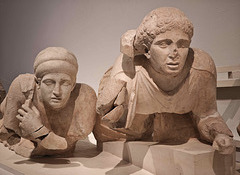
The Temple of Zeus was the dominant structure in the Olympic sanctuary and was built between approximately 480 - 456 BC. Measuring about 64 meters long, 28 meters wide, and 20 meters high, the temple is an important structures of early Classical architecture. It was the largest temple in the Peloponnese and, at the time of its construction, the largest temple in mainland Greece.
The reconstructed West Pediment
At its center is the 3.15-meter-tall Apollo of Olympia. The subject of the depiction is the battle of the Lapiths, with the support of Theseus and Peirithous, against the Centaurs, who, drunken with wine, disrupted the wedding of Peirithous with the Lapith woman Hippodamia or Deidameia.
Details

Olympia - Archaeological Museum
| |
|
|
Olympia was the sanctuary of Zeus in the northwest of the Peloponnese. It was the site of the ancient Olympic Games.
The modern town of Archaia Olympia is located on the outskirts of the ancient sanctuary.
The excavation site is vast and complex. The ancient author Pausanias mentions about seventy temples, some of which have been reconstructed. Much of what the archaeologists have found is on display at the Archaeological Museum.
Portrait head
from a statue of Lucas Verus
2nd c AD

Olympia - Museum of the History of the Ancient Oly…
| |
|
|
The Olympic Games were held for more than 1,000 years. The first games took place in 776 B.C. Participants and spectators from all over Greece took part. They were held continuously over 293 Olympiads until the Roman Emperor Theodosius I banned the Games in 393 AD, as he considered them a pagan cult.
The museum's Neoclassical building was completed in 1888. It stands on a hill about 400 meters northwest of Altis, across the bridge over the Kladeos.
In February 2012, an armed robbery was committed at the museum, during which numerous exhibits were stolen. However, the theft was solved in November 2012, and the items were recovered.
Head of Zeus
Bronze, 520 - 510 BC
Jump to top
RSS feed- Latest items - Subscribe to the latest items added to this album
- ipernity © 2007-2026
- Help & Contact
|
Club news
|
About ipernity
|
History |
ipernity Club & Prices |
Guide of good conduct
Donate | Group guidelines | Privacy policy | Terms of use | Statutes | In memoria -
Facebook
X
