


Ancient Heads and Faces


Larnaca - Archaeological Museum
| |
|
|
With a population of over 50,000, Larnaca is one of the largest cities in Cyprus.
The Larnaca District Archaeological Museum displays the development of the city of Kition up to Roman times, as well as finds from the Neolithic settlement of Chirokitia. It is one of two archaeological museums in Larnaca.
Limestone head
of a bearded male figure with a wreath of leaves
6th c BC

Larnaca - Archaeological Museum
| |
|
|
With a population of over 50,000, Larnaca is one of the largest cities in Cyprus.
The Larnaca District Archaeological Museum displays the development of the city of Kition up to Roman times, as well as finds from the Neolithic settlement of Chirokitia. It is one of two archaeological museums in Larnaca.
Limestone head
of a beardless male figure with a wreath of leaves
6th c BC

Larnaca - Archaeological Museum
| |
|
|
With a population of over 50,000, Larnaca is one of the largest cities in Cyprus.
The Larnaca District Archaeological Museum displays the development of the city of Kition up to Roman times, as well as finds from the Neolithic settlement of Chirokitia. It is one of two archaeological museums in Larnaca.
Terracotta head of a male figurine
wearing earings and a conical hat
Cypro-Archaic period - c. 750–475 BC

Larnaca - Archaeological Museum
| |
|
|
With a population of over 50,000, Larnaca is one of the largest cities in Cyprus.
The Larnaca District Archaeological Museum displays the development of the city of Kition up to Roman times, as well as finds from the Neolithic settlement of Chirokitia. It is one of two archaeological museums in Larnaca.
Two limestomes heads
Cypro-Archaic period - c. 750–475 BC

Larnaca - Archaeological Museum
| |
|
|
With a population of over 50,000, Larnaca is one of the largest cities in Cyprus.
The Larnaca District Archaeological Museum displays the development of the city of Kition up to Roman times, as well as finds from the Neolithic settlement of Chirokitia. It is one of two archaeological museums in Larnaca.
Head of a terracotta figurine
Cypro-Geometric period - c. 1050–750 BC
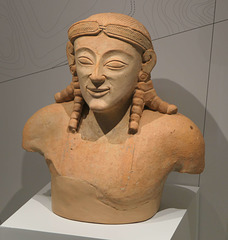
Heraklion - Archaeological Museum
| |
|
|
Crete, the largest and most populous of the Greek islands, is located about 100 km south of the Peloponnese. Crete was the center of Europe's first advanced civilization, the Minoans, from 3000 to 1400 BC. The Minoan civilization was overrun by the Mycenaean civilization from mainland Greece. Crete was later ruled by Rome, then successively by the Byzantine Empire, Andalusian Arabs, the Byzantine Empire again, the Venetian Republic, and the Ottoman Empire. In 1898 Crete, whose people had for some time wanted to join the Greek state, achieved independence from the Ottomans, formally becoming the Cretan State. Crete became part of Greece in December 1913.
Heraklion is the largest city and the administrative capital of the island of Crete. With a municipal population of about 180.000 it is the fourth largest city in Greece. The greater area of Heraklion has been continuously inhabited since at least 7000 BCE, making it one of the oldest inhabited regions in Europe. As a major center of the Minoan civilization it often considered Europe's oldest city.
The Heraklion Archaeological Museum is one of the largest museums in Greeceand the best in the world for Minoan art, as it contains by far the most important and complete collection of artefacts of the Minoan civilization of Crete.
The museum began in 1883 as a simple collection of antiquities; it was about the time when the Minoan civilization was beginning to be rediscovered, and shortly before the first excavations using proper scientific methods. It was also during the period when Crete was a virtually autonomous part of the Ottoman Empire, after the Pact of Halepa of 1878, later followed by the independent Cretan State (1898-1913). The political situation helped to keep Cretan finds on the island during a crucial period of discoveries.
The museum is located in the town centre. It was built between 1937 and 1940 on a site previously occupied by the Roman Catholic monastery of Saint-Francis which was destroyed by earthquake in 1856.
Kouros, a young man, the personification of ideal and aesthetics of Archaic Crete, clay
Praisos 575 - 550 BC

Heraklion - Archaeological Museum
| |
|
Crete is the largest and most populous of the Greek islands, is located about 100 km south of the Peloponnese. Crete was the center of Europe's first advanced civilization, the Minoans, from 3000 to 1400 BC. The Minoan civilization was overrun by the Mycenaean civilization from mainland Greece. Crete was later ruled by Rome, then successively by the Byzantine Empire, Andalusian Arabs, the Byzantine Empire again, the Venetian Republic, and the Ottoman Empire. In 1898 Crete, whose people had for some time wanted to join the Greek state, achieved independence from the Ottomans, formally becoming the Cretan State. Crete became part of Greece in December 1913.
Heraklion is the largest city and the administrative capital of the island of Crete. With a municipal population of about 180.000 it is the fourth largest city in Greece. The greater area of Heraklion has been continuously inhabited since at least 7000 BCE, making it one of the oldest inhabited regions in Europe. As a major center of the Minoan civilization it often considered Europe's oldest city.
The Heraklion Archaeological Museum is one of the largest museums in Greece and the best in the world for Minoan art, as it contains by far the most important and complete collection of artefacts of the Minoan civilization of Crete.
The museum began in 1883 as a simple collection of antiquities; it was about the time when the Minoan civilization was beginning to be rediscovered, and shortly before the first excavations using proper scientific methods. It was also during the period when Crete was a virtually autonomous part of the Ottoman Empire, after the Pact of Halepa of 1878, later followed by the independent Cretan State (1898-1913). The political situation helped to keep Cretan finds on the island during a crucial period of discoveries.
The museum is located in the town centre. It was built between 1937 and 1940 on a site previously occupied by the Roman Catholic monastery of Saint-Francis which was destroyed by earthquake in 1856.
Bust of a kore (maiden)
Late 6th - early 5th c BC

Agios Nikolaos - Archaeological Museum
| |
|
Agios Nikolaos was settled in the late Bronze Age by Dorian occupants of Lato under the name Lato pros Kamara, often simply Kamara. It was the port of Lato for a long time. In the 2nd century BC, Lato was abandoned, and many citizens settled in Kamara. The name of the present-day town comes from the church of Agios Nikolaos, which dates back to the 9th or 10th century and is one of the oldest intact churches in Crete.
In 1970, the Archaeological Museum was opened to house finds from Eastern Crete that had previously been housed in Heraklion
Votive body parts

Athens - National Archaeological Museum
| |
|
Athens, the southernmost capital on the European mainland, is one of the world's oldest cities, with its recorded history spanning over 3,400 years. According to Greek mythology the city was named after Athena, the ancient Greek goddess of wisdom. Classical Athens was one of the most powerful city-states in ancient Greece. It was a centre for democracy, the arts, education and philosophy, and was highly influential throughout the European continent, particularly in Ancient Rome. For this reason it is often regarded as the cradle of Western civilisation and the birthplace of democracy.
Planning for an archaeological museum began with the founding of the Kingdom of Greece. Once financing was secured, construction began in 1866. The main building was inaugurated in 1874, followed by the two side wings in 1881 and 1885.
In 2009, the museum was expanded by approximately 24,000 m² of exhibition space, allowing it to display over 2,000 additional ancient exhibits.
The about 11,000 objects on display come from all regions of Greece, as all important finds were brought exclusively there until the 20th century, so it is considered one of the greatest museums in the world and contains the richest collection of Greek Antiquity artifacts worldwide.
A plaster head of a woman, presumably a goddess. An example of monumental Mycenaean sculpture. Her hair falls in small curls beneath a cylindrical cap.
From the area of the cult center on the Acropolis of Mycenae
13th c. BC

Athens - National Archaeological Museum
| |
|
|
Athens, the southernmost capital on the European mainland, is one of the world's oldest cities, with its recorded history spanning over 3,400 years. According to Greek mythology the city was named after Athena, the ancient Greek goddess of wisdom. Classical Athens was one of the most powerful city-states in ancient Greece. It was a centre for democracy, the arts, education and philosophy, and was highly influential throughout the European continent, particularly in Ancient Rome. For this reason it is often regarded as the cradle of Western civilisation and the birthplace of democracy.
Planning for an archaeological museum began with the founding of the Kingdom of Greece. Once financing was secured, construction began in 1866. The main building was inaugurated in 1874, followed by the two side wings in 1881 and 1885.
In 2009, the museum was expanded by approximately 24,000 m² of exhibition space, allowing it to display over 2,000 additional ancient exhibits.
The about 11,000 objects on display come from all regions of Greece, as all important finds were brought exclusively there until the 20th century, so it is considered one of the greatest museums in the world and contains the richest collection of Greek Antiquity artifacts worldwide.
Portrait head, bronze, about 340 BC
Found in the Antikythera shipwreck. The eyeballs are made from different material and the irises of glas paste. The head was part of a large statue of which diffeent parts (legs, arms..) were found. It´s thought, that the statue depicted the Cynic philosopher Bion of Borysthenes

Larnaca - Archaeological Museum
| |
|
|
With a population of over 50,000, Larnaca is one of the largest cities in Cyprus.
The Larnaca District Archaeological Museum displays the development of the city of Kition up to Roman times, as well as finds from the Neolithic settlement of Chirokitia. It is one of two archaeological museums in Larnaca.
Limestone head
of a female figure wearing a kalathos (basket) decorated with flowers and sphinxes
6th c BC

Larnaca - Archaeological Museum
| |
|
|
With a population of over 50,000, Larnaca is one of the largest cities in Cyprus.
The Larnaca District Archaeological Museum displays the development of the city of Kition up to Roman times, as well as finds from the Neolithic settlement of Chirokitia. It is one of two archaeological museums in Larnaca.
Limestone head
of a beardless male figure with an Egyptian head cover
7th c BC

Larnaca - Archaeological Museum
| |
|
|
With a population of over 50,000, Larnaca is one of the largest cities in Cyprus.
The Larnaca District Archaeological Museum displays the development of the city of Kition up to Roman times, as well as finds from the Neolithic settlement of Chirokitia. It is one of two archaeological museums in Larnaca.
Clay figurine heads
from Alaminos Zorzakis / 3900 - 2500 BC

Larnaca - Pierides Museum
| |
|
|
With a population of over 50,000, Larnaca is one of the largest cities in Cyprus.
The Pierides Museum is the oldest private museum in Cyprus. The Pierides family, which worked as consuls for various countries, created this collection over five generations with the aim of protecting and preserving Cyprus' antiquities and preventing the loss of the island's history. Since 2000, the museum has been mainly supported by the Cyprus Popular Bank.

Larnaca - Pierides Museum
| |
|
|
With a population of over 50,000, Larnaca is one of the largest cities in Cyprus.
The Pierides Museum is the oldest private museum in Cyprus. The Pierides family, which worked as consuls for various countries, created this collection over five generations with the aim of protecting and preserving Cyprus' antiquities and preventing the loss of the island's history. Since 2000, the museum has been mainly supported by the Cyprus Popular Bank.
In 1191, King Richard the Lionheart of England, who had co-led the Third Crusade, conquered the island. In the same year, he sold the island to the Knights Templar, who returned it to him in 1192 following a Cypriot uprising that had been quelled with great difficulty. Richard then sold the island to Guy of Lusignan, the deposed titular King of Jerusalem. His brother and heir, Amalric, recognised the Holy Roman Emperor Henry VI as his suzerain in 1196, thereby legitimising his position against the Byzantine Emperor’s formal claim, and had himself crowned King of Cyprus by one of Henry’s representatives. The Kingdom lasted until 1489. This "Frankish Period" connected Cyprus to European civilisation without dislodging it from its Hellenistic, Byzantine and Eastern origins.
Shard of a broken bowl
14th c. AD

Larnaca - Pierides Museum
| |
|
|
With a population of over 50,000, Larnaca is one of the largest cities in Cyprus.
The Pierides Museum is the oldest private museum in Cyprus. The Pierides family, which worked as consuls for various countries, created this collection over five generations with the aim of protecting and preserving Cyprus' antiquities and preventing the loss of the island's history. Since 2000, the museum has been mainly supported by the Cyprus Popular Bank.
In 1191, King Richard the Lionheart of England, who had co-led the Third Crusade, conquered the island. In the same year, he sold the island to the Knights Templar, who returned it to him in 1192 following a Cypriot uprising that had been quelled with great difficulty. Richard then sold the island to Guy of Lusignan, the deposed titular King of Jerusalem. His brother and heir, Amalric, recognised the Holy Roman Emperor Henry VI as his suzerain in 1196, thereby legitimising his position against the Byzantine Emperor’s formal claim, and had himself crowned King of Cyprus by one of Henry’s representatives. The Kingdom lasted until 1489. This "Frankish Period" connected Cyprus to European civilisation without dislodging it from its Hellenistic, Byzantine and Eastern origins.
Clay bowl
14th c. AD

Limassol - Archaeological Museum
| |
|
|
The area around Limassol has been inhabited since the Stone Age and encompassed two ancient city-kingdoms: Kourion and Amathus. It is assumed that the city was founded by settlers from Amathus. The first recorded mention of the place dates to 451 AD, and the name Lemesos to the 10th century.
The museum was founded in 1948 and has been housed in a modern building since 1975, which has been further extended in recent years.
Head of Aphrodite (?)
Amathus, marble, 2nd c AD
Some believe that the sculptor may have been influenced by Praxiteles’ famous Aphrodite of Knidus.

Limassol - Archaeological Museum
| |
|
The area around Limassol has been inhabited since the Stone Age and encompassed two ancient city-kingdoms: Kourion and Amathus. It is assumed that the city was founded by settlers from Amathus. The first recorded mention of the place dates to 451 AD, and the name Lemesos to the 10th century.
The museum was founded in 1948 and has been housed in a modern building since 1975, which has been further extended in recent years.
The Egyptian dwarf God
Bes
was the master of animals and the protector of women and children
5th c BC
Jump to top
RSS feed- Latest items - Subscribe to the latest items added to this album
- ipernity © 2007-2026
- Help & Contact
|
Club news
|
About ipernity
|
History |
ipernity Club & Prices |
Guide of good conduct
Donate | Group guidelines | Privacy policy | Terms of use | Statutes | In memoria -
Facebook
X
