


Romanesque Capitals

and corbels as well
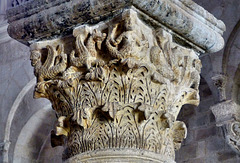
Bitonto - Concattedrale di Bitonto
| |
|
|
Bitonto, today a city of a population of about 55000, was probably founded by Greek settlers. Traces of a city wall dating to the 5th and 4th century BC were found. Legends tell that the name Bitonto is connected to an Illyrian king named Botone. Later "Civitas Butuntinenses" became a self-governing Roman municipium,
A Paleochristian basilica existed very early. During the 9th century, Bitonto successfully withstood a Saracen raid but got destroyed by Byzantine troops in 975. The Normans took over Apulia. In the 11th and 12th century. Under the rule of the Normans of Roger II of Sicily, William I of Sicily (aka William the Wicked) and William II of Sicily (aka William the Good), the city prospered and got new walls.
In 1227, Bitonto was the scene of ex-communication of Frederick II accused by pope Gregory IX of having come to terms with the sultan al-Malik al-Kamil.
-
The Bitonto Cathedral, dedicated to San Valentino, was erected 1175/1200 in the centre of the city. The construction was probably influenced by the "Basilica of San Nicola" in Bari and was done in the typical "Apulian Romanesque" style.
It is proven that the bishopric existed in 1089, though the crypt of the cathedral has remains of a 5th-century church.
This capital is densely populated with mythical creatures. Mermaids, Griffins and winged creatures with human heads, covered with scales.
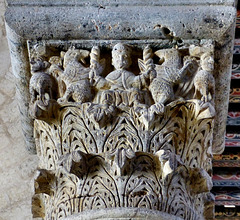
Bitonto - Concattedrale di Bitonto
| |
|
Bitonto, today a city of a population of about 55000, was probably founded by Greek settlers. Traces of a city wall dating to the 5th and 4th century BC were found. Legends tell that the name Bitonto is connected to an Illyrian king named Botone. Later "Civitas Butuntinenses" became a self-governing Roman municipium,
A Paleochristian basilica existed very early. During the 9th century, Bitonto successfully withstood a Saracen raid but got destroyed by Byzantine troops in 975. The Normans took over Apulia. In the 11th and 12th century. Under the rule of the Normans of Roger II of Sicily, William I of Sicily (aka William the Wicked) and William II of Sicily (aka William the Good), the city prospered and got new walls.
In 1227, Bitonto was the scene of ex-communication of Frederick II accused by pope Gregory IX of having come to terms with the sultan al-Malik al-Kamil.
-
The Bitonto Cathedral, dedicated to San Valentino, was erected 1175/1200 in the centre of the city. The construction was probably influenced by the "Basilica of San Nicola" in Bari and was done in the typical "Apulian Romanesque" style.
It is proven that the bishopric existed in 1089, though the crypt of the cathedral has remains of a 5th-century church.
This capital, located on the right side of the nave, depicts Alexander the Great.
A legend in the Alexander romance had Alexander, wishing to see the whole world from above. To do this he harnessed two large birds (or Griffins) with a seat for him between them. To entice them to keep flying higher he placed meat (some say "roasted puppies") on two skewers which he held above their heads.
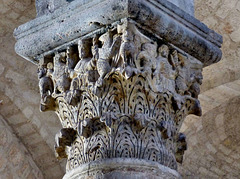
Bitonto - Concattedrale di Bitonto
| |
|
Bitonto, today a city of a population of about 55000, was probably founded by Greek settlers. Traces of a city wall dating to the 5th and 4th century BC were found. Legends tell that the name Bitonto is connected to an Illyrian king named Botone. Later "Civitas Butuntinenses" became a self-governing Roman municipium,
A Paleochristian basilica existed very early. During the 9th century, Bitonto successfully withstood a Saracen raid but got destroyed by Byzantine troops in 975. The Normans took over Apulia. In the 11th and 12th century. Under the rule of the Normans of Roger II of Sicily, William I of Sicily (aka William the Wicked) and William II of Sicily (aka William the Good), the city prospered and got new walls.
In 1227, Bitonto was the scene of ex-communication of Frederick II accused by pope Gregory IX of having come to terms with the sultan al-Malik al-Kamil.
-
The Bitonto Cathedral, dedicated to San Valentino, was erected 1175/1200 in the centre of the city. The construction was probably influenced by the "Basilica of San Nicola" in Bari and was done in the typical "Apulian Romanesque" style.
It is proven that the bishopric existed in 1089, though the crypt of the cathedral has remains of a 5th-century church.
This capital, located on the right side of the nave, depicts Alexander the Great.
A legend in the Alexander romance had Alexander, wishing to see the whole world from above. To do this he harnessed two large birds (or Griffins) with a seat for him between them. To entice them to keep flying higher he placed meat (some say "roasted puppies") on two skewers which he held above their heads.

Coimbra - Sé Velha
| |
|
|
A Roman settlement, named "Aeminium" existed here. When the neighbouring town "Conimbriga" got conquered and destroyed by the Suebes in 468, the survivors moved to "Aeminium" - and renamed it. The Visigoths under King Wittiza named the town "Eminio" later. In 714 the town was conquered by Muslim troops, who changed the name again.
Coimbra was finally recaptured in 1064 by King Fernando de Castilla y León. Coimbra became the second capital of the Kingdom of Portugal (after Guimarãesin) 1139, a status that moved to Lisbon in 1256. The University of Coimbra, founded by Denis of Portugal (aka "Dom Dinis") in 1290, is one of the oldest in Europe.
"Sé Velha" is the old Cathedral of Coimbra. Erected mid 12th century, this was the bishopric until the seat was moved in 1772 to the new cathedral "Sé Nova". The erection of the cathedral is attributed to Master Robert and Master Bernhard, who probably came from France. One of the many hints about the masters´ origin are the capitals and corbels of the apse. This is one of them, depicting two fighting chimares (bird/dog) entangled by vines.

Coimbra - Sé Velha
| |
|
|
A Roman settlement, named "Aeminium" existed here. When the neighbouring town "Conimbriga" got conquered and destroyed by the Suebes in 468, the survivors moved to "Aeminium" - and renamed it. The Visigoths under King Wittiza named the town "Eminio" later. In 714 the town was conquered by Muslim troops, who changed the name again.
Coimbra was finally recaptured in 1064 by King Fernando de Castilla y León. Coimbra became the second capital of the Kingdom of Portugal (after Guimarãesin) 1139, a status that moved to Lisbon in 1256. The University of Coimbra, founded by Denis of Portugal (aka "Dom Dinis") in 1290, is one of the oldest in Europe.
"Sé Velha" is the old Cathedral of Coimbra. Erected mid 12th century, this was the bishopric until the seat was moved in 1772 to the new cathedral "Sé Nova". The erection of the cathedral is attributed to Master Robert and Master Bernhard, who probably came from France.
In the 16th century there were many additions made to the cathedral, but the western portal is still Romanesque and has some nice capitals. Here is one of them. Two bird-chimarae killing two lions - symmetrically and simultaneously. In the upper left corner is a little sign, that looks like a snail shell. Probably a mason's mark.

Coimbra - Sé Velha
| |
|
A Roman settlement, named "Aeminium" existed here. When the neighbouring town "Conimbriga" got conquered and destroyed by the Suebes in 468, the survivors moved to "Aeminium" - and renamed it. The Visigoths under King Wittiza named the town "Eminio" later. In 714 the town was conquered by Muslim troops, who changed the name again.
Coimbra was finally recaptured in 1064 by King Fernando de Castilla y León. Coimbra became the second capital of the Kingdom of Portugal (after Guimarãesin) 1139, a status that moved to Lisbon in 1256. The University of Coimbra, founded by Denis of Portugal (aka "Dom Dinis") in 1290, is one of the oldest in Europe.
"Sé Velha" is the old Cathedral of Coimbra. Erected mid 12th century, this was the bishopric until the seat was moved in 1772 to the new cathedral "Sé Nova". The erection of the cathedral is attributed to Master Robert and Master Bernhard, who probably came from France.
In the 16th century there were many additions made to the cathedral, but the western portal is still Romanesque and has some nice capitals. Here is one of them. Two bird-dog-snake chimarae. Above the couple is a mason's mark.
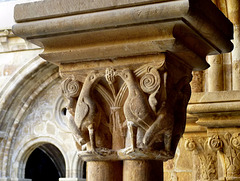
Coimbra - Sé Velha
| |
|
A Roman settlement, named "Aeminium" existed here. When the neighbouring town "Conimbriga" got conquered and destroyed by the Suebes in 468, the survivors moved to "Aeminium" - and renamed it. The Visigoths under King Wittiza named the town "Eminio" later. In 714 the town was conquered by Muslim troops, who changed the name again.
Coimbra was finally recaptured in 1064 by King Fernando de Castilla y León. Coimbra became the second capital of the Kingdom of Portugal (after Guimarãesin) 1139, a status that moved to Lisbon in 1256. The University of Coimbra, founded by Denis of Portugal (aka "Dom Dinis") in 1290, is one of the oldest in Europe.
"Sé Velha" is the old Cathedral of Coimbra. Erected mid 12th century, this was the bishopric until the seat was moved in 1772 to the new cathedral "Sé Nova". The erection of the cathedral is attributed to Master Robert and Master Bernhard, who probably came from France. Around 1218 the building of the cloister, adjoining "Sé Velha", started. Many of the cloister´s capitals are still complete. This one depicts two birds, nibbling a fruit. Maybe an "open" pomegranate, cannot be maize..
Porto - Cathedral
| |
|
Porto is with a population of about 250.000 the largest city in Northern Portugal. In "Greater Porto", the metropolitan area, live even more than 1.7 million people.
The historical center of Porto was proclaimed a World Heritage Site by UNESCO in 1996. Port wine is named after Porto, since the cellars of Vila Nova de Gaia on the southern banks of the river Douro are the centers for packaging, transport and export of the fortified wine. Some years ago I had been here for a couple of days before I started the "Camino Portugues" here.
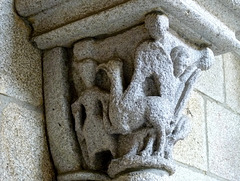
The construction of the dominating Porto Cathedral (Sé do Porto) began around 1100 and was completed more than 2 centuries later. Though it underwent different alterations over the centuries (gothic, baroque), the romanesque structure of the once fortified church is still clearly visible.
The gothic cloister was added end of the 14th century. This Romanesque capital outside the church survived all the "modernisations". What bird is this? An ostrich?
Bouhet - Saint-Laurent
| |
|
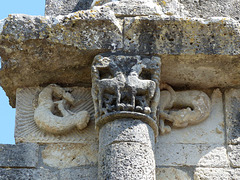
The parish church of Bouhet was erected within the 12th/13th century. It was the church of a priory dependent on the abbey of Saint-Jean de Montierneuf in Poitiers. The church was terribly mutilated during the Wars of Relegions and so only a few parts of the Romanesque structure survived and can be seen today.
When it was tried to "rebuilt what was left of the the church after the destruction, it was not possible to put back the carvings "in situ", as most of the church was just gone.
Here is an acrobat, two beasts on the capital in the center and (half of) a lion, chewing the tail.
Mont Sainte-Odile Abbey
| |
|
Mont Sainte-Odile Abbey (aka "Hohenburg Abbey") was founded by Adalrich, Duke of Alsace, around 690. First abbess of the nunnery was his daughter Sainte Odile (aka "Odile of Alsace"), who by now is the patron saint of the Alsace, making the abbey today to a place of pilgrimage in the area. Second abbess of the monastery btw was Adalrich´s grand daughter Eugenia. Early nunneries often are family affairs e.g. Freckenhorst, Gandersheim..
The monastery got damaged, destroyed and looted a couple of times. After the French Revolution it got sold - and finally in 1853 the catholics of the Alsace had collected enough money, to buy it back - and present the buildings to the Bishop of Strassburg.
Only a few structures of the monastery, constructed within the 12th century after the older buildings burnt down, have survived the times.
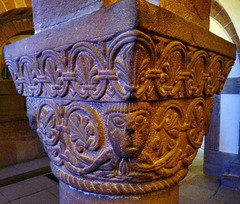
One that still exists after more than 800 years is the baptistry (aka "Holy Cross Chapel"). This room is dominated by this massive central pillar. This is the capital of this central pillar. The very geometric floral decorations and vines remind a bit on the tympanon in Murbach (60kms south), but the four heads on the corners seem kind of "rough".
Left in a niche (barely to be seen on the photo) is the sarcophag of Adalrich and his wife Bereswinde.
Rosheim - Saints-Pierre-et-Paul
| |
|
The construction of the "Église Saints-Pierre-et-Paul" started around 1150. The church is known for the carvings. Some of them is really fantastic.
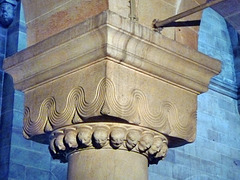
A really breathtaking carving is just under this capital, decorated with a very symmetrical wave.
There is a ring, going all around the pillar, consisting out of 21 human heads. All these 21 faces have a different look, a different facial expression. All have nimbuses, so to be seen here are 21 saints. The carving is so delicate, the composition is so perfect, that these faces seem to be younger, than the other carvings. The same impression, that I had, when I saw the huge figures sitting on the roof. But neither them, nor these are younger. This ring was carved probably before 1200. Even Robert Will was surprised. In "Alsace romane" (Éditions Zodiaque) he points out, that these are the romanesque originals - and not "copies" done later.
The mastercarver, who did this chain of faces, choose the seize of the heads to create exactly 21 faces for the whole circle.
I think he choose 21, as this is 7 multliplied by 3.
3 (God) plus 4 (world). = 7
God + World x God. = 21
Well, that´s not more than a meager theory! Or - maybe - his wife just had her 21. birthday. That would be another theory.

Lavaudieu - Abbaye Saint-André
| |
|
|
|
A settlement named "Comps" was known here since 909. Around 1050 the church and land of Comps were endowed to the Abbaye de la Chaise-Dieu by Raoul de Lugeac. The important Abbaye de la Chaise-Dieu, founded by Saint Robert de Turlande, had about 300 monks at that time. It was decided to found a nunnery here as a priory.
The construction of the cloister and the convent buildings took place between 1052 and 1058, as the nuns moved in already in 1058. In 1487 the name was changed from Comps to Lavaudieu ("Valley of God"), so the nunnery became "Priory Saint-André Lavaudieu". After 1516 the matrons were ordered by the king and were no longer elected by the monastery community, so the strict rules of the order relaxed. In 1718 the former priory became an abbey and at the beginning of the Revolution 13 nuns lived here, all daughters of regional nobles. They were expelled and the abbey was sold. Most of the buildings were used for agriculture, large parts of the convent building were demolished. Meanwhile, the still existing buildings are carefully restored.
When I visited Lavaudieu the first time, church and cloister were locked. This time I had more luck. The church was open, only the cloister was locked!
The church has frescoes of which most were uncovered and restored between 1965 and 1980. Some of them are dated 1315 by an inscription.
This capital, depicting Adam and Eve, is older. Adam has a pretty large navel!

Brindisi - San Giovanni al Sepolcro
| |
|
Settlers, who did trade with Greece, lived here already during the Bronze Age. After the Punic Wars, it became a major center of Roman naval power and maritime trade. After the decline of the Roman Empire Brindisi was conquered by Ostrogoths, and reconquered by the Byzantine Empire in the 6th century. In 674 it was destroyed by the Lombards led by Romuald I of Benevento, It was rebuilt and within the 9th century. It was under the Saracen rule from 836 to 868, when it was retaken by the Byzantines. In 1070, it was conquered by the Normans, led by Robert Guiskard.
Brindisi flourished under the Staufer and developed into a privileged port for the Holy Land during the period of the Crusades. It was an Episcopal See and a new cathedral was constructed, in which the wedding of Norman Prince Roger III of Sicily and Irene Angelina, daughter of the Byzantine Emperor Isaac II Angelos took place.
Emperor Frederick II and Isabella of Brienne embarked from the port of Brindisi in 1228 for the Sixth Crusade.
The round-shaped church was built by the Templars on their return from the Holy Land in 11C. Traditions know, that it was erected at the behest of Norman prince Bohemond.
It recalls the Church of the Holy Sepulchre in Jerusalem. This was a place of pilgrimage, controlled by the Order of Canons of the Holy Sepulcher. In fact, for those who arrived, the building was an advance of that of Jerusalem while for those who returned, a memory.
In 1489 Pope Innocent VIII declared the Order of Canons of the Holy Sepulcher to be extinct and decreed that its assets be transferred to the Order of the Hospital of San Giovanni in Jerusalem and Rhodes.
In 1761 an earthquake destroyed most of Brindisi, the Church of San Giovanni al Sepolcro did not collapse but suffered considerable damage. This led to a long decay and the loss of 80% of the frescoed surface, until the restoration in the mid-nineteenth century which led it to serve as the temporary seat of the Civic Museum from 1850 to 1955. Excavations inside the building found ancient remains from the Roman era, including the floor of a Roman domus.
The people on the capital are holding hands and dancing. Is this where the well-dressed Bohemond celebrates his lucky homecoming from the crusade?
I have already uploaded many photos taken in Brindisi during previous visits, so I will only upload a few. If you want to see more, click here:
www.ipernity.com/doc/323415/album/1333376
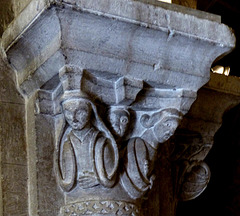
Matera - San Giovanni Battista
| |
|
The original settlement of Matera lies in two canyons carved by the Gravina River. This area, the Sassi di Matera, is a complex of cave dwellings carved into the ancient river canyon. The settlement is divided into the districts of Sasso Barisano and Sasso Caveoso.
The cave settlements in the area are an exceptional example in the Mediterranean area. Inhabited since the Neolithic Age, Matera can be considered one of the oldest cities in the world.
According to Greek, Roman, Langobard, and Byzantine history, which Matera shares with all of southern Italy, Saracens devastated the place in 938. It came under Norman rule in 1043, became a royal seat, and thus achieved considerable wealth. This bloom continued under the subsequent regiments of the Staufer and Anjou, and in 1270 the cathedral of Matera was completed.
Already by the late 1800s, Matera's cave dwellings became noted for intractable poverty, poor sanitation, meager working conditions, and rampant disease. In 1948, when the city was hit by malaria, 15,000 people lived in 3,300 rooms. From the 1950s on the residents were relocated to newly built apartment blocks. Since the Sassi are now a museum town, tourism is also becoming increasingly important.
Known as la città sotterranea ("the underground city"), the Sassi and the park of the Rupestrian Churches were named a UNESCO World Heritage Site in 1993. In 2019, Matera was declared a European Capital of Culture.
Today Matera has a population of about 60.000, who live in the city "above" the sassi. Dozens of small rock-hewn chapels, churches, and former hermitages are carved into the rocks here.
In 1215, nuns in Matera from the Kingdom of Acre and, in 1220, they were granted the chapel of Santa Maria la Nova, previously a Benedictine establishment. In 1229, they began work on a new church as a replacement for this chapel. This was completed in 1236. In 1480, at the time of the Ottoman invasion of Otranto, the nuns abandoned the church, which lay outside the city walls.
In 1695, due to the poor state of the nearby parish church, the archbishop of Matera and Acerenza transferred the parish to the abandoned 13th-century church. At the end of the 18th century, due to the deterioration of the three domes over the transept, they were demolished and replaced with vaults. To help contain the thrust of the new superstructure, the façade was lined with a series of arches, leaving visible the original 13th-century portal.
The floor plan is that of a Latin cross with a central nave.
Most of the Romanesque capitals survived the centuries.
Since I have already uploaded many photos from Matera from previous trips, I will only add a few now.
If you want to see more photos from Matera, click here:
www.ipernity.com/doc/323415/album/1334046

Ferrara - Cattedrale di San Giorgio
| |
|
|
|
Ferrara appears first in a document of the Lombard king Desiderius of 753 when he captured the town from the Exarchate of Ravenna. Later the Franks, after routing the Lombards, presented Ferrara to the Papacy in 754. In 988 Ferrara was ceded by the Church to the House of Canossa, but at the death of Matilda of Tuscany in 1115, it became a free commune. During the 12th century, the history of the town was marked by the wrestling for power between the Guelph Adelardi and the Ghibelline Salinguerra families. The Ghibellines won and in 1264 Obizzo II d'Este was proclaimed lifelong ruler of Ferrara. His rule marked the end of the communal period in Ferrara and the beginning of the Este rule, which lasted until 1598.
The construction of the Cattedrale di San Giorgio began in the early 12th century when the city was taken by Matilda of Tuscany (aka "Matilde di Canossa"). When the new cathedral was consecrated in 1135 it was not completed at all.
The lower part of the facade is Romanesque was probably built in the first half of the 11th century. The building process was continued a century later in Gothic style.
The campanile was added to the cathedral in the second half of the 15th century, but never got completed.
A "renovation" of the Ferrara Cathedral done in the early 18th century resulted in a demolition. Only the facade and the outer walls survived. The medieval interior (five aisles) and the five apses, that once existed are lost. Seen from this side is the 18th-century structure built into the old walls.
Two creatures fight for the space on the capital.

Lügde - St. Kilian
| |
|
|
Lügde was first mentioned in 784 in the "Annales Regni Francorum" ("Royal Frankish Annals") when Charlemagne celebrated his first Christmas in what was then the Duchy of Saxony, namely in "Villa Liuhidi". At that time a small, wooden church probably existed. It may have been built outside the settlement on a previous thing-place, at the time of the first Saxon Wars. This was, where Charlemagne celebrated the Christmas mass.
The foundations of this early church were found during excavations, undertaken in and around the Romanesque church dedicated to St. Kilian. The oldest part of St. Kilian, a cruciform vaulted basilica, is the tower, built around 1100 and raised by 1200. Nave and choir were built at the end of the 12th century.
Here is another of the massive capitals.
Following the theory (see the previous upload) this capital depicts Yggdrasil symbolising the whole kosmos.
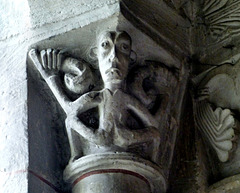
Le Blanc - Saint-Cyran
| |
|
|
Le Blanc is located on the border of Berry, Poitou and Touraine and could "guard" a ford to cross the Creuse. The river actually divided Le Blanc into a "lower town" (Berry) and an upper town shared between Berry and Poitou.
There were two border-fortresses here. Saint-Cyran in the upper town was erected in the 12th century right next to the Château de Naillac, served as a castle chapel and was included in the fortified enclosure.
The church got remodelled and enlarged in Gothic times.
This capital is clearly rougher and older than the previous one. A "Master of Beasts" holding snakes?
Brindisi - San Giovanni al Sepolcro
| |
|
Settlers, who did trade with Greece, lived here already during the Bronze Age. After the Punic Wars it became a major center of Roman naval power and maritime trade. After the decline of the Roman Empire Brindisi was conquered by Ostrogoths, and reconquered by the Byzantine Empire in the 6th century. In 674 it was destroyed by the Lombards led by Romuald I of Benevento, It was rebuilt and within the 9th century. It was under Saracen rule from 836 to 868, when it was retaken by the Byantines. In 1070, it was conquered by the Normans, led by Robert Guiskard.
Brindisi flourished under the Staufer and developed into a privileged port for the Holy Land during the period of Crusades. It was an Episcopal See and a new cathedral was constructed, in which the wedding of Norman Prince Roger III of Sicily and Irene Angelina, daughter of the Byzantine Emperor Isaac II Angelos took place.
Emperor Frederick II and Isabella of Brienne embarked from the port of Brindisi in 1228 for the Sixth Crusade.
-
The round-shaped church was built by the Templars on their return from the Holy Land in the 11C. Traditions know, that it was erected on behest of Norman prince Bohemond .
It recalls the Church of the Holy Sepulchre in Jerusalem. This was a place of pilgrimage, controlled by the Order of Canons of the Holy Sepulcher. In fact, for those who arrived, the building was an advance of that of Jerusalem while for those who returned, a memory.
In 1489 Pope Innocent VIII declared the Order of Canons of the Holy Sepulcher to be extinct and decreed that its assets be transferred to the Order of the Hospital of San Giovanni in Jerusalem and Rhodes.
In 1761 an earthquake destroyed most Brindisi, the Church of San Giovanni al Sepolcro did not collapse but suffered considerable damage. This led to a long decay and the loss of 80% of the frescoed surface, until the restoration in the mid-nineteenth century which led it to serve as the temporary seat of the Civic Museum from 1850 to 1955. Excavations inside the building found ancient remains from the Roman era, including the floor of a Roman domus.
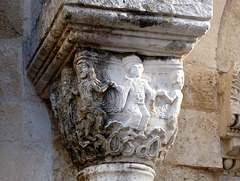
The portal´s left capital depicts dancers. In the center a very well dressed person, dancing on a kind of stage (see the curtain behind).
Jump to top
RSS feed- Latest items - Subscribe to the latest items added to this album
- ipernity © 2007-2025
- Help & Contact
|
Club news
|
About ipernity
|
History |
ipernity Club & Prices |
Guide of good conduct
Donate | Group guidelines | Privacy policy | Terms of use | Statutes | In memoria -
Facebook
X
