


Romanesque Capitals

and corbels as well
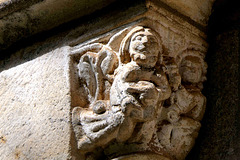
Parada de Sil - Monasterio de Santa Cristina
| |
|
The Benedictine monastery has its origins in the 10th century. Century. It was initially an independent monastery and, from around the 16th century, a priory dependent on the monastery of San Esteban de Ribas de Sil. In the Middle Ages, it was one of the most important monasteries in the Ribeira Sacra. The monks cultivated chestnut trees and vines. The confiscation meant the complete abandonment of the village.
The Romanesque church from the end of the 12th century has been preserved. It has the floor plan of a Latin cross.
Capital
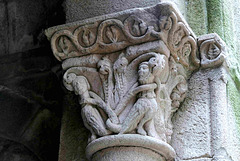
Parada de Sil - Monasterio de Santa Cristina
| |
|
The Benedictine monastery has its origins in the 10th century. Century. It was initially an independent monastery and, from around the 16th century, a priory dependent on the monastery of San Esteban de Ribas de Sil. In the Middle Ages, it was one of the most important monasteries in the Ribeira Sacra. The monks cultivated chestnut trees and vines. The confiscation meant the complete abandonment of the village.
The Romanesque church from the end of the 12th century has been preserved. It has the floor plan of a Latin cross.
Capital
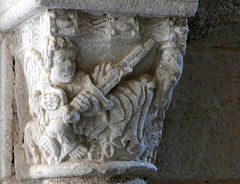
Santo Estevo de Ribas de Sil
| |
|
|
Santo Estevo de Ribas de Sil is a former Benedictine monastery. The ensemble of buildings, in which three cloisters have been preserved, is now used as a Parador hotel.
The first monastery probably already existed in Visigothic times. At the beginning of the 10th century, a hermit settled in the abandoned monastery and founded a new community with other hermits who had retreated to the Sil Valley. The Galician king Ordoño II granted privileges and from 921 the monastery was rebuilt and dedicated to St Stephen. The monastery's coat of arms, which depicts nine mitres, commemorates nine bishops who renounced their episcopal see in the 10th and 11th centuries and retired to the monastery of Santo Estevo. They were buried in the monastery and, as they were venerated as saints, their tombs soon attracted pilgrims.
As there were frequent disputes with the local landlords among the later commendatory abbots, Pope Julius II placed the monastery under the Benedictine Congregation of Valladolid in 1506. As a result, a school of liberal arts and philosophy was established in Santo Estevo and the monastery experienced a new period of prosperity.
Two more cloisters and new monastery buildings, a chapter house, a large kitchen and a dining hall as well as dormitories were built. In the 17th century, 60 monks lived there.
After the disamortisation of 1835, the monastery buildings fell into disrepair and were only restored at the end of the 20th century.
Capital
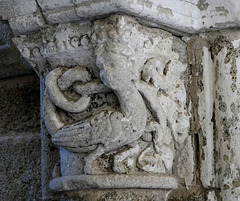
Santo Estevo de Ribas de Sil
| |
|
|
Santo Estevo de Ribas de Sil is a former Benedictine monastery. The ensemble of buildings, in which three cloisters have been preserved, is now used as a Parador hotel.
The first monastery probably already existed in Visigothic times. At the beginning of the 10th century, a hermit settled in the abandoned monastery and founded a new community with other hermits who had retreated to the Sil Valley. The Galician king Ordoño II granted privileges and from 921 the monastery was rebuilt and dedicated to St Stephen. The monastery's coat of arms, which depicts nine mitres, commemorates nine bishops who renounced their episcopal see in the 10th and 11th centuries and retired to the monastery of Santo Estevo. They were buried in the monastery and, as they were venerated as saints, their tombs soon attracted pilgrims.
As there were frequent disputes with the local landlords among the later commendatory abbots, Pope Julius II placed the monastery under the Benedictine Congregation of Valladolid in 1506. As a result, a school of liberal arts and philosophy was established in Santo Estevo and the monastery experienced a new period of prosperity.
Two more cloisters and new monastery buildings, a chapter house, a large kitchen and a dining hall as well as dormitories were built. In the 17th century, 60 monks lived there.
After the disamortisation of 1835, the monastery buildings fell into disrepair and were only restored at the end of the 20th century.
Capital
Santo Estevo de Ribas de Sil
| |
|
Santo Estevo de Ribas de Sil is a former Benedictine monastery. The ensemble of buildings, in which three cloisters have been preserved, is now used as a Parador hotel.
The first monastery probably already existed in Visigothic times. At the beginning of the 10th century, a hermit settled in the abandoned monastery and founded a new community with other hermits who had retreated to the Sil Valley. The Galician king Ordoño II granted privileges and from 921 the monastery was rebuilt and dedicated to St Stephen. The monastery's coat of arms, which depicts nine mitres, commemorates nine bishops who renounced their episcopal see in the 10th and 11th centuries and retired to the monastery of Santo Estevo. They were buried in the monastery and, as they were venerated as saints, their tombs soon attracted pilgrims.
As there were frequent disputes with the local landlords among the later commendatory abbots, Pope Julius II placed the monastery under the Benedictine Congregation of Valladolid in 1506. As a result, a school of liberal arts and philosophy was established in Santo Estevo and the monastery experienced a new period of prosperity.
Two more cloisters and new monastery buildings, a chapter house, a large kitchen and a dining hall as well as dormitories were built. In the 17th century, 60 monks lived there.
After the disamortisation of 1835, the monastery buildings fell into disrepair and were only restored at the end of the 20th century.
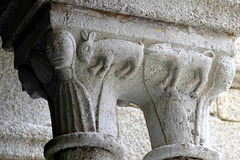
Capital / Two pilgrims and between them a Coquille Saint-Jacques and a gof
Narrow side - Two pilgrims and a Coquille Saint-Jacques
Broad side - A dog hunting a hare
Sant Joan de les Abadesses - Monastery
| |
|
The monastery was founded in 885 by Wilfred the Hairy as one of the first nunneries in Catalonia. First abbess here was his daughter Emma. At that time her brother Radulf was abbot in nearby Ripoll, where Wilfred had founded a monastery as well. A family business!
The church of the nunnery was consecrated in 887, but already in 1017, by request of Bernard I of Besalú, a papal bull suppressed the nunnery. Bernard then established a community of monks. In 1114 Augustinian canons took possession of the monastery, ruled by local abbots until 1484. In 1592 the monastery was secularized and converted into a simple collegiate that was given up in 1856.
The current church dates back to the 12th century, though it got largely restored after an earthquake in 1428. It has a single nave, a wide transept and five apses.
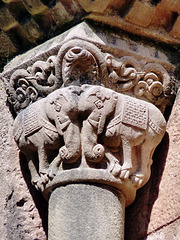
A capital of the extraordenary decorated central apse depicts elephants, a very rare species on medieval capitals. The elephants, seen here, are pretty "exact" and realistic. The ratio body/head and head/trunk is very well, only the ears are missing and the feet look strange.
The first elephant, who is recorded in Europe (after Roman times), was Abul Abbas, presented to Charlemagne by Harun al-Rashid. Abul Abbas reached Aix-la-Chapelle in 802.
The second elephant recorded is the "Cremona Elephant", presented by Sultan Al-Kamil to Frederick II, Holy Roman Emperor, in 1229.
In 1255 Louis IX of France (aka "Saint Louis") brought an elephant home from the 6th cruisade. This one was given to Henry III of England and died in London in 1258.
So during the 12th century, when this capital was carved, there was no elephant in Europe, what has led to the speculation, to see these elephants as carved by moorish carvers, who may have had different experiences/backgrounds.
Brioude - Saint-Julien
| |
|
The Basilica Saint-Julien in Brioude was a collegiate church constructed between 1060 - 1200. The architectoral structure is influenced by great romanesque churches like "Notre-Dame-Du-Port" in Clermont-Ferrand (70kms north) or "Saint-Austremoine" in Issoire (30kms north), planned and constructed within the same century. Three or four very skilled architects worked here over the century, all witrh a different touch. So Saint-Julien is really special, as it differs from the other great churches of the Auvergne.
Brioude was a center of pilgrimage very early, as already within the 4th century a "martyrion" existed over the grave of St. Julien. This building was replaced by an early basilica, financed by Victorius, a "comes" (count), installed by the Visigothic king Eurich after he had seized the Auvergne. Gregory of Tours (538-594 visited and described it, when he about a pilgrimage to Saint-Julien undertaken yearly from Avernis (= Clermont-Ferrand) to Brioude. Within the 10th century William I, Duke of Aquitaine, (aka "Guillaume Le Pieux" - "William the Pious") funded the building of a larger church here. He got buried in this church in 917. Around 1060, works on the church still seen today started with the narthex. It took about 140 years, to complete it - and was a stopover at that time for many pilgrims to Santiago, only two days (60kms) away from Le Puy (Via Podensis).
There are about 125 capitals and carvings inside Saint-Julien and they all differ in artistic style and quality. Bernard Craplet has found six (!) different workshops, what is not that surprising taking in account that it took more than a century to finish this building. None of the capitals of the nave depicts a biblical theme.
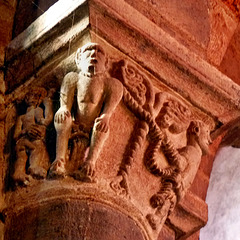
Another "ape/man/rope" capital, but this differs from all the other seen so far within the Auvergne (Droiturier, Besse, Issoire, Thuret, Saint-Nectaire, Clermont-Ferrand, Mozac...). Not the ape on the rope, called "singe cordé" in French, is so much different, but everything around adds some new spice.
Left to the ape stands a man, described by B. Craplet having a "praying gesture". I think, this is a more like a greeting gesture ("Hi").
It is a rough carving, this person may be naked, his legs may be swollen, as if he would suffer from elephantiasis (not a medieval but a tropical disease). I see kind of a cripple, displayed in public (later done in "Freakshows"). I may be wrong, and B. Craplet is right, who wrote, that this capital is from mediocre workmanship.
Any way, there is the ape on the rope - and a "strange person" on the left. To the right a very decorative tree, but taking a closer look makes clear, these are two trees. Futher right the man holding the rope, probably the owner of the "beast" - and further right, the "show" goes on...
Morlaàs - Sainte-Foy
| |
|
In 1080, when Morlaàs was in its heydays, the building of this church started by Centulle V, Viscount of Béarn, who had to make an atonement.
Morlaàs developed to an important "étape" on the Via Tolosana at that time. As the church was dedicated to St. Foy there was a kind of "link" to Conques. Later the pilgrimage business declined, the viscounts had moved away, wars arose.... The church burnt down in 1520, got severely damaged in 1569. During the French Revolution the church turned to a "Temple of Reason". The restorations of the 19th century saved the structure.
Viollet-le-Duc, the influential "Inspecteur général des Edifices Diocésains" led the restoration of the portal. At all places, where he worked (eg "Carcasonne", "Vézelay"), he "recreated" and creatively "completed", what is a method, that is disputed meanwhile. The condition of the portal is a result of this restoration. After the cleaning done in the last years and the installation of pigeon-defence-wires, the carvings are "mint".
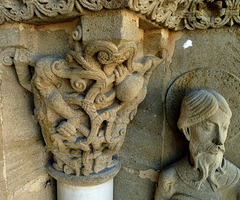
The entrance doors are flanked by pillars and large sculptures of the apostles on either side. Another capital, next to an apostle´s head has another jungle. Other than the previous seen capital, where creeping creatures seem to play in the vines, here are humans caught by the entwined vines.
Aulnay - Saint-Pierre
| |
|
|
"Saint-Pierre d'Aulnay" is a church outside of Aulnay, in the center of an old graveyard. The setting has not changed for centuries. For the pilgrims of the 12th century this church was a major halt - and it still is for all the tourists...
A predecessing church „Saint-Pierre-de-la-Tour“ had been here, that, when the pilgrimage to Santiago de Compostella got more and more popular, was obviously to small, as Aulnay was conveniently situated between Poitiers and Saintes on the Via Turonensis. A new, larger church was needed, so the place was handed over to the chapter of the cathedral in Poitiers. The canons then probably planned this church, that was erected from about 1130/1140 on.
"Saint-Pierre d'Aulnay" is a gem of the "style saintongeais". For Peter Strafford ("Romanesque Churches Of France") this is "one of the best examples of late Romanesque architecture in what used to be Aquitaine".
Not only the exterior of Saint-Pierre is decorated with many wonderful works of art, the carved capitals of the nave, are extraordenary as well.
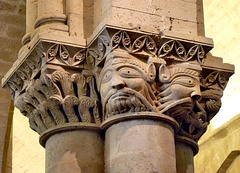
A very symmetrical capital with two grotesque giant heads. They have perfectly combed beards, but very strange eyes and ears.
This capital again seems in such a mint condition, that it may have been "renovated" during the 19th century. Paul Abadie, later known as the architect of "Sacré-Coeur de Montmartre" and strongly influenced by Viollet-le-Duc, worked here.

Aulnay - Saint-Pierre
| |
|
"Saint-Pierre d'Aulnay" is a church outside of Aulnay, in the center of an old graveyard. The setting has not changed for centuries. For the pilgrims of the 12th century this church was a major halt - and it still is for all the tourists...
A predecessing church „Saint-Pierre-de-la-Tour“ had been here, that, when the pilgrimage to Santiago de Compostella got more and more popular, was obviously to small, as Aulnay was conveniently situated between Poitiers and Saintes on the Via Turonensis. A new, larger church was needed, so the place was handed over to the chapter of the cathedral in Poitiers. The canons then probably planned this church, that was erected from about 1130/1140 on.
"Saint-Pierre d'Aulnay" is a gem of the "style saintongeais". For Peter Strafford ("Romanesque Churches Of France") this is "one of the best examples of late Romanesque architecture in what used to be Aquitaine".
This capital - for me - is the most interesting in Aulnay, as three elephants have gathered around the capital. Decades ago during my first year at university I wrote an essay on "Medieval Elephants".
The first elephant, who is recorded in Europe (after Roman times), was Abul Abbas, presented to Charlemagne by Harun al-Rashid. Abul Abbas reached Aix-la-Chapelle in 802.
The second elephant, recorded in medieval times, was the Cremona-elephant, a present from Al Kamil to Frederik II in 1229.
There was no elephant in Europe between 810 and 1229. This carving is based on a myth about a giant animal living "somewhere". To tell the onlookers, what was to be seen, it got an inscription: "Hi(c) sunt elephan(tes)".
The elephants here have tiny ears and very "uncommon" feet, but otherwsie they are pretty "precise".
In case you want to see more medieval elephants, just follow the links:
www.flickr.com/photos/martin-m-miles/sets/72157627646092224/
www.flickr.com/photos/martin-m-miles/galleries/page2/
Saint-Georges-des-Agoûts - Saint-Georges
| |
|
|
Saint-Georges, the parish church of the village Saint-Georges-des-Agoûts (pop ~250) dates back to the 12th century. It got enlarged by an additional aisle in the 16th century.
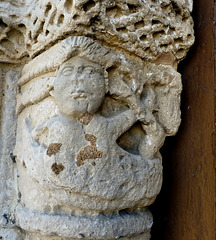
The portal may have altered over the time, but the carvings all around the wooden door are 12th century. Here is the left capital. Two large mermaids, holding each other by the ears. Unfortunately the door is directly behind the capital, so that the right side is only visible, when the door is wide open.
Noailhac - Saint-Pierre-ès-Liens
| |
|
|
"Saint-Pierre-ès-Liens" ("Saint Peter in Chains") is the parish church of Noailhac. The erection of the church started in the 12th century and was probably completed soon after.
The church got partly destroyed during the Hundred Years War, so the nave was rebuilt later in a simple Gothic style, that again suffered damage during the French Revolution.
Large parts of choir of Saint-Pierre-ès-Liens is still Romanesque - and there are some extraordinary capitals.
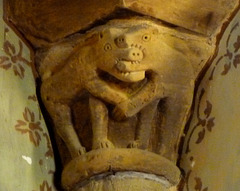
After having found Japanese sumotori on a medieval capital in this small church (see previous upload) I had contemplated about seers, visionaries and wormholes. The same gifted mason created this capital, depicting two dogs. It obviously refers to a Joni Mitchell song from the 1980s or the US-Band "Dog Eat Dog", or..
Le Montet - Saint-Gervais et Saint-Protais
| |
|
For centuries this town was known as "Le Montet-aux-Moines" but after the French Revolution the name was shortened.
Archambault II of Bourbon founded a Benedictine monastery here, as a burial ground for himself and his successors. This priory, dependent on Saint-Michel-de-la-Cluse in Piedmont ("Sacra di San Michele" near Turino, Italy) developed well and was soon after one of the largest of the area.
The vast former abbey-church dates to the 12th century, it got modified in the 14th century and severely damaged in 1567, when during the Wars of Religions Huguenot troops burned down and sacked town and convent.
The church was in very bad conditions after the Revolution and in 1871 the large apse, the ambulatory and the radiating chapels were pulled down. The building lost nearly half of its former length. The nave has some extraordinary capitals.
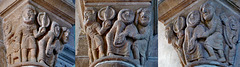
Here is one capital - from three different angles.
From the information given here, I learned, that this capital may depict "Feeding the multitude". Either 5000 (Matthew 14:13-21) or 4000 (Mark 8:1-9) Seen are loaves of bread, handed over by a woman (?) and on the left a man, holding a basket and a fish.
If the person in the center is a woman, I doubt the interpretation.
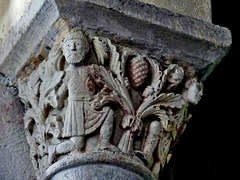
Mozac - Saint-Pierre et Saint-Caprais
| |
|
Mozac Abbey is one of the oldest monasteries in the Auvergne. Dating back into Merovingian times, a legend tells that it was founded by Calminius (later Saint Calmin). He must have been pretty important and well off, as his name is connected to the foundations of three abbeys. He introduced the benedictian rules to the area, and brought (from Rome)a relic of Saint Peter and (from Agen) a relic of Saint Caprasius to Mozac. He got buried in the crypt of this church together with his wife Saint Namadie. Within the 9th century relics of Saint Austremonius, the first bishop of Clermont were transferred to Mozac, so already before Santiago de Compostella was on the map, this was a place of pilgrimage.
In 1095 Mozac abbey got affiliated to Cluny, but was important enough, to have Hugue of Semur, nephew of Hugue of Cluny here as abbot. He was followed by Eustachius, brother of Petrus Venerabilis.
Three churches could be traced by archeologists, what can be seen today is "Mozac 3", a great church built within the first half of the 12th century.
As most of "Mozac 3" got destroyed by a number earthquakes between 1437 and 1490, actually only ruins can be seen. Apses, choir, ambulatory, radial chapels, transept and clerestorys were beyond repair, when the early reconstruction started - in gothic style.
Most pillars and capitals of "Mozac 3" are still in place (in situ). Some / Most of the carvings here are so "perfect", that they seem to be much younger, even baroque, but all are - 12th century - romanesque.
-
Two men, on their knees flank a Y-shaped symmetrical tree / shrub. In the center of this tree / shrub is a fir cone. It could be a grape of course, but the grapes on the other capital are very different.
There is another (probably corresponding) capital depicting two (naked!) men on the knees within "nature".
See here:
www.flickr.com/photos/martin-m-miles/6265924881/
Castelsardo - Concattedrale di Sant'Antonio abate
| |
|
|
The peninsula on which Castelsardo was built, was inhabited already in megalithic times. Some thousands of years later Romans lived here.
The town originates from a castle built in 1102 by the wealthy (and later very powerful and important) Doria family of Genoa. It was named then "Castel Genovese". The Aragonese conquered the place in 1448 and renamed it to "Castillo Aragonés".
The current name "Castelsardo" was given to the town in the 18th century by Charles Emmanuel III of Sardinia, who was Duke of Savoy and King of Sardinia.
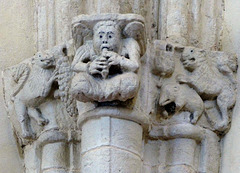
A capital in the "Concattedrale di Sant'Antonio abate".
The capital is placed quite high. The person, who gave the music making angel a "felt pen make up", must have used a ladder.
Narni - Santa Maria Impensole
| |
|
|
The church was erected over an older structure, likely once an ancient Roman Temple. It was probably consecrated in 1175, as there is an inscription with this date over the portal.
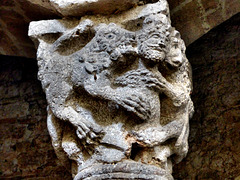
Santa Maria Impensole has a nave an two aisles, subdivided by rounded stone arches with capital with allegorical figures. This capital could well depict Daniel in the lions' den, but the lions seem very aggressive. Maybe this is a martyr before being teared apart and devoured by the lions.
Parma - Duomo di Parma
| |
|
|
Parma, part of the Holy Roman Empire since Charlemagne´s times, was locally ruled by its bishops. During the long Investiture Controversy, Parma was (mostly) member of the Imperial party ("Ghibellini"). Two of Parma´s bishops even became antipopes: Càdalo as Honorius II and Guibert as Clement III.
A paleochristian basilica had existed here in the 6th century. This church burnt down and got replaced in the 9th century by Bishop Wibod. This cathedral was destroyed by fire in 1055.
Bishop Càdalo (= antipope Honorius II) begun the construction of the Duomo di Parma in 1059. The Cattedrale di Santa Maria Assunta got consecrated in 1106, but the new church was heavily damaged by the earthquake in 1117 and had to be restored.
Originally the Duomo was erected on a Latin cross plan, with a nave and two transept arms. Later chapels and structures were added, so by now, the plan is pretty complex.
I had taken some shots of the apse during rain in the afternoon, but returned for some details next morning, when the light was much better.
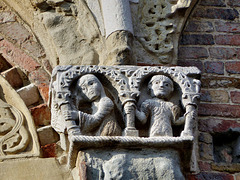
There is a capital (prev. upload) depicting Samson, fighting the lion. This capital may depict the death of Samson, but I am not sure.
Judges 16:29-30
"Then Samson reached toward the two central pillars on which the temple stood. Bracing himself against them, his right hand on the one and his left hand on the other, Samson said, "Let me die with the Philistines!" Then he pushed with all his might, and down came the temple on the rulers and all the people in it. Thus he killed many more when he died than while he lived."
Modena - Duomo di Modena
| |
|
|
In the center of Modena, where the Duomo di Modena (aka "Cattedrale di Santa Maria Assunta e San Geminiano") is placed, churches have existed since the 5th century. After the burial site of Modena's patron Saint Geminianus, a former bishop (+397), was dicovered here, the existing cathedral seemed to small.
The first stone laying for the cathedral of today took place in May 1099, strongly supported by Matilde di Canossa (aka "Matilda of Tuscany"). First architect was Master Lanfranco, descibed as "maestro ingenio clarus [...] doctus et aptus".
The Duomo di Modena was consecrated in 1184, but the building process continued. It was finally completed in 1322.
Many renowned sculptors have worked here. One of them was Anselmo da Campione and over three generations "his" workshop, called the "Campionese-Masters", as most of them came from the area around Campione, today a Italian enclave in Switzerland.
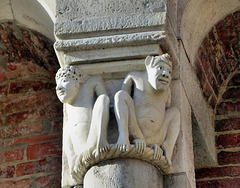
I am not sure, wether one of the "Campionese-Masters" created this capital, but the barber who styled Donald Trump must have seen this capital.
Jump to top
RSS feed- Latest items - Subscribe to the latest items added to this album
- ipernity © 2007-2025
- Help & Contact
|
Club news
|
About ipernity
|
History |
ipernity Club & Prices |
Guide of good conduct
Donate | Group guidelines | Privacy policy | Terms of use | Statutes | In memoria -
Facebook
X
