


Romanesque Capitals

and corbels as well
Civaux - Saint Gervais et Saint Protais
| |
|
|
Civaux, a village with a population of about 1000, has a history rooting very deep. Humans populated the area already, when stepp bisons and mammoths were hunted. Many "pre-historic" artefacts have been excavated in and around Civaux, proving that this place was inhabited over tens of thousands of years.
A settlement stood on the site of the village in Gallo-Roman times, and there are still traces of Roman temples. Excavations have revealed the sites of a theater (capacity 3000), a fortified camp, and the foundations of many villas.
This has been a place of very early christianisation. A funeral stele has been found dating to around 400, a pagan temple and a very early baptisterium were excavated next to the church. A polygonal apse was probably built as will around 400, what actually means that this church, dedicated to Saint Gervais and Saint Protais is one of the oldest in France.
At that time a kind of pilgrimage must have developed. The relics of Saint Gervais and Saint Protais had been miraculously discovered by Saint Ambrose in Milan in 386, so the saints got very popular in Merovingian times, but that does not explain the enigma of Civaux. The village stands in the center of a huge merovingian necropolis.
As many sarcophagi were sold as water basins or troughs in later time, the exact number of graves is unknown. Serious estimations are between 15.000 and 20.000 graves.
There are parallels to nearby Saint Pierre in Cauvigny (16 kms north). The same colours as in Chauvigny were used here during the restauration of the interior. At least one of the capitals is very similar to one in Saint Pierre, but some carvings are absolutely unique. The nave dates back to the 11th century, the apse more than 600 years older.
Thanks to the friendly lady from the Archaeological Museum I could take photos from the gallery of the church. Merci beaucoup!
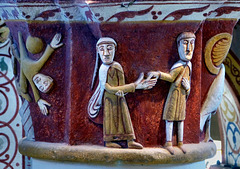
A couple shaking hands.
This carving is pretty unique. It is mostly interpreted as a symbol for marriage. Marriage was recognized as a sacrament in 1184 at the Council of Verona. This capital may be a little older than that. The bride has an enormous long arm and a very large hand.
Note that to the left a person is tumbling.
We will meet him again.
Civaux - Saint Gervais et Saint Protais
| |
|
|
|
Civaux, a village with a population of about 1000, has a history rooting very deep. Humans populated the area already, when stepp bisons and mammoths were hunted. Many "pre-historic" artefacts have been excavated in and around Civaux, proving that this place was inhabited over tens of thousands of years.
A settlement stood on the site of the village in Gallo-Roman times, and there are still traces of Roman temples. Excavations have revealed the sites of a theater (capacity 3000), a fortified camp, and the foundations of many villas.
This has been a place of very early christianisation. A funeral stele has been found dating to around 400, a pagan temple and a very early baptisterium were excavated next to the church. A polygonal apse was probably built as will around 400, what actually means that this church, dedicated to Saint Gervais and Saint Protais is one of the oldest in France.
At that time a kind of pilgrimage must have developed. The relics of Saint Gervais and Saint Protais had been miraculously discovered by Saint Ambrose in Milan in 386, so the saints got very popular in Merovingian times, but that does not explain the enigma of Civaux. The village stands in the center of a huge merovingian necropolis.
As many sarcophagi were sold as water basins or troughs in later time, the exact number of graves is unknown. Serious estimations are between 15.000 and 20.000 graves.
There are parallels to nearby Saint Pierre in Cauvigny (16 kms north). The same colours as in Chauvigny were used here during the restauration of the interior. At least one of the capitals is very similar to one in Saint Pierre, but some carvings are absolutely unique.
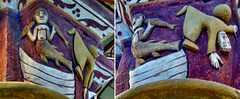
Seen here is only one capital, but as it is close to the wall and I was unable to get the whole "story" into one photo.
A mermaid has entered a small boat (let) and the fisherman is falling overboard (right). The mermaid here stands for lust - and the fisherman stands for the poor sinner, who could not withstand - and now he will fall straight into hell.
Conques - Sainte-Foy
| |
|
|
Conques is a popular stop for all pilgrims traveling the Via Podiensis. This is a treat after having crossed the harsh Aubrac. I had started in Geneva in 2008 and I still remember my feelings, when I reached Conques after some weeks.
A tiny convent existed here already in the 8th century. This grew into a very successful monastery, after the relics of St. Foy arrived in Conques through theft in 866. The relics were stolen by a monk from Conques, who had posed as a loyal monk in Agen for years.
The arrival of the relics of St. Foy caused the pilgrimage route to shift to Conques. As the existing church was too small for all the pilgrims, a new, much larger church had to be constructed. It was completed by the end of the 11th century. As a large pilgrim´s church it had an ambulatory with five radiating chapels. A century later galleries were added over the aisle and the roof was raised over the transept and choir to allow people to circulate at the gallery level. This can still be done for an hour in the evening and is - absolutely breathtaking!
Different masons and carvers have worked in Conques over the building process, so here are different Romanesque styles. The oldest capitals are around the choir´s ambulatory.
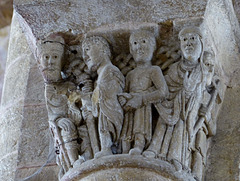
The Condemnation of St. Foy.
The capital seems cracked. The King is "tied" to the scene by the restorers.
Neuilly-en-Donjon - Église Ste-Marie-Madeleine
| |
|
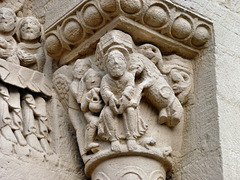
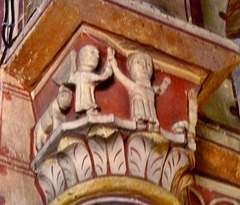
The right capital flanking the lintel depicts a scene from the "Book of Daniel".
14,33 And the angel of the Lord said to Habacuc: Carry the dinner which you have into Babylon, to Daniel, who is in the lions' den.
14,34 And Habacuc said: Lord, I never saw Babylon, nor do I know the den.
14,35 And the angel of the Lord took him by the top of his head, and carried him by the hair of his head, and set him in Babylon, over the den, in the force of his spirit.
14,36 And Habacuc cried, saying: O Daniel, you servant of God, take the dinner that God has sent you.
Escurolles - Saint-Cyr-et-Sainte-Julitte
| |
|
The parish of Escurolles was given to Cluny in 953/054 by Ermengarde, (probably) the wife of Archambaud I de Bourbon, Seigneur de Bourbon (yes, this is where the illustrious name derived from). The church Saint-Cyr-et-Sainte-Julitte was built 11th/12th century. It has a nave and two aisles. The church is known for some pretty archaic carvings.
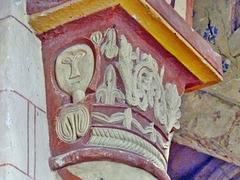
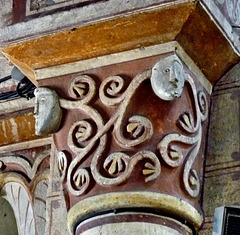
This capital is from the nave, near to the choir.
Probably all capitals were coloured once, but I doubt, that the colour seen here is old. Probably it is from 1908, when the church was under reconstruction. There is a number of decorative foliage in different forms and patterns - and a face. A sculptor, who is able, to carve the foliage, should be able to carve a face better than this. It looks so inartistic.
Maybe this is not a human face, but a symbol. Mayb for the full moon. Or it may be a tree with two branches/leaves - forming a face. I have no idea.

Fleuriel - Notre Dame
| |
|
The 12th century church "Notre-Dame de Fleuriel" was once the seat of a priory, connected the abbey in Tournus. Now it is the parish church. It is known for the western portal. I had read, that it is one of the finest in the area of Bourbonnais. Well, the finer the work of art is, the more restauration and conservation it needs over the time. On this quiet sunday morning, I could slip under the cover and have a close look.
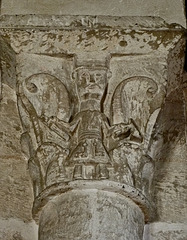
But I did not find the right distance to take photos. This is a detail from the capital, on the right side of the door. I was pretty sure, that this is a mermaid, when I saw it first.
Meanwhile I doubt that a bit. This could be as well a person growing out of the bud. Or it could be the head of a "tendrillar monster". After having entwined the small human body, it now swallows it.
Chantelle - Abbaye Saint-Vincent
| |
|
A previous church at this place was once part of the castle, erected by the Earls of Bourbon on a rocky headland overhanging a meander of the Bouble. In 937 Odo of Cluny, who was the second abbot in Cluny, added this place as a priory to the cluniac sphere. The still existing romanesque church of the "Abbaye Saint-Vincent de Chantelle", was built within the 12th century. Monastic life declined later and after the French Revolution was sold. Mid 19th century it was "bought back" by the abbey of Pradines. Since 1890 ist is a monastery again. The nuns living and working here, produce herbal cosmetics - and sell the worldwide.
www.benedictines-chantelle.com/
Within the "public" area of the nave are some interesting carvings.
A man, having an unproportional large head and very short legs, is holding tools. There is a kind of hammer in his right and a chisel (?) in his left hand. Two more items are hanging down from his belt. Angle meters? The carving is a bit rough, not very delicate. Probably nor carved by one of the masters, that worked within the Auvergne.
But - in case the tools are identified correctly, this probably is a stone sculptor showing his tools. And in case this is right, then this capital may be counted as very early self-portrait!
Sorry for the bad quality of the photo.

Bellenaves - Saint-Martin
| |
|
The parish church of Bellenaves, dedicated to Saint Martin, was a part of priory, when it was built in the second half of the 12th century.
The carvings in- and outside the church differ totally in artistic style and technic. Here is a very elegant (marble?) capital.
Two large bearded men on the sides, a comparably gigantic head in the middle between them. The two men may fight or dance - or just step forward to "showcase" the head. Then this may be the head of John the Baptist.
Bellenaves - Saint-Martin
| |
|
The parish church of Bellenaves, dedicated to Saint Martin, was a part of priory, when it was built in the second half of the 12th century.
The carvings in- and outside the church differ totally in artistic style and technic.
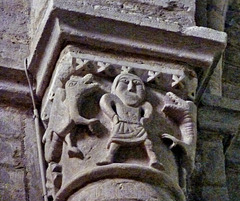
Here, just a few meters away from the "elegant" and very "artistic"-one, a capital carved in a very rough and archaic style.
A man, standing in the middle between two evil dragons. Though the beasts, having two feet, wings, a dragon´s tail and a crocodile´s head, obviously try hard to frighten the guy. He seems stable, standing legs apart. He is not impressed, but very confident. "The dragons cannot harm you. They cannot lay a single finger on you..." was probably part of the sermon.
Thuret - Saint-Bénilde
| |
|
The former church of a priory, built from local limestone 1150/1170, got remodelled quite often over the centuries. This was done not only by architects, but as well by clerics. The church was dedicated to St. Genesius first, then to St. Limin, followed by Saint-Martin. Within the 19th century the dedication changed to Saint-Bonnet and just some decades ago to Saint-Bénilde, a saint born in Thuret in 1805.
Aymon Gilbert Mallay, the architect of the diocese, "over" restaurated the church in 1864. Bernard Craplet ("Auvergne romane") still laments this neo-romanesque impact.
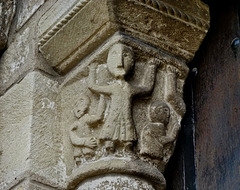
This church actually has very interesting carvings, but the title "Le Vezelay de la Limagne", that I found on a local leaflet, is way too ambitious. This capital from the western portal is very "normal", compared to others in Thuret. It depicts family Atlas! Two atlantes - with their very supportive kids. The artistic style is just a little simple but not really special.

Thuret - Saint-Bénilde
| |
|
The former church of a priory, built 1150/1170, got remodelled quite often over the centuries. This was done not only by architects, but as well by clerics. The church was dedicated to St. Genesius first, then to St. Limin, followed by Saint-Martin. In the 19th century the dedication changed to Saint-Bonnet and some decades ago to Saint-Bénilde, a saint born in Thuret in 1805 under the name Pierre Romançon.
There are interesting carvings here. Ever since the art history discovered them as specific works of art, they have been a subject in the literature.
B. Craplet ("Auvergne roman", 1992) describes the carvings just as "unskilled". He in general disagrees with Z. Swiechowski ("Sculpture Romane D'auvergne", 1973), who sees this as the work of "naive folk art". A. Gybal ("L´Auvergne, berceau de l´artroman", 1958) describes
a specific "Thuret-style" being a totally simplified work of art. Only to be found here. For him, the simplification is the result of the artists inspiration. He makes totally clear, that this is not "folk art" ("l`art populaire"), but the result of artistic work of very skilled monks ("moines tres cultives").
So this is what André Gybal describes as the "Thuret style" of total simplification.
The same capital as before, now from another angle. Adam in the center. Eve, the snake, the apple to the right. Reflective Adam scratches his chin. On the left the third of the skeletal trees, that form the whole of the Garden of Eden. Very minimalistic!
Bernard Craplet wrote "Is there a hidden message within the unskilled sculptures? This is probably not the case. Neither here nor somewhere else."
Thuret - Saint-Bénilde
| |
|
The former church of a priory, built 1150/1170, got remodelled quite often over the centuries. This was done not only by architects, but as well by clerics. The church was dedicated to St. Genesius first, then to St. Limin, followed by Saint-Martin. In the 19th century the dedication changed to Saint-Bonnet and some decades ago to Saint-Bénilde, a saint born in Thuret in 1805 under the name Pierre Romançon.
There are interesting carvings here. Ever since the art history discovered them as specific works of art, they have been a subject in the literature.
B. Craplet ("Auvergne roman", 1992) describes the carvings just as "unskilled". He in general disagrees with Z. Swiechowski ("Sculpture Romane D'auvergne", 1973), who sees this as the work of "naive folk art". A. Gybal ("L´Auvergne, berceau de l´artroman", 1958) describes a specific "Thuret-style" being a totally simplified work of art. Only to be found here. For him, the implification is the result of the artists inspiration. He makes totally clear, that this is not "folk art" ("l`art populaire"), but the result of artistic work of very skilled monks ("moines tres cultives").
According to the literature this capital depicts "Daniel in the lions' den". I am not really sure. It does not have the "common" composition, where Daniel "holds" the lions. In the center is a person standing in the gesture of praying, "protected" by two angels (the right one is lost) from two animals (only one can be seen from this pov). This carving does not have that minimalistic approach just seen at "Adam and Eve".
Bernard Craplet wrote "Is there a hidden message within the unskilled sculptures? This is probably not the case. Neither here nor somewhere else."
Sorry for the bad quality of the photo.
Thuret - Saint-Bénilde
| |
|
The former church of a priory, built 1150/1170, got remodelled quite often over the centuries. This was done not only by architects, but as well by clerics. The church was dedicated to St. Genesius first, then to St. Limin, followed by Saint-Martin. In the 19th century the dedication changed to Saint-Bonnet and some decades ago to Saint-Bénilde, a saint born in Thuret in 1805 under the name Pierre Romançon.
There are interesting carvings here. Ever since the art history discovered them as specific works of art, they have been a subject in the literature.
B. Craplet ("Auvergne roman", 1992) describes the carvings just as "unskilled". He in general disagrees with Z. Swiechowski ("Sculpture Romane D'auvergne", 1973), who sees this as the work of "naive folk art". A. Gybal ("L´Auvergne, berceau de l´artroman", 1958) describes
a specific "Thuret-style" being a totally simplified work of art. Only to be found here. For him, the simplification is the result of the artists inspiration. He makes totally clear, that this is not "folk art" ("l`art populaire"), but the result of artistic work of very skilled monks ("moines tres cultives").
There are more than 50 carvings in Thuret and most of the floral decorated capitals in Thuret are carved in the "conventional" style, that was nomal in the area around 1150. Most, but not all.
This one has the "Thuret-Touch". The theme, "tendrils sprouting out
of a head" is very common all around. Here the tendrils create no symmetry (like mostly). The style is very simplified .The faces are similar to the faces seen on the "Garden Eden"-capital.
Thuret - Saint-Bénilde
| |
|
The former church of a priory, built 1150/1170, got remodelled quite often over the centuries. This was done not only by architects, but as well by clerics. The church was dedicated to St. Genesius first, then to St. Limin, followed by Saint-Martin. In the 19th century the dedication changed to Saint-Bonnet and some decades ago to Saint-Bénilde, a saint born in Thuret in 1805 under the name Pierre Romançon.
There are interesting carvings here. Ever since the art history discovered them as specific works of art, they have been a subject in the literature.
B. Craplet ("Auvergne roman", 1992) describes the carvings just as "unskilled". He in general disagrees with Z. Swiechowski ("Sculpture Romane D'auvergne", 1973), who sees this as the work of "naive folk art". A. Gybal ("L´Auvergne, berceau de l´artroman", 1958) describes
a specific "Thuret-style" being a totally simplified work of art. Only to be found here. For him, the simplification is the result of the artists inspiration. He makes totally clear, that this is not "folk art" ("l`art populaire"), but the result of artistic work of very skilled monks ("moines tres cultives").
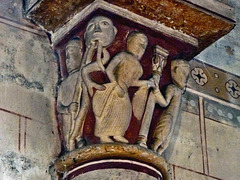
This is the most cryptic capital in Thuret.
A woman and a man in very luxurious garments are holding hands in front of a pillar. This is a wedding attire, as it is widely agreed, that this depicts a wedding scene. The pillar often is a symbol for palace, our at least a prestigious house built from stones.
So seen here is the wedding of a very high ranking, wealthy couple.
And on the left side - a round face with an open mouth. Snakes creep out of the mouth -. and one of them even bites into the lady´s derrière. Further left a man with a pole. He may be a warrier holding a lance. Craplet describes this as a wedding scene, where a "devil´s head is spitting snakes", as a symbol of lust.
If this is right, then it can be understood as a warning. Then this proves, that even in the highest ranks, the devil can infect a woman with sinful lust.
Two more snake can be seen in the church. One is just being eaten by a stork, the other one is communicating with Eve. About an apple.
Ennezat - Collégiale Saint-Victor et Sainte-Couron…
| |
|
Around 1060 a small monastery was founded here, funded by William IV, Duke of Aquitaine (aka Fièrebrace - The Iron Arm).
The building of the romanesque church started immediately and probably only took less than 10 years. This church is counted rightly to the crown jewels of the romanesque architecture in the Auvergne by Bernard Craplet ("Auverne romane").
What makes it so interesting is, that this is the oldest of the crown jewels, as this structure is about 50 years older than Notre-Dame-du-Port, Orcival and Issoire. But it nevertheless shows already all the specific touch, the romanesque style ahs in the Auvergne.
Actually Bernard Craplet places this small church like a stepping stone between the (lost) romanesque cathedral of Étienne II/Pope Stephen II in Clermont and Notre-Dame-du-Port. Though the romanesque church is really small and not complete, this is one of the most important structures in the Auvergne.
The Collégiale Saint-Victor et Sainte-Couronne (now parish church) consists out of three architectural parts. The romanesque church with a nave, two aisles and a transept, a later added narthex and a large gothic part. The building of the gothic church from around 1280 on, took about 200 years.
There are many carved capitals in the romanesque nave. Some nice ones are around the crosssing.
There are many carved capitals in the romanesque nave. Some nice ones are around the crosssing.
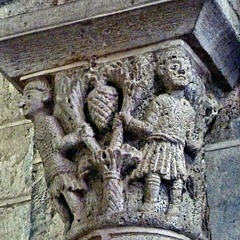
Two men placed into a kind of garden, presenting a giant bunch of grapes (it is not a fir cone!). The dresses of the two differ clearly. The left one wears a chain mail, indicating, that he is a soldier, while the right one only wears very plain clothes with a rope as a belt. He may be the peasant. Cooperation between soldiers and peasants result in a great harvest. Maybe. But maybe this garden and it´s population may be a mythical one, as there was a "fishy"-couple on the other capital, probably depicting the same garden.
Mozac - Saint-Pierre et Saint-Caprais
| |
|
Mozac Abbey is one of the oldest monasteries in the Auvergne, dating back into Merovingian times. A legend tells that it was founded by Calminius (later Saint Calmin). He must have been pretty important and well off, as his name is connected to the foundations of three abbeys. He introduced the benedictian rules to the area, and brought (from Rome)a relic of Saint Peter and (from Agen) a relic of Saint Caprasius to Mozac. He got buried in the crypt of this church together with his wife Saint Namadie. Within the 9th century relics of Saint Austremonius, the first bishop of Clermont were transferred to Mozac, so already before Santiago de Compostella was on the map, this was a place of pilgrimage.
In 1095 Mozac abbey got affiliated to Cluny, but was important enough, to have Hugue of Semur, nephew of Hugue of Cluny here as abbot. He was followed by Eustachius, brother of Petrus Venerabilis.
Three churches could be traced here by archeologists, what can be seen today is "Mozac 3", a great church built within the first half of the 12th century.
As most of "Mozac 3" got destroyed by a number earthquakes between 1437 and 1490. Actually only ruins can be seen. Apses, choir, ambulatory, radial chapels, transept and clerestorys were beyond repair, when the early reconstruction started - in gothic style.
Most pillars and capitals of "Mozac 3" are still in place (in situ).
Some of the carvings here are so "perfect", that they seem to be much younger, even baroque, but all are - 12th century - romanesque.
-
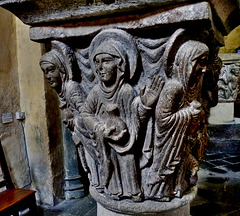
There are three capitals, that are not "in situ" any longer. They are placed on the ground, so the detailled carvings are easily visible. These capitals are carved on all four sites.
This capital is known as "The Resurrection". On the backside is the empty grave - and sleeping guards in full armour.
This is Mark 16:1-2
"When the Sabbath was past, Mary Magdalene, Mary the mother of James, and Salome bought spices, so that they might go and anoint him. And very early on the first day of the week, when the sun had risen, they went to the tomb..."
Mozac - Saint-Pierre et Saint-Caprais
| |
|
Mozac Abbey is one of the oldest monasteries in the Auvergne, dating back into Merovingian times. A legend tells that it was founded by Calminius (later Saint Calmin). He must have been pretty important and well off, as his name is connected to the foundations of three abbeys. He introduced the benedictian rules to the area, and brought (from Rome)a relic of Saint Peter and (from Agen) a relic of Saint Caprasius to Mozac. He got buried in the crypt of this church together with his wife Saint Namadie. Within the 9th century relics of Saint Austremonius, the first bishop of Clermont were transferred to Mozac, so already before Santiago de Compostella was on the map, this was a place of pilgrimage.
In 1095 Mozac abbey got affiliated to Cluny, but was important enough, to have Hugue of Semur, nephew of Hugue of Cluny here as abbot. He was followed by Eustachius, brother of Petrus Venerabilis.
Three churches could be traced here by archeologists, what can be seen today is "Mozac 3", a great church built within the first half of the 12th century.
As most of "Mozac 3" got destroyed by a number earthquakes between 1437 and 1490. Actually only ruins can be seen. Apses, choir, ambulatory, radial chapels, transept and clerestorys were beyond repair, when the early reconstruction started - in gothic style.
Most pillars and capitals of "Mozac 3" are still in place (in situ).
Some of the carvings here are so "perfect", that they seem to be much younger, even baroque, but all are - 12th century - romanesque.
-
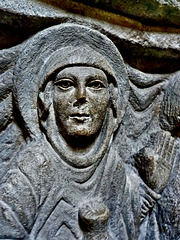
There are three capitals, that are not "in situ" any longer. They are placed on the ground, so the detailled carvings are easily visible.
This is a detail from the capital known as "The Resurrection".
Mark 16:1-2
"When the Sabbath was past, Mary Magdalene, Mary the mother of James, and Salome bought spices, so that they might go and anoint him. And very early on the first day of the week, when the sun had risen, they went to the tomb."
Mary Magdalene - a close up.
Mozac - Saint-Pierre et Saint-Caprais
| |
|
Mozac Abbey is one of the oldest monasteries in the Auvergne, dating back into Merovingian times. A legend tells that it was founded by Calminius (later Saint Calmin). He must have been pretty important and well off, as his name is connected to the foundations of three abbeys. He introduced the benedictian rules to the area, and brought (from Rome)a relic of Saint Peter and (from Agen) a relic of Saint Caprasius to Mozac. He got buried in the crypt of this church together with his wife Saint Namadie. Within the 9th century relics of Saint Austremonius, the first bishop of Clermont were transferred to Mozac, so already before Santiago de Compostella was on the map, this was a place of pilgrimage.
In 1095 Mozac abbey got affiliated to Cluny, but was important enough, to have Hugue of Semur, nephew of Hugue of Cluny here as abbot. He was followed by Eustachius, brother of Petrus Venerabilis.
Three churches could be traced here by archeologists, what can be seen today is "Mozac 3", a great church built within the first half of the 12th century.
As most of "Mozac 3" got destroyed by a number earthquakes between 1437 and 1490. Actually only ruins can be seen. Apses, choir, ambulatory, radial chapels, transept and clerestorys were beyond repair, when the early reconstruction started - in gothic style.
Most pillars and capitals of "Mozac 3" are still in place (in situ).
Some of the carvings here are so "perfect", that they seem to be much younger, even baroque, but all are - 12th century - romanesque.
-
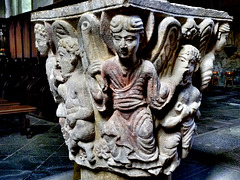
There are three capitals, that are not "in situ" any longer. They are placed on the ground, so the detailled carvings are easily visible.
This capital was found in 1983 during a reconstruction inside a wall.
There are four angels at the corners. Between them sitting on the ground, four men. The angels try to close the men´s open mouths, by grabbing the noses and the jaws. All the men have fanfare horns as well as the angels.
This is very cryptic, but it may be connected to the
The Book of Revelation, chapter 7-1
"And after these things I saw four angels standing on the four corners of the earth, holding the four winds of the earth, that the wind should not blow on the earth, nor on the sea, nor on any tree."
At least there are four angels at the four corners, preventing four men to blow (the horns).
Jump to top
RSS feed- Latest items - Subscribe to the latest items added to this album
- ipernity © 2007-2025
- Help & Contact
|
Club news
|
About ipernity
|
History |
ipernity Club & Prices |
Guide of good conduct
Donate | Group guidelines | Privacy policy | Terms of use | Statutes | In memoria -
Facebook
X
