

Martin M. Miles' photos
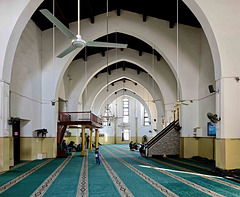
Nicosia - Ömeriye Mosque
| |
|
|
The site of the mosque was originally occupied by the Augustinian Church of Saint Mary, which dated back to the 14th century. During the Ottoman-Venetian War of 1570–73, the church was heavily damaged during the siege of Nicosia in 1570.
Lala Mustafa Pasha, the Ottoman commander, ordered a mosque to be built on the site of the former church, based on a popular belief that Umar, second caliph of Islam, was buried at this site in 7th century.
The construction of the mosque followed a similar groundsplan to the former church, however building of the mosque was conducted in the Islamic style.

Nicosia - Ömeriye Mosque
| |
|
|
The site of the mosque was originally occupied by the Augustinian Church of Saint Mary, which dated back to the 14th century. During the Ottoman-Venetian War of 1570–73, the church was heavily damaged during the siege of Nicosia in 1570.
Lala Mustafa Pasha, the Ottoman commander, ordered a mosque to be built on the site of the former church, based on a popular belief that Umar, second caliph of Islam, was buried at this site in 7th century.
The construction of the mosque followed a similar groundsplan to the former church, however building of the mosque was conducted in the Islamic style.

Nicosia - Ömeriye Mosque
| |
|
|
The site of the mosque was originally occupied by the Augustinian Church of Saint Mary, which dated back to the 14th century. During the Ottoman-Venetian War of 1570–73, the church was heavily damaged during the siege of Nicosia in 1570.
Lala Mustafa Pasha, the Ottoman commander, ordered a mosque to be built on the site of the former church, based on a popular belief that Umar, second caliph of Islam, was buried at this site in 7th century.
The construction of the mosque followed a similar groundsplan to the former church, however building of the mosque was conducted in the Islamic style.

Nicosia - Ömeriye Mosque
| |
|
|
The site of the mosque was originally occupied by the Augustinian Church of Saint Mary, which dated back to the 14th century. During the Ottoman-Venetian War of 1570–73, the church was heavily damaged during the siege of Nicosia in 1570.
Lala Mustafa Pasha, the Ottoman commander, ordered a mosque to be built on the site of the former church, based on a popular belief that Umar, second caliph of Islam, was buried at this site in 7th century.
The construction of the mosque followed a similar groundsplan to the former church, however building of the mosque was conducted in the Islamic style.
To the northwest some parts of the former parts suvived the times.

Nicosia - Ömeriye Mosque
| |
|
|
The site of the mosque was originally occupied by the Augustinian Church of Saint Mary, which dated back to the 14th century. During the Ottoman-Venetian War of 1570–73, the church was heavily damaged during the siege of Nicosia in 1570.
Lala Mustafa Pasha, the Ottoman commander, ordered a mosque to be built on the site of the former church, based on a popular belief that Umar, second caliph of Islam, was buried at this site in 7th century.
The construction of the mosque followed a similar groundsplan to the former church, however building of the mosque was conducted in the Islamic style.
To the northwest some parts of the former parts suvived the times.

Nicosia - Ömeriye Mosque
| |
|
|
The site of the mosque was originally occupied by the Augustinian Church of Saint Mary, which dated back to the 14th century. During the Ottoman-Venetian War of 1570–73, the church was heavily damaged during the siege of Nicosia in 1570.
Lala Mustafa Pasha, the Ottoman commander, ordered a mosque to be built on the site of the former church, based on a popular belief that Umar, second caliph of Islam, was buried at this site in 7th century.
The construction of the mosque followed a similar groundsplan to the former church, however building of the mosque was conducted in the Islamic style.
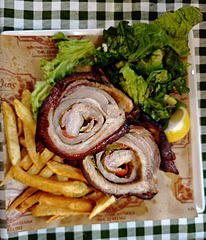
Nicosia - Tsolias Nicosia
| |
|
|
Tsolias Nicosia is a hidden gem of a restaurant near the Green Line.
The Italian classic porchetta has a popular Greek cousin. Here, the pork belly is stuffed with typical Greek flavors—such as oregano, feta, and garlic—and then rolled.

Nicosia - Tsolias Nicosia
| |
|
|
Tsolias Nicosia is a hidden gem of a restaurant near the Green Line. It serves what is known in Cyprus as a "κοτολέτα" – which, in terms of size, looks quite different from what I’m used to under the name "
cutlet".
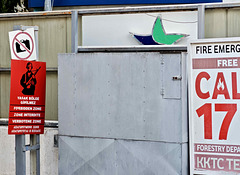
North Nicosia - Green Line
| |
|
|
After the Russo-Turkish War of 1877–1878, the Sultan ceded Cyprus to Great Britain. In 1960, Nicosia became the capital of the Republic of Cyprus, a state founded by Greek and Turkish Cypriots.
In 1974, the Greek military junta staged a coup to unite the island with Greece. The coup overthrew President Makarios III and led to the invasion of the Turkish army. The Turkish army advanced and eventually conquered 37% of Cypriot territory, including the northern part of Nicosia.
Today, Nicosia is divided by the Green Line into a Greek Cypriot and a Turkish Cypriot quarter, monitored by the UN peacekeeping force. Following the fall of the Berlin Wall in 1989, Nicosia is the last divided capital city in Europe.
The Green Line named after the green pencil, that was used to map the ceasefire border in 1963, runs through the Nicosia´s old city. The Green Line became impassable in 1974, but meanwhile there are some checkpoints.

North Nicosia - Letter Box
| |
|
|

North Nicosia - Büyük Hamam
| |
|
|
|
On the site of Büyük Hamam (=Great Hamam) the Lusignan church of St. George of the Latins was constructed from 1306 to 1309.
The building was rebuilt as a Turkish bath between 1571 and 1590 during the first years of the Ottoman rule. The Gothic-style main entrance is one of the few remaining elements of the original church. Because the street level has risen over centuries, the entrance is now significantly below road level.

North Nicosia - Büyük Hamam
| |
|
|
On the site of Büyük Hamam (=Great Hamam) the Lusignan church of St. George of the Latins was constructed from 1306 to 1309.
The building was rebuilt as a Turkish bath between 1571 and 1590 during the first years of the Ottoman rule. The Gothic-style main entrance is one of the few remaining elements of the original church. Because the street level has risen over centuries, the entrance is now significantly below road level.
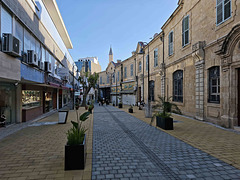
North Nicosia - Arasta Sokagi
| |
|
|
Arasta Street (Arasta Sokagi) is known for its blend of British-era buildings and modern retail. In summer, the pedestrian zone is for sure absolutely bustling. In winter, it is very quiet.

North Nicosia - Adem Kader
| |
|
Adem Kader claims on its website to have been the leading textile and accessories store in Cyprus since 1959.
ademkader.net/index.html

North Nicosia - İplik Pazarı Mosque
| |
|
|
The mosque was once surrounded by a yarn-spinning bazaar (İplik Pazarı), from which its current name is derived. The building dates from the early 19th century. An inscription inside the mosque from 1826 documents its patronage by the Governor of Cyprus. The minaret is one of the few minarets with a stone spire on the island.

North Nicosia - Kumarcilar Han
| |
|
|
Kumarcilar Han (Gambler´s Inn) is located near the larger and older Büyük Han. It was probably erected around the end of the 17th century. In 2018, the Kumarcilar Han has been fully restored, and is used as a cafe/restaurant, as well as small shops selling local items.

North Nicosia - Büyük Han
| |
|
|
Büyük Han (Great Inn) is the name of a historic Ottoman caravanserai dating back to the 16th century. Built in 1572, shortly after the Ottoman conquest, it is generally considered the oldest Turkish building on the island.
The two-story building housed animals and small shops on the ground floor, while the upper floor provided 68 beds for travelers. The large courtyard served as a marketplace for goods from near and far.
Over the centuries, the building has been used for various purposes, including as Nicosia's central prison during British rule (1892–1903).
Following extensive restoration in 2003, Büyük Han has been revived and now houses artisan workshops, galleries, souvenir shops, cafes, and restaurants.

North Nicosia - Büyük Han
| |
|
|
Büyük Han (Great Inn) is the name of a historic Ottoman caravanserai dating back to the 16th century. Built in 1572, shortly after the Ottoman conquest, it is generally considered the oldest Turkish building on the island.
The two-story building housed animals and small shops on the ground floor, while the upper floor provided 68 beds for travelers. The large courtyard served as a marketplace for goods from near and far.
Over the centuries, the building has been used for various purposes, including as Nicosia's central prison during British rule (1892–1903).
Following extensive restoration in 2003, Büyük Han has been revived and now houses artisan workshops, galleries, souvenir shops, cafes, and restaurants.
