

Pandora
Cave wall
Ursa Major / Ursa Minor ~ ಸಪ್ತ ಋಷಿ ಮಂಡಲ
Samudra-Manthan
Berlin Wall
Checkpoint Charlie
Leda & the Swan
Figure 19-7
Rose gerenium
Mr. Chang
Orange Chicken
Algebra Of Darkness
Salad
Mr. Chang's ride
Veggi lettuce wrap
Rhinoceros
Honey crabs
Figure 16
Cityscape #4
Dass Sweets
महा भारत / Maha Bharath
Cityscape #3
Crab apples
City scape 2
दशावतार / Dashavatara
Types of masks
Winter citysape
Morning sun
door
Ball game for Seniors :o((
Jello
A salad
Renovation
See also...
Keywords
Authorizations, license
-
Visible by: Everyone -
All rights reserved
-
48 visits
Stupa at Saranath
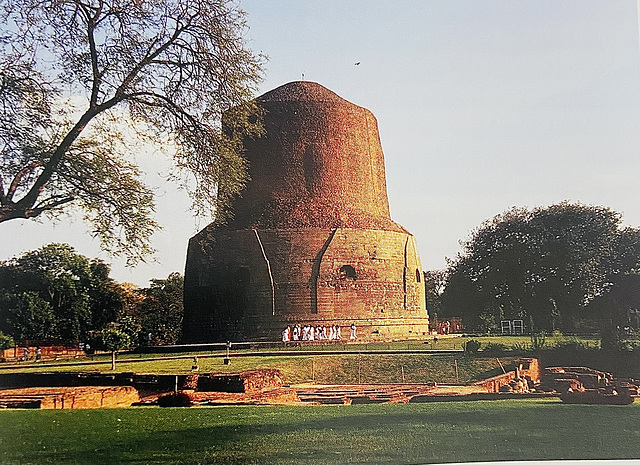

The Stupa at Sarnath outside Beneres marks the site of Buddha’s first sermon
Image from

Image from
Gabi Lombardo, Ecobird, Percy Schramm have particularly liked this photo
- Keyboard shortcuts:
Jump to top
RSS feed- Latest comments - Subscribe to the comment feeds of this photo
- ipernity © 2007-2026
- Help & Contact
|
Club news
|
About ipernity
|
History |
ipernity Club & Prices |
Guide of good conduct
Donate | Group guidelines | Privacy policy | Terms of use | Statutes | In memoria -
Facebook
X

The stupa (“stupa” is Sanskrit for heap) is an important form of Buddhist architecture, though it predates Buddhism. It is generally considered to be a sepulchral monument—a place of burial or a receptacle for religious objects. At its simplest, a stupa is a dirt burial mound faced with stone. In Buddhism, the earliest stupas contained portions of the Buddha’s ashes, and as a result, the stupa began to be associated with the body of the Buddha. Adding the Buddha’s ashes to the mound of dirt activated it with the energy of the Buddha himself.
Before Buddhism, great teachers were buried in mounds. Some were cremated, but sometimes they were buried in a seated, meditative position. The mound of earth covered them up. Thus, the domed shape of the stupa came to represent a person seated in meditation much as the Buddha was when he achieved Enlightenment and knowledge of the . The base of the stupa represents his crossed legs as he sat in a meditative pose (called padmasana or the lotus position). The middle portion is the Buddha’s body and the top of the mound, where a pole rises from the apex surrounded by a small fence, represents his head. Before images of the human Buddha were created, reliefs often depicted practitioners demonstrating devotion to a stupa.
The ashes of the Buddha were buried in stupas built at locations associated with important events in the Buddha’s life including Lumbini (where he was born), Bodh Gaya (where he achieved Enlightenment), Deer Park at Sarnath (where he preached his first sermon sharing the Four Noble Truths), and Kushingara (where he died). The choice of these sites and others were based on both real and legendary events.
“Calm and glad"
According to legend, , who was the first king to embrace Buddhism, created 84,000 stupas and divided the Buddha’s ashes among them all. While this is an exaggeration (and the stupas were built by Ashoka some 250 years after the Buddha’s death), it is clear that Ashoka was responsible for building many stupas all over northern India and the other territories under the Mauryan Dynasty in areas now known as Nepal, Pakistan, Bangladesh, and Afghanistan.
One of Ashoka's goals was to provide new converts with the tools to help with their new faith. In this, Ashoka was following the directions of the Buddha who, prior to his death (parinirvana), directed that stupas should be erected in places other than those associated with key moments of his life so that “the hearts of many shall be made calm and glad.” Ashoka also built stupas in regions where the people might have difficulty reaching the stupas that contained the Buddha’s ashes.
The practice of building stupas spread with the Buddhist doctrine to Nepal and Tibet, Bhutan, Thailand, Burma, China, and the United States where large Buddhist communities are centered. While stupas have changed in form over the years, their function remains essentially unchanged. Stupas remind the Buddhist practitioner of the Buddha and his teachings almost 2,500 years after his death.
For Buddhists, building stupas also has karmic benefits. Karma, a key component in both Hinduism and Buddhism, is the energy generated by a person’s actions and the ethical consequences of those actions. Karma affects a person’s next existence or re-birth. For example, in the ten merits of building a stupa are outlined. One states that if a practitioner builds a stupa he or she will not be reborn in a remote location and will not suffer from extreme poverty. As a result, a vast number of stupas dot the countryside in Tibet (where they are called chorten) and in Burma (chedi).
The journey to Enlightenment
Buddhists visit stupas to perform rituals that help them to achieve one of the most important goals of Buddhism: to understand the Buddha’s teachings, known as the Four Noble Truths (also known as the dharma and the law) so when they die they cease to be caught up in samsara, the endless cycle of birth and death.
The Four Noble Truths:
1. Life is suffering (suffering=rebirth).
2. The cause of suffering is desire.
3. The cause of desire must be overcome.
4. When desire is overcome, there is no more suffering (suffering=rebirth).
Once individuals come to fully understand the Four Noble Truths, they are able to achieve Enlightenment, or the complete knowledge of the dharma. In fact, Buddha means “the Enlightened One” and it is the knowledge that the Buddha gained on his way to achieving Enlightenment that Buddhist practitioners seek on their own journey toward Enlightenment.
The circle or wheel
One of the early sutras (a collection of sayings attributed to the Buddha forming a religious text) records that the Buddha gave specific directions regarding the appropriate method of honoring his remains (the Maha-parinibbāna sutra): his ashes were to be buried in a stupa at the crossing of the mythical four great roads (the four directions of space), the unmoving hub of the wheel, the place of Enlightenment.
If one thinks of the stupa as a circle or wheel, the unmoving center symbolizes Enlightenment. Likewise, the practitioner achieves stillness and peace when the Buddhist dharma is fully understood. Many stupas are placed on a square base, and the four sides represent the four directions: north, south, east, and west. Each side often has a gate in the center, which allows the practitioner to enter from any side. The gates are called torana. Each gate also represents the four great life events of the Buddha: East (Buddha’s birth), South (Enlightenment), West (First Sermon where he preached his teachings or dharma), and North (Nirvana). The gates are turned at right angles to the axis mundi to indicate movement in the manner of the arms of a svastika, a directional symbol that, in Sanskrit, means “to be good” (“su” means good or auspicious and “asti” means to be). The torana are directional gates guiding the practitioner in the correct direction on the correct path to Enlightenment, the understanding of the Four Noble Truths.
Sign-in to write a comment.