


Limekilns

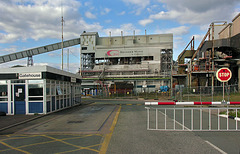
Lostock works - STOP
| |
|
Back in 2005 I attempted to get some shots of the four big limekilns at Brunner Mond's Lostock soda ash works. This is as near to the gate as I got before security was out shouting about no photography allowed. I didn't argue as the car park I was standing on is well inside the boundary of their ownership.
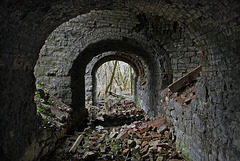
Draw tunnel
| |
|
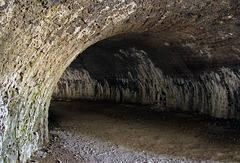
One of two draw tunnels for railway wagons serving the Bellmanpark limekilns at Clitheroe.
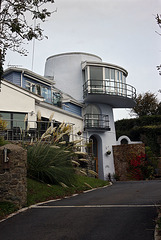
Red Wharf Bay limekiln
| |
|
|
At first glance this house may appear to have incorporated a windmill, but in fact this was a circular tower limekiln. The internal form at the bottom is an inverted cone with very thick walls. The adjacent quarry is shown with a rectangular limekiln on the 1889 OS map and this is marked as 'old' by 1900. This kiln first appears on the 1920 map, so probably dates from soon after 1900. The RCAHMW website states that an early twentieth century photograph shows a group of labourers in front of the kiln, which was banded with iron straps and had a tall chimney above.
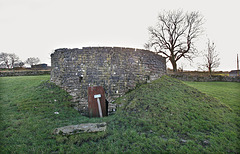
Budgetts Farm Limekiln
| |
|
|
Small disused field kiln just outside Butterton. It is in a good state of repair which is quite unusual for this type of structure.
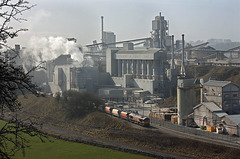
Tunstead departure
| |
|
A little of the morning mist hangs in the air as 66031 departs Tunstead quarry with a heavy load of limestone.
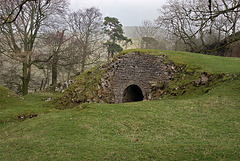
Hall Dale kiln
| |
|
A very pleasant day out yesterday with fellow Fickrite BITH*. We wandered around various bits of the White Peak seeking out interesting bits and pieces which included this dleightfully situated limekiln high up above Hall Dale. It is in reasonable condition and was notable for having the pot lined with stock brick rather than firebricks. The bricks were considerable younger than the kiln body and I assume that this was a bit of a bodge late in its active life.
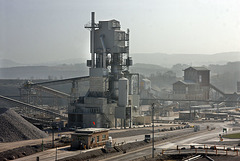
Maerz Kilns
| |
|
New limekilns at the Tarmac operated Tunstead Quarry. Completed in 2010 at a cost of £13.4 million and fuelled by natural gas, the Maerz kiln processes 40–20mm limestone to produce high-purity quicklime. The two interconnected kilns replace two rotary limekilns introduced in 1955 and have reduced carbon emissions by 40%.
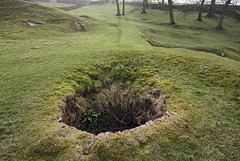
Mouth of the kiln
| |
|
Limekiln at Hall Dale, Ilam from the charging side. The quarry for the stone is just off to the left.
Liaosichang limekilns
| |
|
|
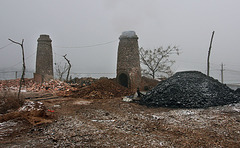
Limekilns at Liaosichang west of Baofeng near Pingdingshan. Limestone ready for burning on the left and a large supply of coal to the right. The main body of each kiln is underneath and they are emptied through a draw tunnel below and behind the chimneys
Craven Limeworks
Row limekiln
| |
|
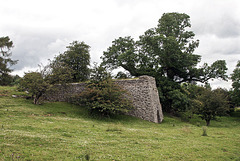
This substantial limekiln stands on a hillside in the hamlet of Row, above the Lyth valley in the south of Cumbria a short distance to the west of Kendal.
Blackwoodridge Limekiln
| |
|
|
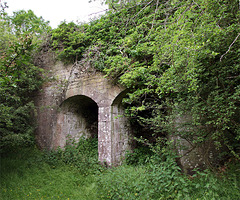
Blackwoodridge limeworks were well established by 1858 and there were extensive quarries and three further kilns at that time. By 1899 all had closed although the site has subsequently been used in processing ground limestone. This single kiln has a large pot and two draw tunnels at the front.

Limekiln at Hoften's Cross
| |
|
Eighteenth century earthen limekiln at Hoften's Cross, Cauldon Lowe. The mounds in the foreground are the ashes and waste raked from the kiln.
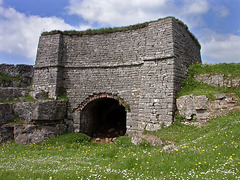
Tissington
| |
|
Disused field kiln in the Parish of Tissington, north of Ashbourne. The stone for this kiln was quarried from the field alongside.
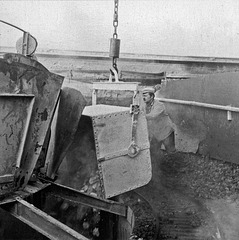
Charging a limekiln
| |
|
Historic view of stone being charged into a limekiln at Ampsin, Liège. This is a large commercial running kiln 11 metres deep and 6 metres in diameter. The pot is covered by a steel lid with a series of doors that can be raised for charging as seen here.
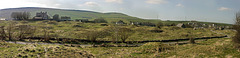
Limekiln panorama
| |
|
At Dove Holes the proximity of the limestone to supplies of coal meant that an extensive limeburning industry developed in the seventeenth century. The lime was burned in large earthen kilns adjacent to the shallow quarries from which it was extracted . As the quarries move location it was easiest just to build another kiln alongside and this has led to extensive areas of quarries and kilns on both sides of the A6 just to the south of the village. This panorama shows just some of the limekiln landscape with remains dating from the 17th and 18th centuries.
Best viewed Large .
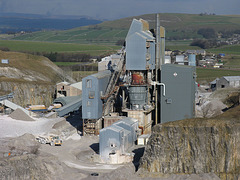
Maerz kilns
| |
|
The two Maerz kilns at the Buxton Lime Industries, Hindlow Quarry, are supplied with stone brought by rail from Tunstead.
Draw tunnel
| |
|
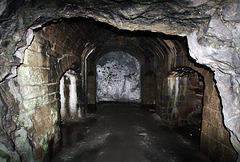
Draw tunnel for the limekilns at the East Buxton Lime Works. The works opened in 1880 adjacent to the Midland Railway west of Millers Dale Station. The two kilns here were cut into the solid rock. Production ended in 1944.
Jump to top
RSS feed- Latest items - Subscribe to the latest items added to this album
- ipernity © 2007-2026
- Help & Contact
|
Club news
|
About ipernity
|
History |
ipernity Club & Prices |
Guide of good conduct
Donate | Group guidelines | Privacy policy | Terms of use | Statutes | In memoria -
Facebook
X
