


Limekilns


Hindlow limekilns
| |
|
|
Maerz limekilns at the Buxton Lime Industries Hindlow Quarry. The stone for burning is brought in by rail from Tunstead as quarrying has ended here.
Ampsin limekilns
| |
|
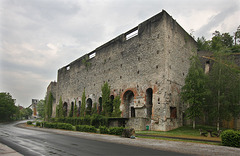
In 1919, Hippolyte Dumont built three lime kilns at Ampsin near Liège. A large lime and cement works was developed here and flourished until c1970 when the Dumont-Wautier Company built the new rotary kiln in its nearby quarry. These old kilns are 11 metres deep and 6 metres in diameter.
Flagstaff Quarry, Penmon
| |
|
|
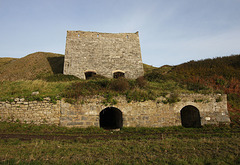
There was a small quarry and pier at this site before 1874 and these kilns were part of the operations at that time. In 1888 William Baird & Co took over and developed the quarry to supply fluxing stone for their steelworks in Glasgow. After a period of low activity Dinmore Quarries Ltd commenced working the site, mainly producing kiln burnt lime for agriculture and this continued until 1948 when all production ceased. The tunnels below the kiln drawing level were for loading lime into carts or possibly railway skips. This was dropped down through shafts with iron doors.

Winnington by night
| |
|
The limekilns and the chimneys of the CHP plant are reflected in the dragonfly pond at Anderton Nature Park.
Lledwigan kilns
| |
|
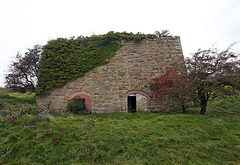
The second pair of limekilns at Lledwigan south of Llangefni are close to the A5. In use in 1888 the kilns were abandoned by 1900.
High Greenfield
| |
|
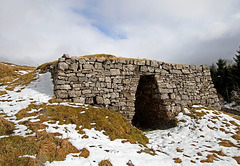
Single limekiln high up above Weardale. It appears to have been working during the nineteenth century and possibly early 20th century.
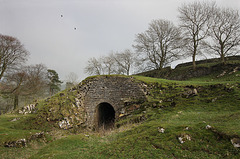
Hall Dale limekiln
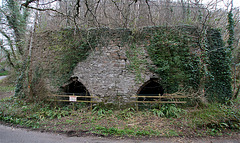
Shallowpool
| |
|
This two pot limekiln stands alongside the West Looe River and was working from at least the 1780s. It is shown as disused on the 1881 OS Map. When the lessee died in 1822 there was 850 tons of limestone sitting here and a further 810 tons at East and West Looe. All stone and culm for burning here had to be brought up the river by boat.

Draw tunnel
| |
|
The draw tunnel of the limekiln at Astonhill is built with large gritstone blocks. At the draw hole end the stonework is blackened with soot from the firing.

Local limeburning
| |
|
Whilst driving to Cromford on a route I have used many times, I was surprised to spot a limekiln alongside the road that I had never noticed before. On the way back I stopped for a look. It is an eighteenth century intermittent kiln in quite good condition considering its age. The pot is lined with sandstone as is the draw tunnel. To the left is the small quarry that supplied the stone.

Grange Mill
| |
|
Ben Bennett Jr Ltd is one of the smaller limestone quarry operators in the Peak District. The modern plant fronts the road with old fashioned redundant limekilns forming a retaining wall to the premises.
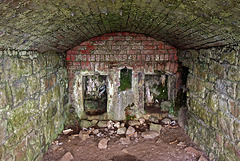
Lledwigan Kiln draw holes
| |
|
Inside one draw tunnel of a pair of draw kilns at Lledwigan on Anglesey. These were working in 1888 but by 1900 were disused. These commercial draw kilns have two draw holes in each tunnel with a poke hole between.
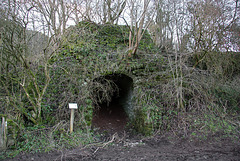
Gratton
| |
|
Small limekiln at the bottom of Gratton Dale. This is typical of the small kilns that once abounded across the White Peak.
Cocklaw Limekilns
| |
|
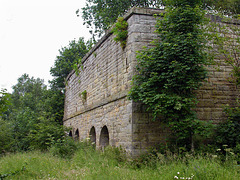
This pair of limekilns stand alongside the former Hexham to Reedsmouth railway and were once connected to Cocklaw Quarry by a tramroad. They appear to have been erected at some point after 1865.
Pant limekilns
| |
|
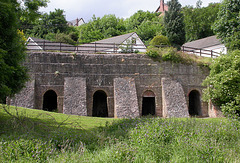
The Grade II listed Pant bank of six kilns stand close to the Ellesmere Canal which was once used to carry away the product. Many sources refer to five kilns here, but there is, in fact, a sixth. The left-hand kiln is now blocked up with the face buried. Stone was brought down from the Llanymynech quarries via an inclined plane.Production seems to have ended here before 1880. A private house now stands where the charging bank was located.

Limekilns
| |
|
18th or very early 19th century limekilns at High Edge up above Buxton and Harpur Hill. This view has the remains of two earthen kilns, right and centre, with the waste mound to the left. These intermittent kilns were operated on a commercial basis and supplied lime into Cheshire and Lancashire. The raw stone came from the hillside behind and to the right, whilst coal was supplied from mines around Axe Edge and Goyt's Moss a short distance to the west.

Draw holes
Gradbach limekiln
| |
|
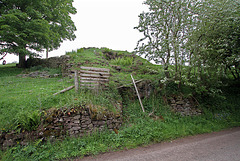
I have driven past this spot many times and never noticed this old limekiln at Gradbach. Having seen it on an old map it didn't take long to spot it in the ground. It was old in 1875 and may date from the eighteenth century.
Jump to top
RSS feed- Latest items - Subscribe to the latest items added to this album
- ipernity © 2007-2026
- Help & Contact
|
Club news
|
About ipernity
|
History |
ipernity Club & Prices |
Guide of good conduct
Donate | Group guidelines | Privacy policy | Terms of use | Statutes | In memoria -
Facebook
X
