

tarboat's photos
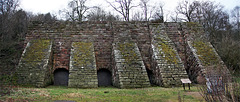
Consall limekilns
| |
|
At Consall Forge against the canalised River Churnet stands a bank of four large limekilns. These date from the early nineteenth century and were linked to the North Stafford Railway, a plateway built between 1815 and 1819, running from the Caldon Canal to north of Caverswall. Coal was brought in on the plateway from a number of local collieries and lime carried to Weston Coyney and beyond. By 1840 the line was out of use although it is unclear when the kilns ceased operation.
After years of neglect the kilns have been repaired and unfortunately made ultra safe. Three of the draw holes have been bricked up and the right hand one remains open but gated. The bowls have been filled in and the kiln top secured with a hideous fence.
Electricity
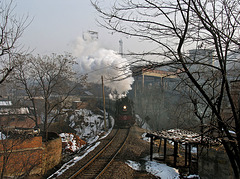
Passing Dazhuangkuang colliery
| |
|
The afternoon passenger service threads its way through the houses at Dazhuankuang on the western fringe of the Pingdingshan coal railway.
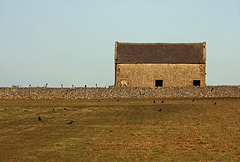
Barn near Elton
| |
|
We took a walk into the Derbyshire Dales this afternoon in glorious sunshine. On the higher ground above Elton stands this lonely barn with an accompaniment of crows.

Entering the Gulumanhan loops
| |
|
The last few months of steam on the Jitong railway saw QJ class locomotives double-heading on the section between Chabuga and Daban. I always liked the semaphore signals at the passing places and particularly those at Gulumanhan, where a heavy westbound train is seen here entering the loops.
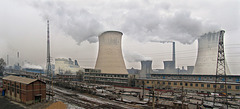
Fushun Cogen power station
| |
|
Situated fairly close to the enormous opencast coal mine at Fushun, the Cogen plant has a capacity of 150Mw.
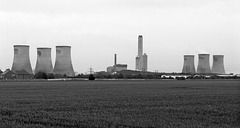
Didcot power station
| |
|
2000Mw Coal/Gas fired station at Didcot A and 1360Mw Combined Cycle Gas Turbine station at Didcot B.
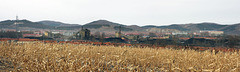
Coal on the cob
| |
|
Beyond the maize fields stands the Donghaikuang colliery and associated housing for the workers. This is a typical industrial landscape in north east China.
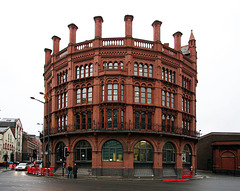
12 Hanover Street
| |
|
This extraordinary building curves around into Duke Street close to the centre of Liverpool. It was built in 1889-90 to the designs of Edmund Kirby and originally formed the offices and warehousing for Ellis & Co who were shipowners. The terracotta work was produced by the Ruabon Brick and Terra Cotta Company.
Passing the yellow house
| |
|
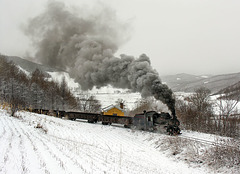
Christmas greetings to all my Flickr friends.
Seeking a suitably snowy and Christmassy image I found this view of the Huanan coal railway with a C2 class locomotive with the empties passing the lineman's house about half way up the climb to the summit. The only problem is that this scene dates from April rather than December. They have long winters in north-east China.
Coal picking
| |
|
|
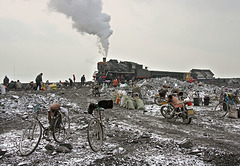
The collection of small pieces of coal and semi-coal from the waste material has been developed into a highly organised activity on the Xinghua colliery tips. Every trainload of material is sifted by the picking gangs who operate not only on the level summit area but also on the steep and dangerous slope on the other side of the tracks. There was a constant stream of people wheeling away sacks of material balanced on the crossbar of their bicycles.
Didao Hebei washery
| |
|
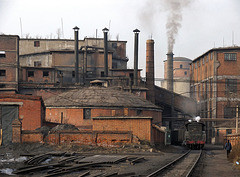
Chinese colliery architecture at its best at Didao, part of the Jixi collieries. The circular building contains a concentrator for dealing with coal slurry which is then often used to make briquettes. It is roofed over because of the extreme cold experienced in north-east China in winter.
Local power
| |
|
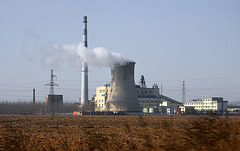
Power generation in China includes a large number of small local power plants similar to the situation in Britain sixty or seventy years ago. Due to the massive demand for electricity as the Chinese economy expands these are not yet being shut down as larger units come on line. This station, close to Jinzhou, was photographed from a moving minibus.
Didao washery
| |
|
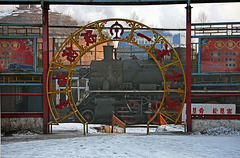
On arrival in the Jixi area in early December we transferred straight from the sleeper train to the washery on the Didao system operated by the Jixi Mining Administration. Soon after the sun rose SY1213 was to be found stabled outside the control office whilst the crew had breakfast.
Rural transport
| |
|
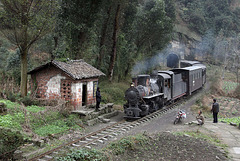
The Jiayang coal railway is a rare survivor of a narrow gauge line that continues to serves a whole community. Due to the lack of roads in the area the line carries almost everything up to the villages and towns in this remote part of Sichuan Province.
Towards the top end of the line a morning passenger service is seen emerging from one of the tunnels just north of Bagou.
Dove Holes
| |
|
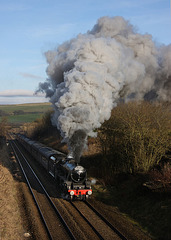
Having photographed the Buxton Spa Express as it passed Combs it was then a case of seeing whether I could get back to the car and traverse the single track road to Dove Holes in time for a second shot by the station.
In the event it was a very close run thing. It took ages to climb the hill to the car and then at Dove Holes there was nowhere to park. The exhaust from the locomotive looked very close and I finally abandoned the car by the station bridge and dived into the crowd by the parapet. No time to think, just lens cap off and shoot! I suspect that the sunny side would have been too tight for a decent view so I am quite happy with the result here.
Double heading
| |
|
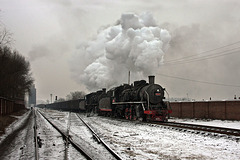
A dark winter morning in Jixi as a pair of SY class locomotives set out from the yard at Dongchang colliery with a long coal train heading for the China Rail interchange.
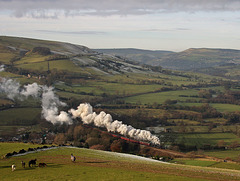
Buxton Spa Express
| |
|
|
|
The annual Buxton Spa Express with Black 5 45407 in charge climbs past Combs on the ex LNWR line from Stockport to Buxton on a fine sunny day after overnight frost and fog.
