

tarboat's photos
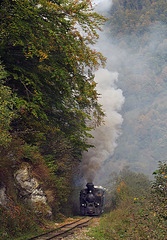
Heading up the valley
| |
|
Morning train of empty log bogies with a coach for the workforce heads out of Viseu de Sus.
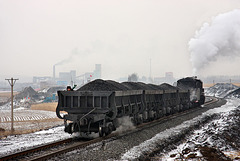
Pushing spoil
| |
|
Xinghua mine lies at the far western end of the Chengzihe system on the Jixi Coal Railway. It is the large colliery seen in the distance as a load of spoil is propelled rapidly along the line towards the tip which is situated about half way to the reversing point at Zhengyang colliery. The flagman peers ahead from his position mixed in the with spoil in the front wagon. Not much fun facing into the icy wind on a day such as this.
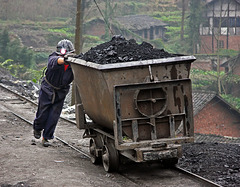
Huangcunjin mine
| |
|
The first tub of the morning is pushed from one of the adits at the Huangcunjin mine at Bagou.The coal will shortly be tipped into the bunkers for transfer to the railway to Shibanxi
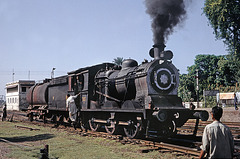
SGS
| |
|
A Standard Goods Superheated Setting back from the station at Malakwal Junction. A happy day was spent here watching the action, followed by a hair-raising drive back to Rawalpindi.
Lijing mine - steam still lives
| |
|
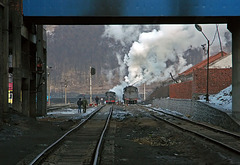
I was told that steam was all but finished on the Hengshan system at Jixi. It was almost dark, well below freezing, and I was frozen to the marrow in the bitter wind. So why did I stay in the barren windswept wasteland that is Lijing Colliery?
And then there was action. SY 1018 arrived with coal empties and SY1344 departed with a trainload of spoil for the tip. 1600 ASA and 1/15 second at f5.6. I must be soft in the head.

Pipe gantries
| |
|
Pipework and reeds at the rear of the Boots manufacturing plant at Beeston, Nottingham. Viewed across the Beeston and Nottingham Canal.
The Blue Bridge
| |
|
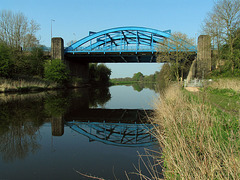
Known to all locals as 'the Blue Bridge", the Hartford bridge on the Northwich Bypass over the River Weaver is, in fact, two spans built side-by-side. The nearer one was erected in 1939 to replace a stone arch bridge, but the further span was delayed due to the outbreak of the war and was finally finished in the early 1950's I think.
Fenceposts
| |
|
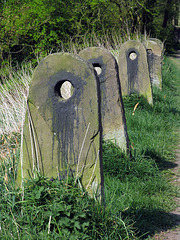
When the Macclesfield Canal was being built high embankments caused considerable difficulties to the engineers due to subsidence and slipping. Some of these banks have continued to cause problems and in these cases the normal hedgerow boundary was replaced by a fence comprising stone posts with holes cut in them to carry a tarred cable. It has been suggested that this may have been a re-use of the haulage cable from the Chapel Milton incline plane on the Peak Forest Tramway which was in the same ownership as the canal from the 1840s.
These are some of the fenceposts on Dane-in-Shaw bank at Congleton, a structure that still causes the canal engineers problems of subsidence.
Relics - water tank
| |
|
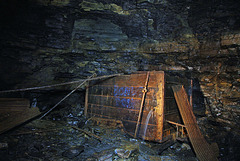
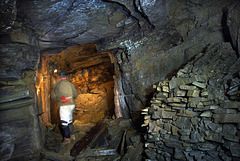
One of the joys of underground exploration is the survival of artefacts that would have long since disappeared above ground. This wooden water is still holding water nearly eighty years after abandonment of this extensive gritstone mine.
Cracken Edge mine
| |
|
The Cracken Edge Quarries were exploited for gritstone in the nineteenth century and probably earlier. There is very little published on the history of the site even though it is extensive and clearly visible from a long way off. What is clear is that the best stone became difficult to access by quarrying and was then exploited to a small extent by mining under the existing quarry faces.
Caver Keith assists in giving scale to, and lighting the further reaches of one of the mine passages.
The eyes of the posts
| |
|
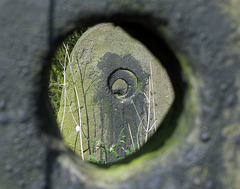
When the Macclesfield Canal was being built high embankments caused considerable difficulties to the engineers due to subsidence and slipping. Some of these banks have continued to cause problems and in these cases the normal hedgerow boundary was replaced by a fence comprising stone posts with holes cut in them to carry a tarred cable. It has been suggested that this may have been a re-use of the haulage cable from the Chapel Milton incline plane on the Peak Forest Tramway which was in the same ownership as the canal from the 1840s.
This view is looking through some of the fenceposts on Dane-in-Shaw bank at Congleton. The cable has long gone but the tar remains around the holes.

Canada House
| |
|
Canada House on Chepstow Street, Manchester, was erected 1905-09 to the design of W and G Higginbottom as a textile packing warehouse for H S Booth and others. The cast iron framing is faced in fine buff terracotta with a variety of decoration. The building is listed Grade II.
Moving timber
| |
|
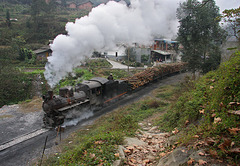
A trainload of logs sets off from Mifengyang on the Shibanxi Coal Railway. The timber had been brought down to this place on the backs of a number of pack horses that are used to transport heavy goods in this remote area with no roads.
Old Co-op - detail
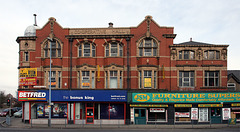
Little Hulton Co-operative
| |
|
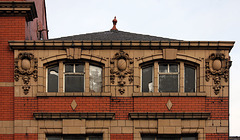
No longer in Co-op use, this fine building incorporates some lovely terracotta decoration and lettering. Pity about the ground floor changes.
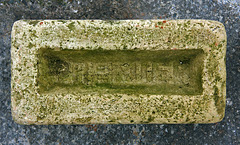
Aston Hall Coal & Brick Co, Flintshire - obverse P…
| |
|
The Aston Hall works were situated on the slopes below Buckley Mountain. The works was established c1864 by Messrs Kershaw and taken over by the coal co in 1868 when there were two kilns in use.
This is the obverse face of a Premier brand brick. The company catalogue from the 1890's states:
"The Aston Hall Premier" bricks and terracotta are manufactured from a special clay of exceptional quality and unique character which is recognised by leading architects as producing the first and best Buff Goods in the kingdom. They are particularly noted for retaining their original colour and for not vegetating as is the case with the soft common buff bricks. The electric light has been placed throughout the works, and manufacture now goes on day and night.
The colliery closed in 1909 and, as the clay supplies had come from underground it was just a matter of time before the stockpile of some 10,800 tons was used up. The final dismantlement sale was on 24th July 1913.

Aston Hall Coal & Brick Co, Flintshire
| |
|
The Aston Hall works were situated on the slopes below Buckley Mountain. The works was established c1864 by Messrs Kershaw and taken over by the coal co in 1868 when there were two kilns in use.
This is the face of a Premier brand brick. The company catalogue from the 1890's states:
"The Aston Hall Premier" bricks and terracotta are manufactured from a special clay of exceptional quality and unique character which is recognised by leading architects as producing the first and best Buff Goods in the kingdom. They are particularly noted for retaining their original colour and for not vegetating as is the case with the soft common buff bricks. The electric light has been placed throughout the works, and manufacture now goes on day and night.
The colliery closed in 1909 and, as the clay supplies had come from underground it was just a matter of time before the stockpile of some 10,800 tons was used up. The final dismantlement sale was on 24th July 1913.
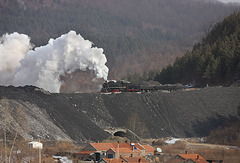
Windy day on the spoil tip
| |
|
This was the day that I discovered what a 'Siberian Blast' was. The wind picked up during the day and by early afternoon it was fit to cut right through you as temperatures plummeted towards -20C. I also learned that spoil trains pushed uphill on the Lishu system at Jixi and passed right through the Pinggang Colliery to tip on a massive embankment beyond.
SY 1118 pushes out onto the tip as the exhaust is whisked away on the wind from Siberia.
