

tarboat's photos

Gillan & Brown
| |
|
Loosely based upon the Injector Works of Davies and Metcalfe (Engineers to Railway and Industry), but with added railway connection, is this model of Gillan & Brown (Engineers to the World) seen at the Macclesfield Model Railway Exhibition this weekend.

Lady's Incline
| |
|
Standard gauge railways reached the Poynton Collieries in 1845 with the opening of a branch of the Manchester and Birmingham Railway from a junction with the Macclesfield line up to the Albert Pit. A coal yard was laid out on the east side the turnpike road level crossing from which landsales were made and trains assembled for dispatch onto the main line. By 1848, a further line was constructed from this yard to the Lord and Lady Pits at Hockley. It was known as the Lady's Incline and comprised a self-acting incline some 600 yards long at a gradient of 1 in 40, followed by some 400 yards at an easier inclination until Lord Pit was reached.
The self-acting incline continued in use until 1882 when it was converted to locomotive operation following the purchase of a tank locomotive from Walker Brothers of Wigan. When the collieries closed in 1935 the tracks were soon removed and the incline became a public footpath, well used by local people.
In 1984 the local council undertook improvements to the surface and during preparatory works the remains of the top wheelpit and rope guides for the self-acting incline were revealed. These were left in-situ and a course of bricks laid on top to represent the structures below the surface. This has survived well, as can be seen in this recent view looking down the incline across the wheelpit.

When times were better.
| |
|
Panorama of Redcar furnace and associated structures in June 2008 when business was good and recession was not in anyone's mind.

Washery bound
| |
|
Uphill trains run tender first on the Lishu system of the Jixi Coal Railway. As the sun falls low in the winter sky, SY 0951 trudges up with wooden hoppers filled with coal to be washed at the Pingang Colliery. It may have been a short train but the gradient is steep and the loco was working hard. The sound was wonderful!

Taiping Mine
| |
|
SY 0951 waits with its train whilst the wagons are filled by a loading shovel at the Taiping Mine which is situated on the remaining stub of the branch that once ran to the Qikeng Mine on the Lishu system of the Jixi Coal Railway. I waded through deep snow to try to find a position where all the locomotive wheels were visible, but this proved not to be possible and this was the best viewpoint I could reach.
Qikeng Mine
| |
|
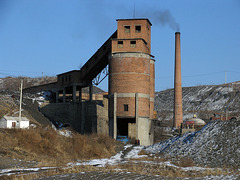
Small colliery connected to the Lishu system of the Jixi Coal Railways. At this time one or two trains a day were loading under the bunkers where the blue lorry stands but since then the mine has closed and the tracks have been lifted.

Donghaikuang Mine
| |
|
Donghaikuang is a long and rough drive from the center of Jixi town to this mine which is situated on a remote section of the Jixi coal railways. Trains on this branch have to travel some distance over the National Railways to reach the CHP plant at Jidong. There is usually only one train each way during daylight in winter and this is being prepared here with much shunting under the distant loading bunkers.

Above Yaojie
| |
|
SY 1097 leads a long train of empty coal hoppers across the viaduct on the approach to Yaojie. This train will have come from the aluminium smelter at the top of this line. Visibility was as good as it gets in this area!

Winnington Works by night
| |
|
The lights of the Brunner Mond soda ash plant at Winnington reflect on the sluggish River Weaver. The massive structure housing the nine patent shaft limekilns is prominent in the centre.

Frodsham
| |
|
|
Barge Panary at the North West Farmers wharf on the River Weaver just below Frodsham Bridge. This barge, owned by Viaduct Shipping, was built in 1937 and trades between Seaforth Grain Terminal and Frodsham.
Coal breakers
| |
|
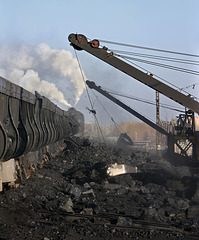
The coal extracted at the Sandaoling opencast mine is brought to an unloading point at the washery near the town where it is tipped onto a bar screen over the bunkers. Two cranes with steel 'D' shaped weights are then used to break up the oversize lumps so that they can fall through before being conveyed into the washery. This train is part way through unloading and the breakers are in use as one of the loaded wagons is tipped.

Shunting Breza Colliery
| |
|
A frosty and misty morning as Yugoslavian built USA tank clone is shunting the yard at Breza Colliery in Bosnia-Herzegovina.

Fleetline at Charles Street
| |
|
Mechanical attention underway on Daimler Fleetline YJA 8 at Charles Street garage Stockport.
Colliery winder
| |
|
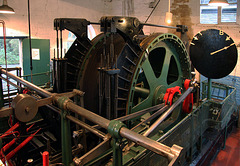
Steam winding engine and drum at Caphouse Colliery, built in 1876 by Davy Bros Ltd, Sheffield. This wound coal until 1974 and continued in use for shaft inspections until 1979. It is very small for colliery use and the shaft capacity was only 33 tons per hour. This led to the driving of a drift to enable output to be significantly increased.
Today the engine is preserved as part of the National Coal Mining Museum which is based at the colliery. It no longer winds the shaft as a modern electric winder is used to take visitors underground.

Big train, little tractor
| |
|
Oil tanks heading west towards Lindong on the Jitong Railway in the days when QJs were in charge.

Fan House
| |
|
The Unstone Coal & Coke Co Ltd sank two collieries in the village of that name during the late 1860s. Both had short lives and were closed in 1884.
An exploration of the mineral line that served these collieries, and others, yielded plenty of remains on the ground even after 125 years of abandonment. On the site of Unstone Main Colliery this is the building that housed the ventilating fan. The curving brickwork on the right side is typical of the installation for a Guibal fan and the one located here was 20ft in diameter and 6½ ft wide. Air would have been drawn from the workings via a tunnel conected to the opening in the far wall with the evasee chimney rising up on the left side of the building.
Photos of a surviving Guibal fan can be seen here .
Drawing of a Guibal Fan here .

Short train in the murk
| |
|
China Rail had a shortage of empty wagons on this morning as SY 0362 of the Yaojie Coal Railway heads for Yaojie from the exchange sidings at Haishiwan on a murky, foggy morning.
The limekiln in front of the bridge was not in operation during the winter period.

Ellistown
| |
|
Ellistown is situated close to Coalville in Leicestershire and takes its name from Colonel Joseph Joel Ellis who sank the Ellistown Colliery there in 1873 and soon after a brickworks was opened by the colliery.
Joseph Ellis died in 1897 and the colliery, brickworks and estate being carried on by trustees under Orders of the Court of Chancery until 1936. The colliery and brickworks were then separated into two separate companies and bricks production was then under the auspices of the Ellistown Brick and Pipe Company until closure shortly before the Second War.
