

tarboat's photos
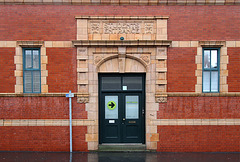
Students' Entrance
| |
|
|
|
Side entrance to the former Technical School on Abbey Road, Barrow-in-Furness was built 1900-1903 for Barrow Corporation to the design of Woodhouse and Willoughby. The building contractor was W Gradwell and Co. It is listed Grade II.
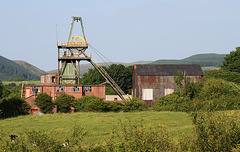
Florence mine
| |
|
|
The Florence ironstone mine near Egremont continued in use until 2008. It was the last working deep iron ore mine left in Western Europe and produced ore, products for the cosmetics industry and high quality haematite for jewellery. Production ended when BNFL ended the contrract for the mine to supply water and the cost of pumping rendered the mine uneconomic.
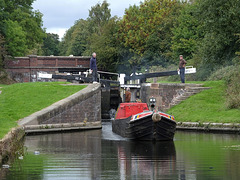
Rushall Locks
| |
|
|
Tanker narrowboat descending the lower section of the Rushall Locks near Walsall on the Birmingham Canal Navigations. There isn't much traffic on these further reaches of the BCN which is a great shame as the boating is lovely.
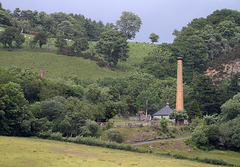
Central Van mine
| |
|
|
The Central Van Lead Mining Company Limited was floated in 1871 and was another example of blind optimism triumphing over common sense as the majority of the rich ores in the area had already been extracted. No lead was produced and operations ceased in 1878. The remains of this expensive venture include two chimneys and foundations of the enginehouse.
Falcon Mill
| |
|
|
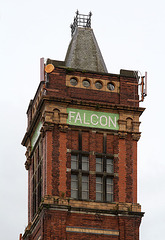
The Falcon Mill on Handel Street, Bolton, was built for Falcon Spinninmg Co Ltd in 1907 on the site of the former Brookfield Mill. In 1925 there were 96,000 spindles in use. It was still spinning cotton for Vantona-Viyella Yarns in 1985. It is grade II listed.
The tower incorporates the mill name in white glazed brick against green glazed brick. The decorative buff terracotta columns have been removed where the lighter brickwork now shows.
A good place to sit
| |
|
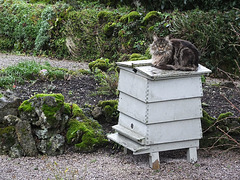
Seen in a garden at Alport. This is clearly a good place to sit and watch what is going on all around.
Alport
| |
|
|
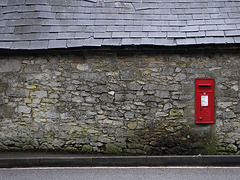
Just a scene in the village of Alport from today's wanderings in the Derbyshire Peak District.
Abercastle
| |
|
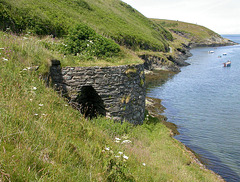
Disused limekiln nestling into the hillside at the little harbour at Abercastle. This is typical of the small coastal kilns that operated in the late eighteenth and early nineteenth century. The fuel for burning local limestone would have arrived in small sailing vessels which often beached to unload their cargo into carts.
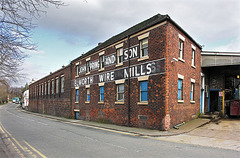
John Pring and Son Ltd, Elworth Wire Mills
| |
|
|
The long established wireworks of John Pring and Son Ltd at Elworth, Sandbach, Cheshire. The works manufactured specialist wires including Electro Galvanized Auto Bailing Wire and Hard Draw Annealed and Galvanized Wire. It was bought by American owners, the Leggett and Pratt group, and in 2009 the business was closed and placed in receivership. The site was cleared for housing development.
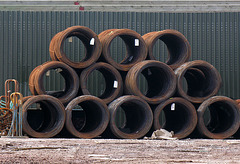
Pring's stockyard
| |
|
|
Wire coils in the stockyard of John Pring & Son Ltd at Elworth, Sandbach, Cheshire. Sadly all now gone and demolished after the firm went into receivership in 2009.
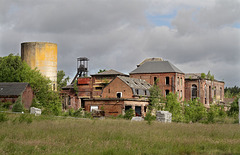
Coke and coal
| |
|
|
S.A. Cokeries et Houillères d'Anderlues first erected coke ovens in 1904 which were replaced by new ones in 1931. The works produced foundry coke and was one of the smallest and oldest coke by-product plants still operating in Belgium at the time of closure in November 2002.
In the background is the headframe of Puits No.6 which was the last of the mines operated by SA Collieries Anderlues and which closed in 1969.

Market Tavern
| |
|
|
The Market Tavern on the corner of Percy Street and Tontine in Hanley. There is a small amount of rather attractive terracotta decoration on this building and I would date it as being from the 1880s. Since I took this photograph a lot of the street clutter has been removed in a pedestrianisation scheme.
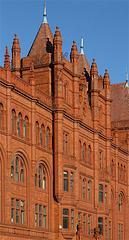
Duckworth's
| |
|
|
|
The Essence Factory in Old Trafford was completed in 1896 for Duckworth and Co to the design of architects Briggs and Wostenholme of Blackburn. The frontage comprised offices with the manufacturing and warehousing to the rear. After the Duckworth Group was taken over by Cargill in 2003 the premises were soon redundant and became empty by 2007. The Grade II listed building has been publicised for a number of years as a probable base for the Church of Scientology but it currently stands vacant. The terracotta is of high quality and was probably manufactured by Dennis of Ruabon who certainly made the bricks used at the front.
The Monster Mine
| |
|
|
|
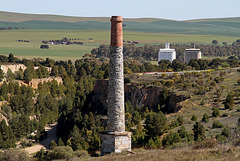
The Burra Burra Copper Mine (The Monster Mine) was established in 1848 mining the copper deposit discovered in 1845. Miners and townspeople migrated to Burra primarily from Cornwall, Wales, Scotland and Germany. The mine first closed in 1877, briefly opened again early in the 20th century and for a last time from 1970-1981. The Burra mines supplied 89% of South Australia's and 5% of the world’s copper for 15 years and the settlement has been credited (along with the mines at Kapunda) with saving the economy of the struggling new colony of South Australia.
Pen-y-Clyn Mine
| |
|
|
|
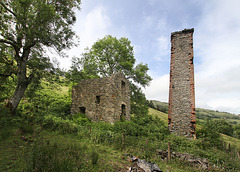
In 1846 William Lefeaux was fortunate enough to discover a rich lead orebody close to the surface at Pen-y-Clyn in about 1846. This did not persist in depth but work appears to have continued on and off here until at least 1869. It has been suggested that this was also known as West Van Mine.
The tiny engine house at Pen-y-Clyn Mine seems to have little information available about its history. David Bick suggested that it was erected c1863 and contained a rotative Cornish Engine of c20" cylinder. The buildings here have been subject to some restoration and consolidation by the Welsh Mines Preservation Trust.
John Swift, Fruit Merchant
| |
|
|
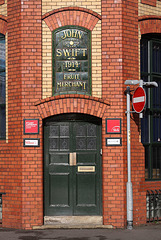
The entrance to the Swift building at the junction of Addington Street and Mason Street in Manchester's Northern Quarter. This former warehouse has now been converted to offices.
Female of the species
| |
|
|
|
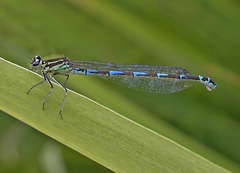
The male Variable Damselfly Coenagrion pulchellum is fairly easily recognised and differentiated from similar species whereas the female can be rather more difficult to identify. This is a female seen at a marl pit at Churton in the west of Cheshire.
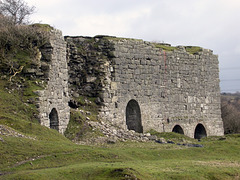
Pant-y-Pydew kilns
| |
|
A fine block of five kilns stands adjacent to a large working quarry. The stone here was worked in the first half of the nineteenth century by John Lloyd and by 1862 it was operating as Lloyd Jones & Co. There is a large bank of lime waste in front of the kilns. Lime from here was used in the building of docks in Liverpool, Birkenhead and Belfast between 1860 and 1890. It appears that the bank of kilns was extended twice. Production ended in 1914 and the face of one kiln has now collapsed whilst its neighbour shows signs of having been robbed of stone.
