

tarboat's photos
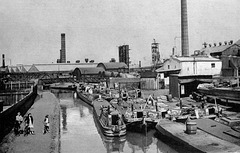
Clayton's Yard, Oldbury
| |
|
|
|
A whole fleet of tarboats are tied up here at the yard of Thomas Clayton (Oldbury) Limited on the Titford Canal. Thes boats carried gasworks bye products such as gas tar and ammonia water to Midland Tar Distillers at Oldbury and from the mid 1950s at Four Ashes on the Staffordshire and Worcestershire Canal. Until the mid 1950s they also brought gas oil from Stanlow on the Manchester Ship Canal. Clayton's canal operations ran down in the 1960s and their yard seen here disappeared under the M5 motorway viaduct after 1966.
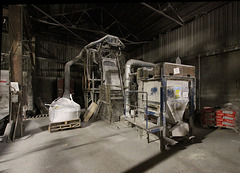
Brickmaking
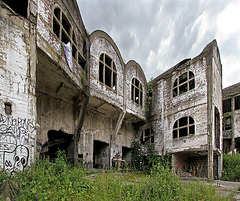
Charbonnages de Gouffre
| |
|
|
Shaft No.10 was opened by Société des Charbonnages du Gouffre in 1916. The concrete structures here were built in 1934 when the mine could produce up to 145,00 tonnes per annum. The mine closed in 1969 and was later a zoo and a scrapyard. It now stands derelict and rather the worse for wear.
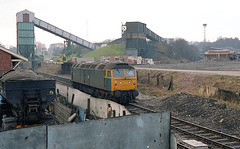
Running round
| |
|
Silverdale Colliery. 47 354 sets off to run around its train of MGR hoppers before pushing them under the bunker for loading.
Lumbhole Mill
| |
|
|
|
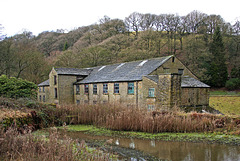
Lumbhole Mill in Kettleshulme is a fine survival of a textile mill located in a fairly remote place to take advantage of water power. Erected during the 18th century as a candlewick (tufted cotton fabric) mill, the breast-shot wheel was connected to a steam beam engine c1830. This engine, built by Sherrats of Salford, and the wheel both survive in situ. It has had a number of engineering and storage uses since textile manufacturing finished.
Pre-heater
| |
|
|
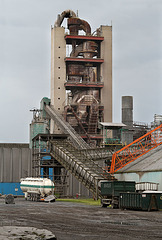
Pre-heater stage for the rotary cement kiln at Antoing works. The CBR cement works at Antoing on the Scheldt is part of the Heidelberg group. The kiln was started in 1986 and in 2012 produced 822,594 tonnes of cement clinker.
Murray's and McConnel & Kennedy's Mills
| |
|
|
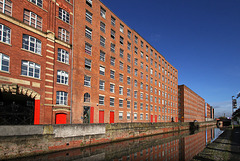
Alongside the Rochdale Canal in Ancoats are this fine group of cotton mills. From the right are Murray's Decker Mill (1801-02) and Old Mill (1798), McConnel & Kennedy's Sedgwick Mill (1819-20) and Royal Mill 1912).
Defensive line
| |
|
|
|
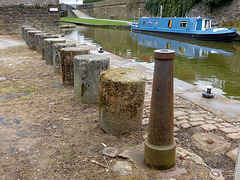
Anti-tank cylinders guarding the wharf at Marple on the Macclesfield Canal. The metal object is a crane base.
Compstall Navigation
| |
|
|
|
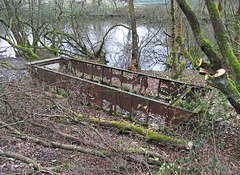
The steam engines that assisted the waterwheels in powering George Andrew's cotton mill at Compstall required coal for the boilers and this was supplied for a time by a mine high up in Ernocroft Wood to the east of the River Etherow. The coal was brought down a self-acting incline and across the river on a trestle bridge to a staithe at the side of the canalised leat feeding the mill reservoirs from a weir upstream. From here tub boats hauled the coal in loads of about 8 tons to the mill.
This is the remains of the last surviving tub boat which now sits rotting at the edge of the pool near the weir. These boats were 22 feet 6½ inches long by 6 feet 5 inches wide at the gunnels and at the bottom of the hold they were 18 feet 10 inches long, the vertical sides being 3 feet 2½ inches high. They were constructed of wrought-iron plates riveted together and towing rings were attached to the gunnels. There were also four rowlocks, used for steering purposes, as there was no rudder. The coal traffic on the navigation seems to have ended at some point between 1848 and the 1860s.
Cornish leftovers
| |
|
|
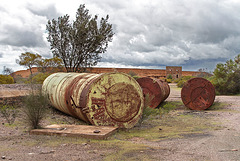
Disused Cornish boilers are scattered across the ground adjacent to Taylor's Shaft at the Moonta Copper Mines in South Australia. These vessels have been used for water storage after their steamraising days were over. Richman's 1869 enginehouse which housed a 32 inch Cornish beam engine driving crushing and concentration machinery stands in the background. The large tailings dump was reworked by leaching with seawater in the 1920s and 30s and the terraced effect dates from those times.

Power over the hill
| |
|
|
Ratcliffe-on-Soar Power Station peeks over the horizon. Seen on a walk around Gotham's former gypsum mines.
Holme Mill
| |
|
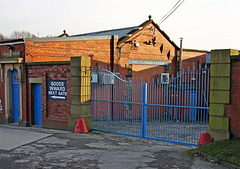
Holme Mill at Ramsbottom was built in 1912 and owned by The Holme Mill Manufacturing Co. Ltd. It was used for weaving cotton. The company was in liquidation in 1924 and must have had other owners until it became used for carpet manufacture by Cormar Carpets in 1956. It remains in use by Cormar to this day.
Nant Hall Road Church
| |
|
|
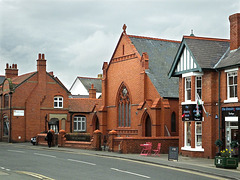
More terracotta goodness from Prestatyn. Nant Hall Road Presbyterian Church was established here in 1902.
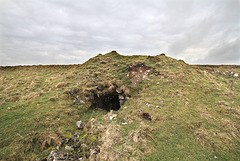
Intermittent limekiln
| |
|
This medium-sized intermittent kiln to the west of Hillhead was worth a visit whilst mooching around the Harpur Hill bomb store near Buxton. The draughting tunnel is still accessible and the kiln is in reasonable condition considering that it has probably been out of use for nearly 200 years.

Nacreous cloud
| |
|
|
|
I think that this phenomenon, seen whilst walking the old collieries on Combs Moss, is Nacreous cloud.
Nacreous clouds are wave clouds. Their sheet-like forms slowly undulate and stretch as the waves evolve. The clouds can also be associated with very high surface winds which may indicate the presence of, or induce, winds and waves in the stratosphere. They form at temperatures of around minus 85ºC, colder than average lower stratophere temperatures, and are comprised of ice particles ~10µm across. The clouds must be composed of similar sized crystals to produce the characteristic bright iridescent colours by diffraction and interference.
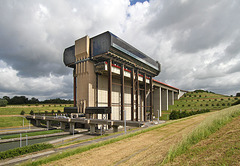
An uplifting experience
| |
|
|
|
The Strépy-Thieu boat lift was designed during the Canal du Centre's modernisation program in order to replace a system of two locks and four 16-metre lifts dating from 1888 to 1919. Building started in 1981 and was completed in 2002 after which 1350 tonne standard barges were able to pass between the Meuse and Scheldt rivers. It is the tallest boat lift in the world with a rise of 73.15 metres.

Civic pride
| |
|
|
|
A nice bit of terracotta at the 1903 built former UDC offices on Nant Hall Rd, Prestatyn.
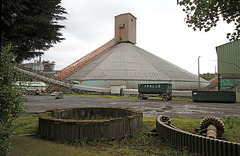
CBR Antoing
| |
|
|
Clinker storage at Antoing works. The CBR cement works at Antoing on the Scheldt is part of the Heidelberg group. The kiln was started in 1986 and in 2012 produced 822,594 tonnes of cement clinker.
