

tarboat's photos
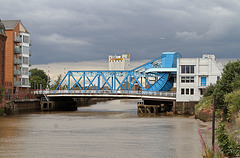
North Bridge, River Hull
| |
|
|
There has been a bridge at this point (close to the North Gate of the city walls) since 1541, before which there was a ferry. A hydraulically operated horizontal drawbridge was constructed in 1870 connecting Charlotte Street and Witham.
In 1925 plans were submitted for a new bridge designed by the City Engineer T. Thomas which included a straightened approach road approximately 30 yards north of the 1870 bridge. The bridge was contracted in 1927 for £86,100 to the Widnes Foundry (1925) Ltd, who constructed it as a Scherzer rolling lift bridge between 1928 and 1931. It was Grade II listed in 1994.
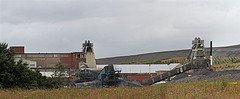
Thoresby Colliery
| |
|
|
The last but one deep mining colliery in Britain was Thoresby which was sunk in 1925. This was taken during its last week of production.
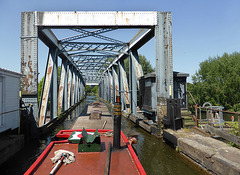
Crossing the tank
| |
|
|
|
The tarboat is just passing onto the Barton Tank (Barton swing aqueduct) over the Manchester Ship Canal as it heads towards Worsley and Leigh. It looks as if the steelwork could do with some painting.
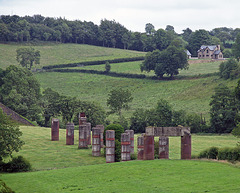
The Pillars of Monaghan
| |
|
|
|
Prehistoric or post-industrial?
Originally constructed as a timber truss bridge this viaduct carried the Dundalk and Enniskillen Railway (later Great Northern Railway of Ireland) on the approaches to the River Finn crossing. It was later replaced by lattice girder spans on braced metal trestles and then in c1925 it was replaced again by steel plate girder spans on cylindrical piers. On closure in 1959 the deck and much of the metal casing from the piers was removed, just leaving the pillars with one cross beam as a monument to the railway.
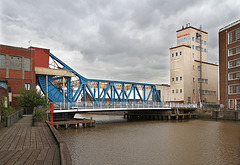
Drypool Bridge
| |
|
|
The Drypool bridge over the River Hull is a Scherzer lifting bridge and was designed by W. Morris, the Hull City Engineer. It was fabricated in Hull, being completed in March 1961. In the background the Shotwell building is a shot tower, making lead shot for shotgun cartridges.
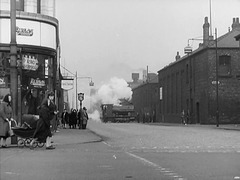
Forge Lane crossing
| |
|
|
|
Industrial steam locomotive crossing Forge Lane to enter the yard of Bradford Colliery in 1948. The view is taken from outside the Burton's shop in Ashton New Road. The colliery closed in 1968 and today even Forge Lane has completely vanished under the surrounds to the Etihad Stadium.

Power station sunset
| |
|
|
|
The third of the train window shots features the coal fired power station at Hailar in the Mongolian Autonomous Region of China as the sun sets on a bitterly cold day.
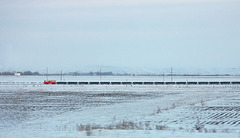
Limestone on the narrow gauge
| |
|
|
|
Another shot through a train window.
Following on from my previous image , the cement works near Hailar appears to be served by a narrow gauge railway that brings in the limestone from quarries several miles away. The last shot I took before it became too dark for photography was this view of a diesel locomotive hauling a long train of loaded bogie wagons heading for the works.
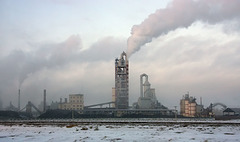
East of Hailar
| |
|
|
Inspired by a train window shot I saw recently, I decided to dig out some of my own travelling pics.
This is a large cement works seen from the overnight train from Manzhouli to Beijing shortly after departing from the stop at Hailar. It was almost dark and I had to bump up the ISO setting but the result isn't too bad.

161 High Street
| |
|
|
This office building in High Street, Hull, was built c1900 and is now listed Grade II.
Civic pride
| |
|
|
|
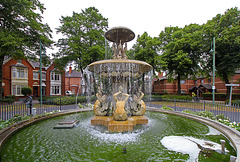
As Kingston-upon-Hull was rapidly expanding in the second half of the nineteenth century one expression of municipal pride was the erection of a number of public fountains including a number in the middle of wide streets which comprised a cascade with several levels suported by herons above and mermaids with conch shells bvelow. Located in a ‘circus’ at the junction of Boulevard, Cholmley Street and Gordon Street this Avenue style fountain was constructed c.1871 and was described in Sheperdson’s Guide to Hull in 1875 as: - ‘about midway [of Boulevard] there is a large circular space with a colossal fountain in the centre’. It was very similar but not exactly the same, as the fountains along Prince's Avenue.
All of the fountains were prone to traffic accidents it seems and the Boulevard fountain was no exception; on the 27th August 1924 the fountain was hit by a car and was removed soon after. As the regeneration and conservation of the Boulevard area has taken place in the past few years a campaign to have a new fountain in the Boulevard was successful and in 2008 a fine new - and working - fountain was erected. This was cast by Durham Foundry (Sheffield) Ltd, using ductile iron to allow welding of the various sections. I think it looks great.
Kellingley Colliery
| |
|
|
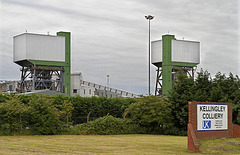
Britain's last deep mine. Kellingley this afternoon. Still coaling, but shedding men again today.

Baslow Colliery
| |
|
|
Coal mining remains at Baslow, Derbyshire. There are a large number of old shaft mounds across this land, most dating from the 18th century. The colliery, on land owned by the Duke of Rutland, worked the Ringinglow seam in the Lower Coal Measures.
West Burton Power Station
| |
|
|
|
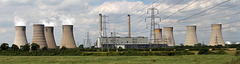
At West Burton there are two power stations on the River Trent near Gainsborough, Lincolnshire. One is a coal-fired power station, which was commissioned in 1968, and the second is a combined cycle gas turbine power station, commissioned in 2011. Both stations are owned and operated by EDF Energy. This is the coal fired station which generates 2,000 MW and was the first station of this capacity in Britain.
Scarborough - police box
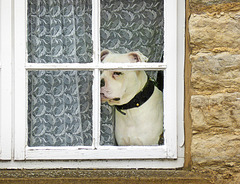
Oh yes!
| |
|
|
|
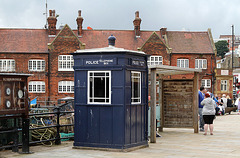
Seen at a window in Helmsley, North Yorkshire. I was immediately reminded of a certain insurance advert on the TV.
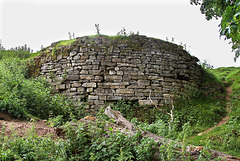
Studley Park kiln
| |
|
This long disused limekiln is hidden away in the middle of the Deer Park at Studley Royal.

Thoresby - the end
| |
|
|
|
Thoresby colliery will close today, two weeks early. The financial demise of UK Coal made this inevitable and now several hundred men will lose their jobs without any hope of finding an equivalent in the UK. This leaves Kellingley as the only deep mine in Britain until it too closes later this year.
Best viewed large
