

tarboat's photos
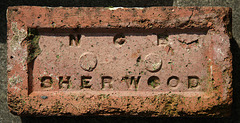
NCB Sherwood
| |
|
Sherwood Colliery in Mansfield Woodhouse was sunk in 1902. A brickworks was working in the pit yard by 1914 and the continuous kiln remained in use into National Coal Board ownership. Closure of the brickworks was on 19 April 1958 although the pit remained open until 1992.
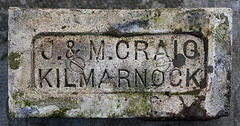
J & M Craig, Kilmarnock
| |
|
J. & M. Craig was formed by two brothers, James and Matthew, in 1847, with fireclay and brick works at Dean and Hillhead in Kilmarnock, and at Perceton, near Irvine. They also made high class sanitaryware. The company was incorporated as J.& M. Craig Ltd in 1896 but went into liquidation in 1923. At both sites the company worked coal and fireclay mines.
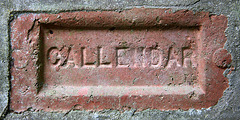
Callendar
| |
|
Callendar brick works was to the south of Glen Village near Falkirk. The brick and fireclay works moved to this location in the 1880s as part of the Callendar Coal Co. In 1947, the brickworks were separated off into a private company, the Callendar Brick & Fireclay Co. Ltd. This company was bought by Hepworth Iron Co in 1967 and the works closed down c1979. The site had nine kilns of five different designs.
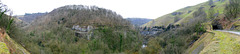
Miller's Dale
| |
|
|
A view over Miller's Dale during a walk on the Monsal Trail. Peak District limestone country at its best.
Lamorna Cove
| |
|
|
|
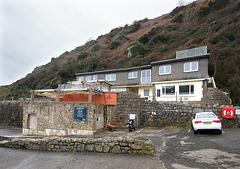
The limekiln at Lamorna Cove, on the south-western tip of Cornwall, was constructed in 1854. It was used to burn lime for construction of a pier to ship granite from the local quarry. Whilst the kiln has survived it is now largely hidden behind a boat shed and under the patio of the local cafe.
St Keyne limekiln
| |
|
|
|
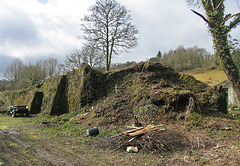
The limekiln at St Keyne on the Looe River was in use by 1833 and survived into the early 20th century. It is now very decayed with the pot demolished although the loading ramp remains intact.
In the boilerhouse
Swan and Railway
| |
|
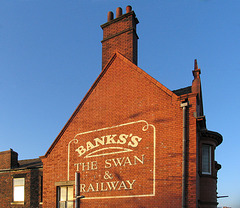
The Swan and Railway on Wallgate in Wigan was built as a hotel in 1898 to the design of W.E.V. Crompton. Today it functions as a rather basic pub but is listed Grade II.
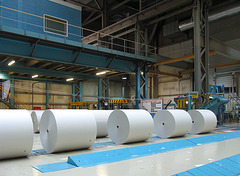
Empty newspapers
| |
|
Rolls of newsprint after cutting to width at the UPM paper mill, Shotton, Deeside. The mill produces about 22% of the UK newsprint requirement.
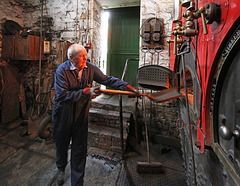
The stoker
| |
|
|
|
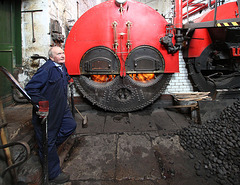
Boilerman firing one of the two Lancashire boilers at Queen Street Milll, Burnley.
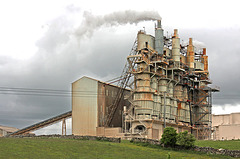
PFR Kilns
| |
|
|
Four Maerz PFR limekilns at the Tata Steel operated Hardendale Quarry at Shap.
A PFR kiln (parallel flow regenerative shaft kiln) consists of two vertical shafts and a connecting crossover channel. Both shafts work with each other. While one calcines the product, the other preheats the stone. In the burning shaft the lime is calcined in parallel flow. The hot combustion gases are then transferred through the crossover channel to the non-burning shaft where they preheat the limestone in counter flow in the upper area of the shaft. The flow direction of the gases is reversed at regular intervals. This allows the regenerative preheating of the stone to take place (the stone in the preheating zone of the kiln acts as heat exchanger) and thus for the maximum use of the heat contained in the kiln gases. The principle of calcination in parallel flow is ideal for the production of high-reactive quicklime. A PFR kiln from Maerz processes up to 800 tons of burnt lime per day.
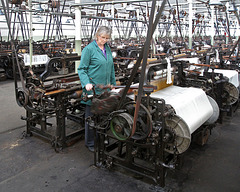
Weaving by steam
| |
|
|
|
Queen Street Mill at Harle Syke, Burnley, was built in 1894 for the Queen Street Manufacturing Company for weaving plain cotton fabric. The business saw little modernisation up to closure in 1982 since when the mill has been run as a museum, still operated by the 500 hp steam engine. The weaving shed once housed nearly 1,000 Lancashire looms and even today there are 300 looms. When running the noise is deafening. Sadly Lancashire County Council have announced closure of the museum and there is little future for the looms and engine which will surely be subject to the depredations of scrap thieves and vandals.
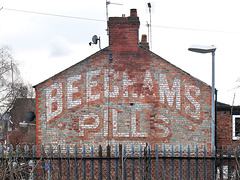
Beecham's Pills
| |
|
|
Advertising from days gone by, seen from the platform at Shotton Low Level Station.
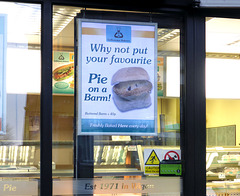
It has to be Wigan
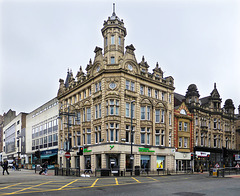
Yorkshire Building Society
| |
|
|
|
This highly decorated building at 148 to 150 Briggate in Leeds was built as Shop and offices for Hepworths c1904. The architect was Percy Robinson and the terracotta by the Leeds Fireclay Company. The modelled panels were designed by E Caldwell Spruce who is best known for his sculpting work for Burmantofts. It is listed Grade II.
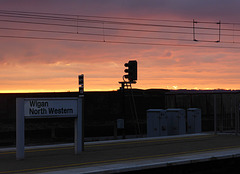
North Western sunset
Dust extraction
| |
|
|
|
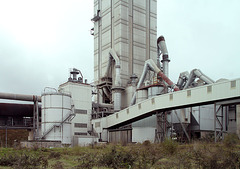
The base of the preheater tower at Padeswood cement works is a mass of dust extraction pipework. Part of the Heildelberg Group, the business is currently operated as Hanson Cement.
Sandplace
| |
|
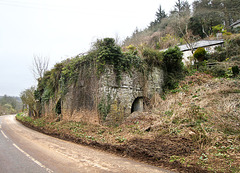
A pair of kilns roadside close the route of the Liskeard to Looe Canal. These may be the kilns that last worked in 1903 when in the ownership of Messrs Bishop and Peters.
