

tarboat's photos

Padeswood cement works
| |
|
|
Heidelberg owned cement works near Mold, North Wales. The No.4 kiln replaced three earlier ones and cost £63 million. It is 65 metres long with a 95 metre preheater tower that feeds in raw materials. Alternative fuels to be used at Padeswood include Cemfuel, which is processed from the residue of recycled waste solvents, and Profuel, which comprises paper and plastic wastes. Vehicle tyres can also be used as an alternative fuel.

Halifax Flour Society 1879
| |
|
|
The Halifax Flour Society was formed on 1st May 1847 to provide a co-operative corn mill following discontent against the Corn Laws, corn dealers' prices, and because much flour was adulterated. The Society sold to the public through agents. Initially 2,800 people bought £1 shares, and the Society bought a mill at Bailey Hall from where the first batch of cheap flour was sold in 1848. When the Bailey Hall mill became too small, a new 6-storey Bailey Hall was built in 1862. This was one of the most modern grain mills at the time and was opened with a party for 1,400 people on April 7, 1863. Later the Society bought more land at Bailey Hall and a new mill was opened in 1880. This is the building seen here. The Society was sold to the Co-operative Wholesale Society in 1915 and the Bailey Hall mill was sold to Paton & Baldwin. This mill eventually closed for flour production in the 1930s.

Australia Mill
| |
|
|
|
Slate sawing machines remain in the mill on the Australia level at Dinorwic Quarry. The site has been abandoned since 1969.

Welsh Highland sunshine
| |
|
|
|
Palmerston and Prince fetch a train of vintage stock around the curves approaching Rhyd-Ddu on the Welsh Highland Railway. The Snowdonian background includes the tips of a number of long disused slate quarries.

Cement works rail 2
| |
|
|
|
One of two 1975 built GEC Traction locomotives stands at the Hanson owned Ribblesdale Cement Works at Clitheroe stands outside the shed at the works.

Incline 43
| |
|
|
High up in the Penmaenmawr quarries is this drum house for incline 43 with the locomotive shed for the railways on this level outside which sits the rusting remains of a De Winton vertical boilered locomotive.

Steelile
| |
|
|
Steelile, on a building at Keshcarrigan, Leitrim. The Irish Steel Company Ltd was based at Haulbowline, Cork and traded from 1939 to 2001. Steelile was registered as a trademark by the company in 1960.

Hongshila brickworks
| |
|
|
Disused brickworks at Hongshila in the Nanpiao district of Liaoning Province in north-east China.

Lingquan (Jalainur) power station
| |
|
|
The sun sets behind the 600Mw Lingquan power station at Jalainur in the Mongolian Autonomous Region of China. It is operated by the China Huaneng Group which is the largest electricity producer in China with a market share of just less than 14%. The steam trains that served the nearby opencast mine and several deep mines have been replaced with diesels and the opencast mine is now closed.

Containers at Piccadilly
| |
|
|
A container service from Trafford Park threads its way through the side of Manchester Piccadilly just after the morning rush. This section of line is a major bottleneck and finding daytime freight paths is certainly difficult.
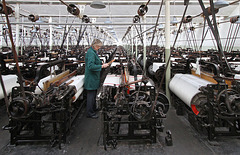
Looms
| |
|
|
Queen Street Mill at Harle Syke, Burnley, was built in 1894 for the Queen Street Manufacturing Company for weaving plain cotton fabric. The business saw little modernisation up to closure in 1982 since when the mill has been run as a museum, still operated by the 500 hp steam engine. The weaving shed once housed nearly 1,000 Lancashire looms and even today there are 300 looms. When running the noise is deafening. Sadly Lancashire County Council have announced closure of the museum and although a reprieve was given for the summer the future is still not looking good for this historic gem.

A fresh one
| |
|
|
A newly emerged male Black Darter ( Sympetrum striolatum ) having just alighted after its maiden flight at a pool in Delamere Forest this morning. This is the earliest date that this species has been recorded on the wing in Cheshire.

Another one gone
| |
|
|
|
Ferrybridge 'C' power station was closed earlier this year. Operated by Scottish and Southern Energy plc this 2000 megawatt power station first generated electricity in 1966.

When railways go bad
| |
|
|
|
Flood damage at Middlewood on the Stockport to Buxton line after several inches of rain fell in around an hour. Network Rail reckons that services will be resumed in a week.

Cottage Road Cinema
| |
|
|
|
The Cottage Road Cinema is the oldest cinema in Leeds and one of the oldest cinemas in the UK in that it has been continuously showing films since 1912. It came very near to closing in 2005 but was rescued at the 11th hour by Charles Morris. It became part of his Northern Morris Group which has saved other veteran cinemas in Skipton, Keighley, Ulverston, Elland and Windermere. The Cottage Road was originally called the Headingley Picture House and was converted from a garage and motorcycle assembly shop. It opened for business on Monday, July 29, 1912 when seats cost sixpence and reserved seats one shilling.

Farewell Rugeley
| |
|
|
Rugeley 'B' power station was still generating a few weeks ago but was finally switched off on June 9th.

Claughton brickworks
| |
|
|
The reopened brickworks at Claughton is operated by Forterra, which is the new name for Hanson Building Products.

Leeds Liberal Club
| |
|
|
This attractive terracotta building was completed in 1891 as the Leeds and County Liberal Club to the designs of local architects Chorley and Connon. Previously known as Quebec House, it was owned in the 1970s by Norwich Union and later became known as National Employers House. Since 2001 the building has been Quebecs, a boutique hotel of 45 rooms. It is listed Grade II.
