

tarboat's photos
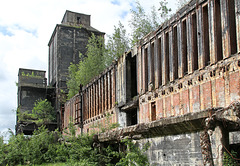
Disused ovens
| |
|
|
|
S.A. Cokeries et Houillères d'Anderlues first erected coke ovens in 1904 which were replaced by new ones in 1931. The works produced foundry coke and was one of the smallest and oldest coke by-product plants still operating in Belgium at the time of closure in November 2002.
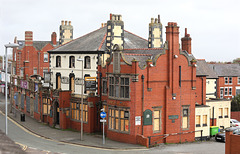
Station Hotel
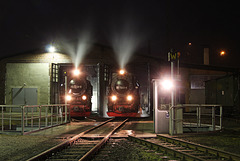
Nordhausen shed

Dry dock
| |
|
|
The dry dock in the former Shropshire Union Railways and Canal Company maintenance yard at Ellesmere dates from 1806. As well as for boat maintenance it was used as a gauging dock to establish the draught of boats with various weights of cargo so that the correct tolls could be allocated. Along with the rest of the maintenance yard it remains in use and is listed Grade II*.
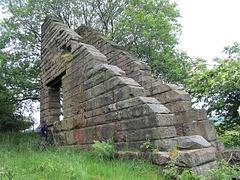
Cliviger Colliery
| |
|
|
The Union Pit and Railway Pit of the Cliviger Coal Company were both linked by ginney lines to a coking and processing plant adjacent to the Burnley to Todmorden railway. There are still significant remains on the site including this stone structure that seems to have been associated with raising coal to be loaded into railway wagons.

Central fire station
| |
|
|
|
The former Central Fire Station on Abbey Road, Barrow-in-Furness, was built in 1911 by the Borough Surveyors under architect Arthur Race. The terracotta for this Grade II listed building was supplied by Burmantofts of Leeds.
On the tip
| |
|
|
|
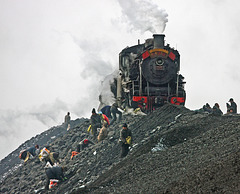
A closer crop of the view of SY 1437 on the Xinghua tip on the Jixi Coal Railway.The sheer number of people picking through the waste was remarkable.
Kelpies
| |
|
|
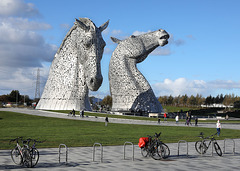
Kelpie - a water spirit of Scottish folklore, typically taking the form of a horse and reputed to delight in the drowning of travellers.
The Kelpies are horse-head sculptures standing next to the extension of the Forth and Clyde Canal. The sculptures were designed by Andy Scott and were completed in October 2013. They form a gateway at the eastern entrance to the Forth and Clyde Canal, and the new canal extension built as part of The Helix land transformation project. The Kelpies are a monument to horse powered heritage across Scotland. Built of structural steel with a stainless steel cladding, The Kelpies are 30 metres high and weigh 300 tonnes each and form the largest equine sculpture in the world.
The site has become a major tourist attraction and was very busy when I visited. The various tea rooms were very welcome after walking down from Falkirk.
Under the cinema
| |
|
|
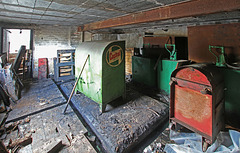
The Brookfield Cinema in Poynton opened in 1938 and closed as a cinema in 1957. Subsequently it was used as a car repair workshop, restaurant, gym, and club, but most of these did not last long. At the rear of the building was the engine room which had housed two Russell Newbery engines to drive the dynamos to supplying the mercury arc rectifiers for the projector lamps. The engines were rescued by the nearby Anson Engine Museum and the space was then used to store oil tanks and dispensers which are seen here mainly standing on the old engine beds. In the far corner as the galvanised tanks that held cooling water for the engines.
The building was demolished soon after this photo was taken in 2015 and an Aldi shop now stands on the site.

Midland Railway Institute
| |
|
|
The Midland Railway Institute on Railway Terrace, Derby, was opened in February 1894 as a cultural and educational centre for railway workers. At one time it contained a library of some 18,000 books, a concert hall with a stage and sitting for 500 people. In addition there were several other rooms set on one side for dining, meetings and games. In 1980 the Railway Institute had been leased off to the Post Office Social Club but that closed in 1994. Following the failure of plans to convert it to an arts centre, it was opened as a pub and party venue in 1996.
In the woods
| |
|
|
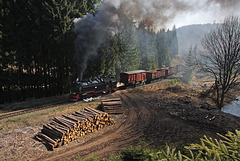
Transporter wagons with standard gauge stock aboard make up a train on the Harzquerbahn north of Nordhausen.
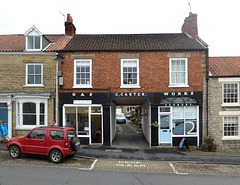
Gas Works Foundry
| |
|
This shop front in Kirkbymoorside dates from 1863 whilst the Kirk Forge operated here until around 1980. The lettered panels are cast iron. The building is listed Grade II.
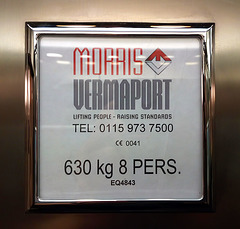
Lifting People - Raising Standards
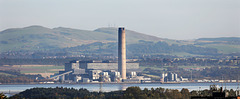
Longannet
| |
|
|
|
Disused Longannet power station seen from Falkirk. It had a generating capacity of 2,400 MW and is operated by Scottish Power. The station was completed in 1973 and at that time it was the largest in Europe. In addition to coal it was capable of burning biomass, natural gas and sludge. It closed in March 2016 after missing out on a contract with National Grid.
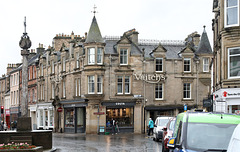
Veitch's Corner
| |
|
|
Veitch's outfitting business was started in 1884 by Robert Veitch and his wife, Helen Binnie Peden at their house in Gladstone Place, Peebles, and one year later they moved into newly-built premises at 2 High Street. About 1887 the business extended into the adjoining shops, which had been formerly occupied by J. Laidlaw (butchers) and J. Mason (bootmakers) at 1 and 3 Northgate and twenty-three years later they took over premises at the rear, for a men's department. The upper-floor living-accommodation was also converted for business use at that time. The Veitch's 'logo' was originally drawn on the back of an envelope by a friend of R. B. Veitch whilst they were serving together during the First World War, and remained unchanged therafter.
The business closed in 2008 and lay empty until January 2016 when Costa Coffee opened after several other proposals to re-open one of Peebles most historic buildings had failed to materialise.
Crown Hotel
| |
|
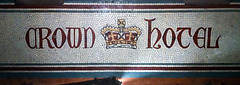
I spotted this mosaic in the entrance to the former Crown Hotel in Hawick. It was partly obscured by the two inward opening doors and the only way to capture the whole of the lettering was to close the doors to the street and use flash.
Gladhouse Mains kilns
| |
|
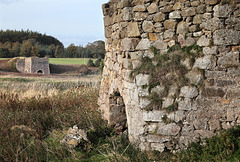
These two kilns both part of the Side Lime Works in Midlothian. In use in the mid nineteenth century they were both disused by 1893.
Hairy
| |
|
|
|
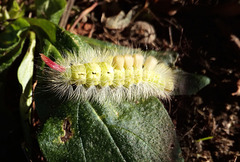
Whilst out and about I found this hairy beast wandering around the edge of a copse. It is the caterpillar of the Pale Tussock Moth ( Calliteara pudibunda ) and was looking for a place to pupate. The actual moth is rather less eyecatching.
