

This little piggie went to market ...
Wolf willow
Welcome to the Calgary Stampede
Food for her babies
Waiting for the big drop
Star-flowered Solomon's Seal
He knows he's handsome
Killdeer
Indian Village, Calgary Stampede
Sunny Gaillardia
Entrance to the tipi
For the love of yellow
The Black Tern challenge
Wood Frog
What the bears love to eat
Two of a kind
Pearl Crescent on Shrubby Cinquefoil
Bokeh and blur
Purple grasses bokeh
Delicate Harebells
Sleepy baby
Bokeh, bloom and spider
The sweetest kitten
Flashy and fun, the Mach 3
Spreading Dogbane
Pied-billed Grebe and babies
Is this White Pine?
A ring of hearts
Papayas
Too hot for the birds
Crab Spider on Gaillardia
Time to head for home
Is this an Orsodacnid Leaf Beetle
A beakful of bugs
Prickly Rose
Skinny wings
One of my favourite fungi
Say "cheese!"
Green on green
To lift the spirits
Old and twisted
Heart-leaved Arnica
Textures
Iridescence
Little bird, big caterpillar
Keywords
Authorizations, license
-
Visible by: Everyone -
All rights reserved
-
319 visits
Arctic Skipper
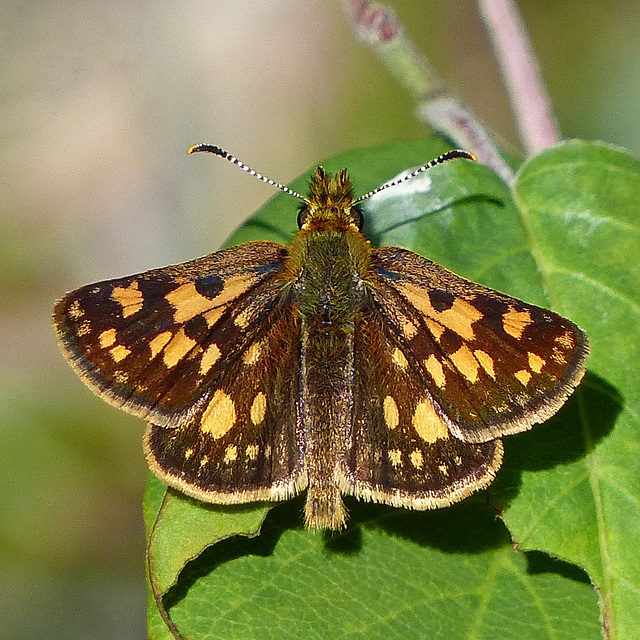

A tiny Skipper butterfly, seen at Griffith Woods on 15 June 2013. The Arctic Skipper is also known as Chequered Skipper.
"Eggs are laid in June or July and take about 10 days to hatch. On hatching, the larvae make shelters from rolled grass blades tied with silk from where they emerge at night to feed. In the autumn they construct a hibernaculum by drawing together several blades and the fully grown larvae spend the winter here. Before hibernation they are a pale green, after hibernation they are a pale beige. Upon waking the following spring they make no attempt to feed and will rest on a blade of grass for up to a week before pupating. The pupae are a pale buff colour with dark lines running along the length and are well camouflaged. About five or six weeks later the adult emerges and can be seen on the wing between May and July depending on the latitude (later further north). A very active butterfly, it needs a lot of nectar and sunshine. However, they are less strictly diurnal than other skippers. Although preferentially flying from the late morning to dusk, they may be found before dawn and some time after dusk too." From Wikipedia.
en.wikipedia.org/wiki/Chequered_Skipper
"Eggs are laid in June or July and take about 10 days to hatch. On hatching, the larvae make shelters from rolled grass blades tied with silk from where they emerge at night to feed. In the autumn they construct a hibernaculum by drawing together several blades and the fully grown larvae spend the winter here. Before hibernation they are a pale green, after hibernation they are a pale beige. Upon waking the following spring they make no attempt to feed and will rest on a blade of grass for up to a week before pupating. The pupae are a pale buff colour with dark lines running along the length and are well camouflaged. About five or six weeks later the adult emerges and can be seen on the wing between May and July depending on the latitude (later further north). A very active butterfly, it needs a lot of nectar and sunshine. However, they are less strictly diurnal than other skippers. Although preferentially flying from the late morning to dusk, they may be found before dawn and some time after dusk too." From Wikipedia.
en.wikipedia.org/wiki/Chequered_Skipper
, LeapFrog have particularly liked this photo
- Keyboard shortcuts:
Jump to top
RSS feed- Latest comments - Subscribe to the comment feeds of this photo
- ipernity © 2007-2026
- Help & Contact
|
Club news
|
About ipernity
|
History |
ipernity Club & Prices |
Guide of good conduct
Donate | Group guidelines | Privacy policy | Terms of use | Statutes | In memoria -
Facebook
X

Sign-in to write a comment.