

Herb Riddle's photos

HBM ~ A seat by the snowdrops
| |
|
|
|
A rare few hours of blue sky and sunshine brings us back to Dunham Massey to see the first snowdrops of the year. The good weather, albeit being cold, brings out many visitors here all clamouring for a bit of natures colour before the promised snows and rains returned just hours later.
See PiP for closer view of flowers.
Have a perfect day.

Aconite
| |
|
|
|
Spring beckons-hopefully as we take a walk in rare sunshine for a few hours.
Aconitum, also known as aconite, monkshood, wolfsbane, leopard's bane, devil's helmet, or blue rocket, is a genus of over 250 species of flowering plants belonging to the family Ranunculaceae.
Enjoy the day.

Ok, who’s turn is it to open the gate?
| |
|
|
|
Another shot from our December week in the Lake District. This one taken on our day in Coniston. As can be seen most of the low lying fields were under water. The other side of the gate is a wheelchair walk!
Best full screen
Enjoy the weekend.

Windswept
| |
|
|
|
Another vintage shot, this time from 2013. Taken on a windy day on the Cumbrian coast near Humphrey Head. It must be windy here almost permanently judging from the angle of this tree.
A little artistic edit here to add to the flavour (˚◡˚)
Enjoy full screen

Smardale Gill and its bridge
| |
|
|
|
A little south of the Smardale Gill Viaduct we have walked down the path just seen here between the two walls, over the old humpback bridge across Scandal Beck and now we treck uphill back to the old railway line walk to the viaduct. See PiP
It is officially listed with notes that it was there before 1948.
Enjoy the day.

Diamond Falls, St Lucia
| |
|
|
|
Diamond Falls, located within the Diamond Falls Botanical Gardens near the town of Soufrière, St. Lucia. This waterfall is known as one of the most colourful in the Caribbean because its water comes from volcanic springs and is rich in minerals. These minerals leave behind vibrant deposits on the surrounding rock face, creating the unique orange, yellow, and brown hues seen in the image.
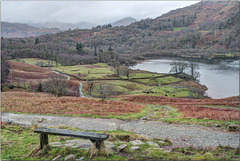
A Rydal Water view
| |
|
|
|
Wwe are on the northern side of Rydal Water, looking west towards Grasmere and White Moss. To our left and well above us is the famous Rydal Cave.
Enjoy full screen.

Welcome!
| |
|
|
|
We are actually at St Brelades’s parish church in the Island of Jersey.
Best full screen
Enjoy the day

Leaving Madeira
| |
|
|
|
A golden oldie here from 2008: After cruising parts of the Caribbean we sailed across the Atlantic to the Island of Madeira before cruising on to Southampton, England.
Enjoy the day.

The Langdale Pikes from Eltewater
| |
|
|
|
We are in fact on the banks of the River Brathay as it runs out of Elter Water here. Heavy rains abound but the sun peeps out to lighten the foreground for us here. As you can imagine, I loved the brightly lit fence post here as well as the illuminance of the grass.
Best full screen
Enjoy the weekend.

The cliffs of Hunstanton
| |
|
|
|
Welcome to these famous cliffs. We did want to walk the full length of this stripped part but the incoming tide did not allow us to do that. So a car ride to the other side and the previous photo (PiP) shows the results.
The stripes in the cliffs are caused by layers of different-coloured rock. The main layers are carrstone and chalk. Carrstone is the brown layer and consists of sandstone - sand cemented together by iron oxide (rust). In places where the cement is stronger, the rock is darker and less crumbly. There are no fossils in this layer apart from a little fossilised wood. The red and white chalk is made of limestone. Limestone forms in warm tropical climates, which suggests that Hunstanton's climate was once warmer than it is today. The colour of the red chalk is due to iron staining.
See PiP for opposite direction
Best full screen
Enjoy the day

The cliffs of Hunstanton from the town side
| |
|
|
|
The stripes in the cliffs are caused by layers of different-coloured rock. The main layers are carrstone and chalk. Carrstone is the brown layer and consists of sandstone - sand cemented together by iron oxide (rust). In places where the cement is stronger, the rock is darker and less crumbly. There are no fossils in this layer apart from a little fossilised wood. The red and white chalk is made of limestone. Limestone forms in warm tropical climates, which suggests that Hunstanton's climate was once warmer than it is today. The colour of the red chalk is due to iron staining.
See PiP for opposite direction
Best full screen
Enjoy the day

A Yorkshire Dales sunset
| |
|
|
|
Here, high above the Yorkshire Dales villages of Settle and Langcliffe we witness a typical late afternoon winter light. This area is festooned with dry stone boundary walls but it has a great deal of natural limestone outcrops too as witnessed here.
Enjoy full screen
Have a good day.

A corner of Tarn Hows
| |
|
|
|
After passing the small herd of Belted Galloway bullocks and deciding that we would have our picnic further along the lake, we looked back and saw this very nice scene. I liked the ochre coloured ferns contrasting with the blue sky and water here.
See PiP for original cattle picnic time.
Have a perfect day.

In memory of Alan
| |
|
|
|
Seen in the centre of the Lake District village of Hawkshead. This memorial bench dedicated to Alan Hardisty did make me think that perhaps he was an Everton football club player and my later research shows he did work behind the scenes for decades, particularly in kit and equipment roles, where he became a familiar and trusted presence to generations of players, managers, and staff at Goodison Park. Though not a player, he was widely regarded as part of the fabric of the club — one of those people who quietly keep everything running.
When he passed away in 2022, Everton paid tribute to him as a dedicated servant of the club, and many former players and colleagues shared memories of his loyalty, professionalism, and warmth.
Since it is near Christmas here that would explain the decoration and the blue – well that is the kit colour of Everton football club-naturally.
Have a perfect day.

A window on Lladdwyn Island
| |
|
|
|
A colourful view of Tŵr Mawr lighthouse on Lladdwyn Island through the old window of St Dwynwen’s Church. This is a ruined medieval church dedicated to St Dwynwen, the Welsh patron saint of lovers, often seen as the Welsh equivalent of St Valentine. It was a place of pilgrimage during the Middle Ages as archaeological work has shown traces of earlier buildings beneath the present ruins, indicating a long and complex ecclesiastical history. It has a cross shaped plan.
Tŵr Mawr lighthouse is Welsh for “great tower” and started life as an unlit marker it was improved with lighting in 1846. It was made redundant when the smaller nearby tower was fitted with more modern equipment in 1975
The PiP shows the same lighthouse taken last year.
Best full screen
Enjoy the day
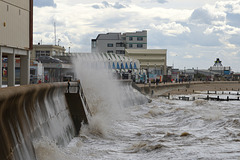
Hunstanton in the wind.
| |
|
|
|
Reaching the northern part of this seaside town our way is almost blocked by big wave splashes. Time for a photo, I thought.
Enjoy the day.

HFF ~ The pier is Closed!
| |
|
|
|
Another capture of flooded Coniston Water. This was the entrance to cruise yacht Gondola pier. Not many takers here at the moment.
Best full screen
Enjoy the weekend.
