

Along the canal
Autumn Golds
Autumn mist at Alexandra Park
Rest-up in Greenfield.
HFF – A Tandle Fence
An Autumn walk near Dovestones.
A rural Autumn
Our constant companions
A Clachtoll fishing building
A Clachtoll view
The final reach
A Loch Assynt view
Rainbow at Brushes
Ardvreck Castle
Loch Beannach, Assynt
Plover Scar Lighthouse
Lets sit and ponder Plover Scar
At work
Leeming Beck near Hornby
Rainbow at Higher Swineshaw reservoir
Which way should we go today?
Peep!
The last voyage!
Hen Borth in all its beauty.
St Rhwydrus Church, Hen Borth, Anglesey
Across Hen Borth, Anglesey
Flight of the Kittiwake
A Cemlyn Bay view
Parys Mountain 2
Parys Mountain - Hell on Earth!
Surfer in Porth Chapel
A Cornish Wave
Sunset at Wheal Coates.
Godrevy Lighthouse view.
View south over Trevellas Cove
Trevellas Cove
In tribute to our dear friend Andy: Wheal Coates,…
Wheal Coates tin mine, then and now. For Andy
Atlantic rainbow seat
Weston-Super-Mare – The Grand Pier
The west face of Ingleborough
Hornby Castle from the River Wenning
The chimney
Lone Tree at Silverdale
Clachtoll Bay
See also...
See more...
Keywords
Authorizations, license
-
Visible by: Everyone -
All rights reserved
-
497 visits
The Skerries
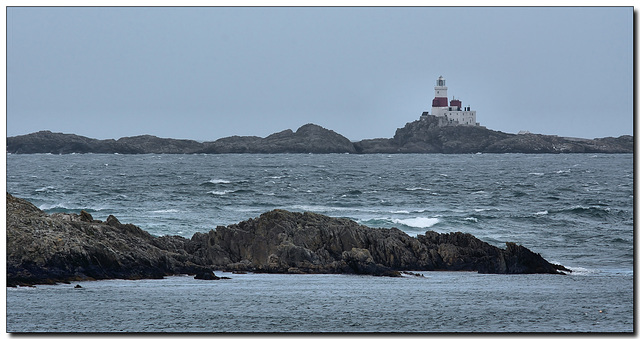

A very long range view of this lighthouse seen here from near Carmel Head.
"The Skerries Lighthouse was first lit on the highest point of the largest island in The Skerries, Isle of Anglesey after 1716. A patent for the lighthouse was subsequently obtained in 1824. The builder was William Trench, who lost his son off the rocks and died in debt in 1725. He is said to have originally been allowed a pension from the Post Office, rather than payment from shipping tolls. An act of 1730 allowed his son-in-law, Sutton Morgan, to increase the dues charged for shipping and confirmed the patent on the light to Morgan's heirs forever.
It was rebuilt around 1759 by Morgan's heirs for about £3,000. The rebuilt lighthouse was a slightly tapering limestone tower, 6.65 metres (21.8 ft) in diameter and about 8.5 metres (28 ft) high. It was lit by a coal brazier on top of the tower. Morgan Jones, raised the top of the tower on 1778 by 6.7 metres (22 ft) and built an iron balcony with railings enclosing the oil-burning lantern. The lantern was glazed all around with square panes and covered by a cupola.
Trinity House took over operation of the lighthouse under an enabling act of 1836
The lighthouse was lavishly restored by James Walker, exhibiting two of his characteristics: a decrease in diameter and a solid parapet. The stone-built gallery was 0.84 metres (2.8 ft) wide and bracketed out on corbels with a crenellated parapet. A new cast-iron lantern, 4.25 metres in diameter, was glazed with square panes around a dioptric light with mirrors, later replaced by a lens. On the north side of the tower there is a former external doorway exhibiting the Trinity House coat of arms, which now leads to the engine room.
The light shines at a height of 36 metres (118 ft) above the average high tide, with an intensity of 1,150,000 candelas. It flashes twice every 10 seconds and can be seen 22 nmi (41 km; 25 mi) away. In 1903–4, a solid circular tower, about 3 metres (9.8 ft) in diameter, was added to the south-west side of the main tower to carry a sector light. This shines at an elevation of 26 metres (85 ft) above the sea. The light was automated in 1987 and is now controlled from Holyhead.
Nearby are castellated dwellings having cobbled yards and entrance stairs, along with symmetrically sited privies, a garden, a stone bridge connecting two islets, and a unique stone well-head building. An axial corridor leads from the dwellings to the lighthouse tower's base. The early date of the lighthouse keepers’ cottages makes the buildings of considerable interest. For a number of summers, they have been used by wardens working for the Royal Society for the Protection of Birds." WiKi
Enjoy full size as usual.
"The Skerries Lighthouse was first lit on the highest point of the largest island in The Skerries, Isle of Anglesey after 1716. A patent for the lighthouse was subsequently obtained in 1824. The builder was William Trench, who lost his son off the rocks and died in debt in 1725. He is said to have originally been allowed a pension from the Post Office, rather than payment from shipping tolls. An act of 1730 allowed his son-in-law, Sutton Morgan, to increase the dues charged for shipping and confirmed the patent on the light to Morgan's heirs forever.
It was rebuilt around 1759 by Morgan's heirs for about £3,000. The rebuilt lighthouse was a slightly tapering limestone tower, 6.65 metres (21.8 ft) in diameter and about 8.5 metres (28 ft) high. It was lit by a coal brazier on top of the tower. Morgan Jones, raised the top of the tower on 1778 by 6.7 metres (22 ft) and built an iron balcony with railings enclosing the oil-burning lantern. The lantern was glazed all around with square panes and covered by a cupola.
Trinity House took over operation of the lighthouse under an enabling act of 1836
The lighthouse was lavishly restored by James Walker, exhibiting two of his characteristics: a decrease in diameter and a solid parapet. The stone-built gallery was 0.84 metres (2.8 ft) wide and bracketed out on corbels with a crenellated parapet. A new cast-iron lantern, 4.25 metres in diameter, was glazed with square panes around a dioptric light with mirrors, later replaced by a lens. On the north side of the tower there is a former external doorway exhibiting the Trinity House coat of arms, which now leads to the engine room.
The light shines at a height of 36 metres (118 ft) above the average high tide, with an intensity of 1,150,000 candelas. It flashes twice every 10 seconds and can be seen 22 nmi (41 km; 25 mi) away. In 1903–4, a solid circular tower, about 3 metres (9.8 ft) in diameter, was added to the south-west side of the main tower to carry a sector light. This shines at an elevation of 26 metres (85 ft) above the sea. The light was automated in 1987 and is now controlled from Holyhead.
Nearby are castellated dwellings having cobbled yards and entrance stairs, along with symmetrically sited privies, a garden, a stone bridge connecting two islets, and a unique stone well-head building. An axial corridor leads from the dwellings to the lighthouse tower's base. The early date of the lighthouse keepers’ cottages makes the buildings of considerable interest. For a number of summers, they have been used by wardens working for the Royal Society for the Protection of Birds." WiKi
Enjoy full size as usual.
Keith Burton, Steve D, J.Garcia, neira-Dan and 17 other people have particularly liked this photo
- Keyboard shortcuts:
Jump to top
RSS feed- Latest comments - Subscribe to the comment feeds of this photo
- ipernity © 2007-2026
- Help & Contact
|
Club news
|
About ipernity
|
History |
ipernity Club & Prices |
Guide of good conduct
Donate | Group guidelines | Privacy policy | Terms of use | Statutes | In memoria -
Facebook
X

Thank you for the interesting note.
Herb Riddle club has replied to Steve Paxton clubMore info here: www.photographers-resource.co.uk/a_heritage/lighthouses/LG2_EW/The_Skerries.htm
Enjoy the day. Herb
Best TOZ
.
Herb Riddle club has replied to TOZ clubKeep safe. Herb
Herb Riddle club has replied to David G Johnson clubKeep well. Herb
Sign-in to write a comment.