

Amelia's photos
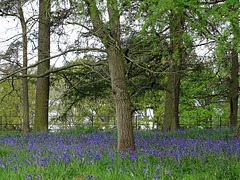
HFF from Attingham Park
| |
|
|
|
Find the fence amid the bluebells.
We all know, or think we know, what a true English bluebell, Hyancinthoides non-scripta, is. But many folks confuse the English bluebell with the Spanish bluebell, Hyacinthoides hispanica.
On the Spanish flower, the bells are all around the stem, not just on one side, which gives the English bluebell its drooping stature. The leaves are wider and bigger. The petals of each bell open wider and flare at the ends rather than curl. The bells are slimmer on the English bluebell. The stamen is blue on the Spanish version and yellow on the English one. The English bluebell is a deeper blue than the Spanish one, which is a delicate shade of pale blue. The English bluebell is stronger scented. The Spanish bluebell is taller. The Spanish bluebell can tolerate sunshine and happily grows in open spaces, whereas the English bluebell prefers at least partial shade and is never found growing in open spaces. Spanish bluebell flowers lift their heads towards the sun. English bluebells never do. But in their favour the Spanish bluebells are much more showy and the colours can be pale blue, purplish, pink or white, but I dig them out of my garden as soon as I see them.
www.youtube.com/watch?v=bGrWkRw70JU
www.youtube.com/watch?v=PRWi5Xah91s
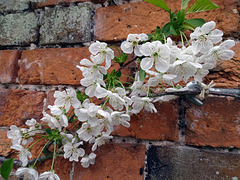
HWW
| |
|
|
|
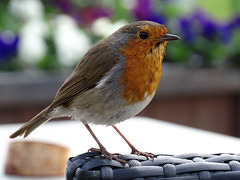
Spare a crumb please

Spare a crumb please
| |
|
|
|
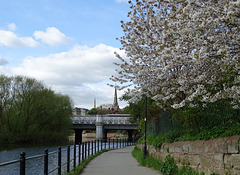
Barrier, Cherry tree, Bridge and Church
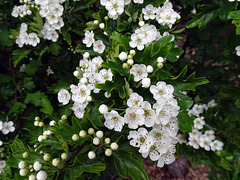
The darling buds of May at Attingham Park
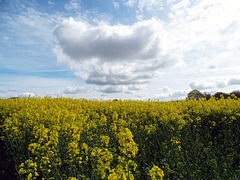
Oil seed rape
| |
|
|
|

Round the bend
In memory of Marie-claire who loved Nature
| |
|
|
|
Today's Sunday Challenge is: Dreaming
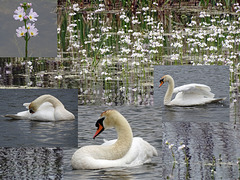
Yesterday we visited the Aston Locks Nature Reserve again and saw a pair of swans, 4 coots, an unidentified bird of prey (possibly a kestrel) and a delightful area of what appears to be Cuckoo Flower in one of the ponds. It would have been nice to collect all of this together as a dream photo, but the coots were too far away and the hawk was a blur in the sky. So here is a collage of dreaming.
The bird hide is now open, and a cold spring has arrived.
HFF from Shrewsbury
| |
|
|
|
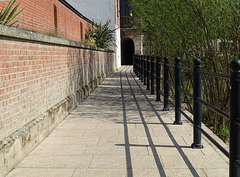
The opening at the end leads to a short tunnel that passes under the Welsh Bridge.
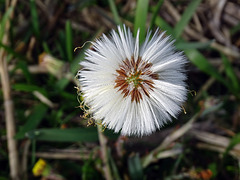
Tussilago farfara, coltsfoot seed head.
| |
|
|
|
The common name comes from the leaf's supposed resemblance to a colt's foot. The plant is believed to have been brought to the United States by early settlers for its medicinal properties.
Coltsfoot is a perennial herb, rhizomatous, 2-20 in tall with large basal leaves and scaly-bracted stem. The plant is now native to Europe and can be found in stream banks, moist field or pastures, roadsides and disturbed areas. It can also be found in drier sites and in poor soils, but it is intolerant of shade and is not commonly found in wooded areas
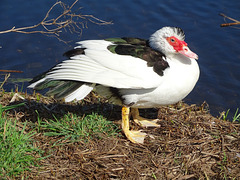
Muscovy duck (Cairina moschata)
| |
|
|
|
Birds have up to 25,000 feathers, and regular preening keeps each one of those feathers in top condition. Preening is a bird's way of grooming its feathers to keep them in the best condition. While preening, birds remove dust, dirt, and parasites from their feathers and align each feather in the optimum position relative to adjacent feathers and body shape. Most birds will preen several times a day to keep themselves healthy.
The PiP shows this Muscovy duck conditioning its plumage.

Iris, Mimosa and Forsythia. All fake, but rather…
| |
|
|
|

Easter eggs
| |
|
|
|
Today's Sunday Challenge is: 'FAKE'.
Eggs that one can't boil, fry, poach, scramble or even make an omelette with. What a swiz. ;-)
Hope you all enjoy the Easter holiday this weekend.
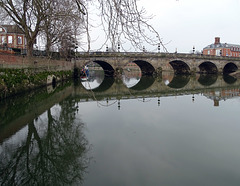
The Welsh Bridge
| |
|
|
|
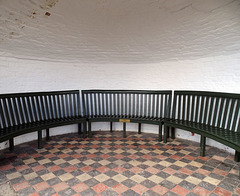
HBM from Erddig
| |
|
|
|
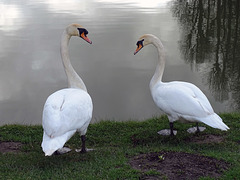
The look of love
| |
|
|
|
Dusty Springfield - The Look of Love 1967
It is fairly easy to distinguish the male swan or COB from the female swan the PEN. The large black fleshy lump at the base of the bill is much larger and more pronounced on the male, this can be called the "berry". The male's tail is also wider and more fanned out, whereas the Pen's comes to a single point. This difference is not so obvious in this photo.
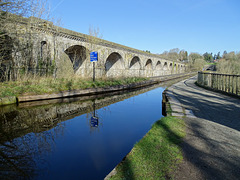
HFF from Chirk
| |
|
|
|
