

Amelia's photos
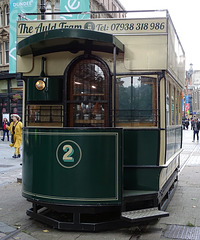
The Auld Tram
| |
|
|
|
Dundee 2 was constructed by the Milnes Company in Birkenhead during the late 19th century and after ending its service days when the Dundee tram system was electrified the body was sold on for re-use. The car was later rescued but sustained severe fire damage to the top deck whilst in storage; however the remaining portion of the lower saloon was eventually cosmetically restored by members of the Merseyside Tramway Preservation Society and was later transported back home to Dundee.
The tram was then moved to Nottingham where it was modified to suit its new role as a street cafe at a cost of around £45,000. The original tram seating was re-used to create a suitable work area and the end platforms and dash panels were also recreated, whilst wooden boarding was added to disguise the roof line. I remember distinctly the green and cream colour of the Dundee transport system, (now all the buses are different colours), but I wouldn't have ridden on this tram because the City Corporation then replaced the steam and horse trams with electric traction between 1900 and 1902, and I'm not that old. ;-)
We were in this district to meet up with my granddaughters who are both at Dundee University. (See PiP)
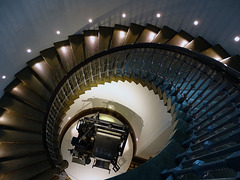
Interior of McManus Art Gallery
| |
|
|
|
At the bottom of the staircase is a linotype machine ( "line casting" machine) used in printing. Along with letterpress printing, linotype was the industry standard for newspapers, magazines and posters from the late 19th century to the 1960s and 70s, when it was largely replaced by offset lithography printing and computer typesetting.
This is a nod to Dundee's '3 Js', Jute, Jam and Journalism. DC Thomson is a Scottish publishing and television production company best known for producing The Dundee Courier, The Evening Telegraph, The Sunday Post, Oor Wullie, The Broons, The Beano, The Dandy, and Commando comics.
Courtesy of en.wikipedia.org/wiki/DC_Thomson

The McManus Gallery, Dundee
| |
|
|
|
The McManus Galleries were originally dedicated to Queen Victoria’s Consort and named the Albert Institute. Conceived as a focus for literature, science and art, Sir George Gilbert Scott created a powerful Gothic icon reflecting the city’s contemporary confidence, wealth and intellect in 1867.

Robert Burns at the McManus Gallery
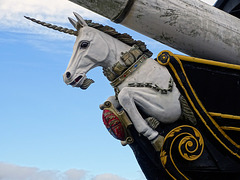
HMS Unicorn
| |
|
|
|

HMS Unicorn
| |
|
|
|
HMS Unicorn, of 46 guns, was built for the Royal Navy in the Royal Dockyard at Chatham and launched in 1824. She is now the World’s last intact warship from the days of sail, one of the six oldest ships in the world and Scotland’s only representative of the sailing navy.
HMS Unicorn spent her early years in reserve in the south of England and was brought to Dundee in 1873 to serve as the reserve training ship for the Tay. She carried out this function for nearly a century, and also acted as the headquarters ship for the Senior Naval Officer in Dundee during both World Wars.
The building in the background is the Clocktower building and has been a landmark of the port area for over 130 years. It was built to show its clock face to any vessel within the harbour or on the River Tay. This category A listed building was successfully restored to provide nine luxury apartments and three double-storey penthouses. The Clocktower conversion Won the Dundee Civic Trust Award in 2009 and the Saltire Society Design Awards for renovations 2007-2009.
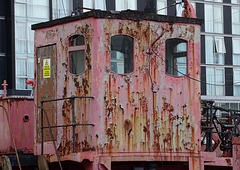
Surface Rust on North Carr lightship
| |
|
|
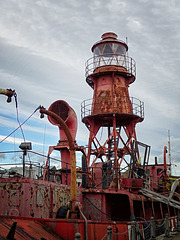
The lightship, built on the Clyde in 1933, was stationed off the notorious North Carr rocks, a mile and half from Fife Ness, until 1975, a crucial part of the life saving network operated by the Northern Lighthouse Board.
In May 1976 the North Carr Lightvessel was sold to the North East Fife District Council, and in July 1976 it was used as a floating museum based in Anstruther harbour. We have seen it in Anstruther, looking in far better condition.
Since January 2002 the Lightship has been based in Victoria Dock, Dundee and was used by the Maritime Volunteer Service (MVS) as a base for Unit meetings and training. But it has now been confirmed that MVS has sold the lightship for only £1 to Taymara, a Dundee-based maritime charity who plan to restore it. The lightship looks a bit shabby at the moment, but apparently it's just surface rust. I have my doubts.
North Carr Lightship
| |
|
|
|
The lightship, built on the Clyde in 1933, was stationed off the notorious North Carr rocks, a mile and half from Fife Ness, until 1975, a crucial part of the life saving network operated by the Northern Lighthouse Board.
In May 1976 the North Carr Lightvessel was sold to the North East Fife District Council, and in July 1976 it was used as a floating museum based in Anstruther harbour. We have seen it in Anstruther, looking in far better condition.
Since January 2002 the Lightship has been based in Victoria Dock, Dundee and was used by the Maritime Volunteer Service (MVS) as a base for Unit meetings and training. But it has now been confirmed that MVS has sold the lightship for only £1 to Taymara, a Dundee-based maritime charity who plan to restore it. The lightship looks a bit shabby at the moment, but apparently it's just surface rust. I have my doubts.

North Carr Lightship
| |
|
|
|
The lightship, built on the Clyde in 1933, was stationed off the notorious North Carr rocks, a mile and half from Fife Ness, until 1975, a crucial part of the life saving network operated by the Northern Lighthouse Board.
In May 1976 the North Carr Lightvessel was sold to the North East Fife District Council, and in July 1976 it was used as a floating museum based in Anstruther harbour. We have seen it in Anstruther.
Since January 2002 the Lightship has been based in Victoria Dock, Dundee and was used by the Maritime Volunteer Service (MVS) as a base for Unit meetings and training. But it has now been confirmed that MVS has sold the lightship for only £1 to Taymara, a Dundee-based maritime charity who plan to restore it. The lightship looks a bit shabby at the moment, but apparently it's just surface rust. I have my doubts.
HFF and a good weekend to you all
| |
|
|
|
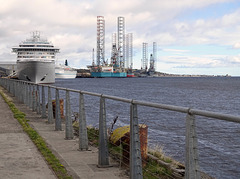
Seaborne Ovation berthed at the Port of Dundee. I expect both these cruise ships unloaded some passengers who visited the new V&A museum. 2 days later we saw Seaborne Ovation anchored in the River Forth where it seemed that passengers were being ferried to and from the Port of Leith in Edinburgh.
The slowdown in the North Sea oil and gas industry has led to fewer rigs being utilised. This has resulted in oil rigs being removed from the North Sea, with Dundee stepping up to provide a berthing place for them until they are required again in the future.
Curlew
| |
|
|
|
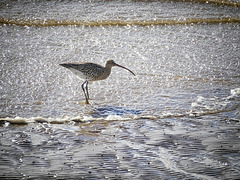
The curlew is the largest European wading bird, instantly recognisable on winter estuaries or summer moors by its long, down-curved bill, brown upper-parts and long legs.
River Tay Rail Bridge
| |
|
|
|
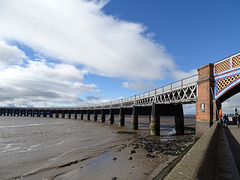
The Tay Bridge (or Tay Rail Bridge) is a railway bridge about two and a quarter miles (three and a half kilometres) long that spans the Firth of Tay in Scotland, between the city of Dundee and Wormit in Fife. It was opened on 20 June 1887.
This 'new' double-track bridge was designed by William Henry Barlow. It was built by William Arrol & Co. 18 metres (59 ft) upstream of, and parallel to, the original bridge. The foundation stone was laid on 6 July 1883 and construction involved 25,000 metric tons of iron and steel, 70,000 metric tons of concrete, ten million bricks (weighing 37,500 metric tons and three million rivets. Fourteen men lost their lives during its construction, most by drowning.
The original Tay Bridge was designed by noted railway engineer Thomas Bouch, It was a lattice-grid design, combining cast and wrought iron. The bridge was opened for passenger traffic on 1 June 1878. On the night of 28 December 1879 at 7.15 pm, the bridge collapsed after its central spans gave way during high winter gales. A train with six carriages carrying seventy-five passengers and crew, crossing at the time of the collapse, plunged into the icy waters of the Tay. All seventy-five were lost.
The stumps of the original bridge piers, seen here, are still visible above the surface of the Tay even at high tide.
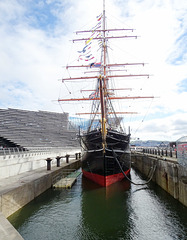
The RRS Discovery
| |
|
|
|
RRS Discovery is a barque-rigged auxiliary steamship built for Antarctic research, and was launched in 1901. It was built by the Dundee Shipbuilders Company, and its first mission was the British National Antarctic Expedition, carrying Robert Falcon Scott and Ernest Shackleton on their first, and highly successful, journey to the Antarctic, known as the Discovery Expedition.
The ship cost £34,050 to build, plus another £10,322 to be fitted with engines and machinery and more than £6000 for other equipment and fittings: The total cost for the Discovery was £51,000, equivalent to £4.1m in modern currency.

Panmure Passage. Sculptor: Marion Smith
| |
|
|
|
The sculpture is sited on the location of the slipway where the RRS Discovery was launched in 1901. Each cut out taken from the 11 upright slabs relates to a cross-section of the hull of the vessel. The title of the sculpture acknowledges Panmure Shipyards where the vessel was built by The Dundee Shipbuilders Company. It's possible to see 2 columns of the Tay Road Bridge through the sculpture. I loved this sculpture. It looked so unprepossessing at first, but was fascinating when one looked through it.
Material: Norden Granite.
Length 615cm
Width 180cm
Height 240cm
www.marionsmithsculptor.co.uk/commissions/panmure-passage
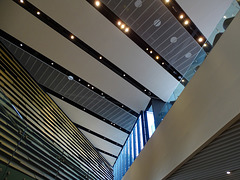
V&A Interior
| |
|
|
|
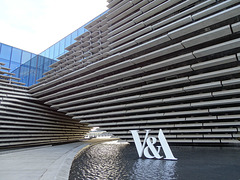
Dundee V&A
| |
|
|
|
The V&A Dundee, designed by Japanese architect Kengo Kuma, at a cost of £80 millionm is Scotland's first design museum. Located on the on the banks of the River Tay, it opened to the public on 15 September. Kuma designed the building to evoke the dramatic cliffs of Scotland's coastline. Built on reclaimed land, the museum stands at the centre of a £1 billion transformation of Dundee's former docks. The museum extends over the River Tay with a pointed corner that protrudes like the bow of a boat. This prow-shaped space contains the museum's large entrance space, cafe and shop, with timber walls the reference the building's concrete exterior cladding.
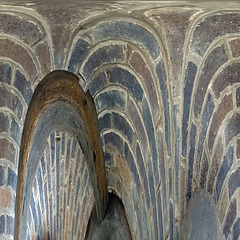
TSC today 2
| |
|
|
|
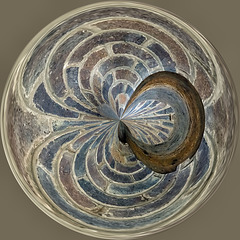
Old beams and brickwork
| |
|
|
|
The Sunday Challenge: "Take an ordinary object and make it beautiful".
The old beams at the Bear Steps in Shrewsbury, PiP1, are historic, but the infill bricks are less than beautiful.
