

Tay Bridge south
There's a hole in the sky
Fire Dance
HFF everyone
Clock keys
Clock keys 3
Heads I win, tails you lose
Nereid (1995–6) in bronze by David Nathan
Welsh National War Memorial
Moon
Queen Mary 2 in the Port of Stavanger
HFF everyone. Reflecting on a fence
Stavanger glass blowers
The glass blower's work
TSC
Fruticose lichen on Larch. Usnea subfloridana.
Foliose lichen, Xanthoria parietina, on hawthorn
Wide eyed and legless
Neptune
Minerva
Saturday Self Challenge
Hazardous appliances.
TSC
Bottleneck
Refraction and reflection
Listening to Cricket. TSC
Handmade for the Saturday Self Challenge.
HFF Everyone
Structure
The Knockin Telescope
Sunburst
Nothern Rock at Ravenglass
Unidentified flying objects?
A worm's eye view on Sunday lunch
Comfort versus style
These boots are made for walking. SSC
Anstruther lighthouse. HFF everyone.
Shrewsbury rail bridge
Underneath
Red minimalism
Polar opposites
Behind the facade. TSC
Roots
The first HFF of 2018
Shropshire shadows on New Year's Day
Location
Lat, Lng:
You can copy the above to your favourite mapping app.
Address: unknown
You can copy the above to your favourite mapping app.
Address: unknown
See also...
Keywords
Authorizations, license
-
Visible by: Everyone -
All rights reserved
-
1 155 visits
Looking towards Dundee
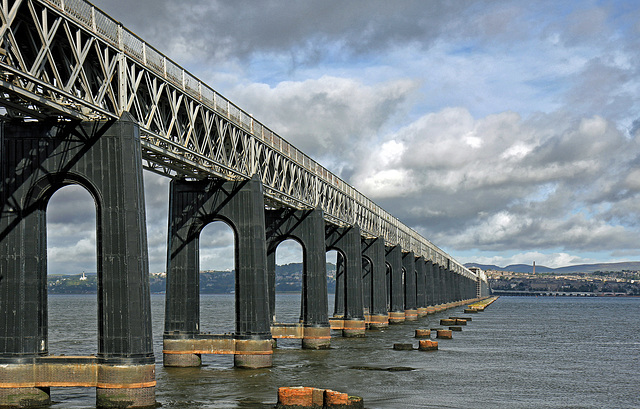

The Tay Bridge (or Tay Rail Bridge) is a railway bridge about two and a quarter miles (three and a half kilometres) long that spans the Firth of Tay in Scotland, between the city of Dundee and Wormit in Fife. It was opened on 20 June 1887.
This 'new' double-track bridge was designed by William Henry Barlow. It was built by William Arrol & Co. 18 metres (59 ft) upstream of, and parallel to, the original bridge. The foundation stone was laid on 6 July 1883 and construction involved 25,000 metric tons of iron and steel, 70,000 metric tons of concrete, ten million bricks (weighing 37,500 metric tons and three million rivets. Fourteen men lost their lives during its construction, most by drowning.
The original Tay Bridge was designed by noted railway engineer Thomas Bouch, It was a lattice-grid design, combining cast and wrought iron. The bridge was opened for passenger traffic on 1 June 1878. On the night of 28 December 1879 at 7.15 pm, the bridge collapsed after its central spans gave way during high winter gales. A train with six carriages carrying seventy-five passengers and crew, crossing at the time of the collapse, plunged into the icy waters of the Tay. All seventy-five were lost.
The stumps of the original bridge piers, seen here, are still visible above the surface of the Tay even at high tide.
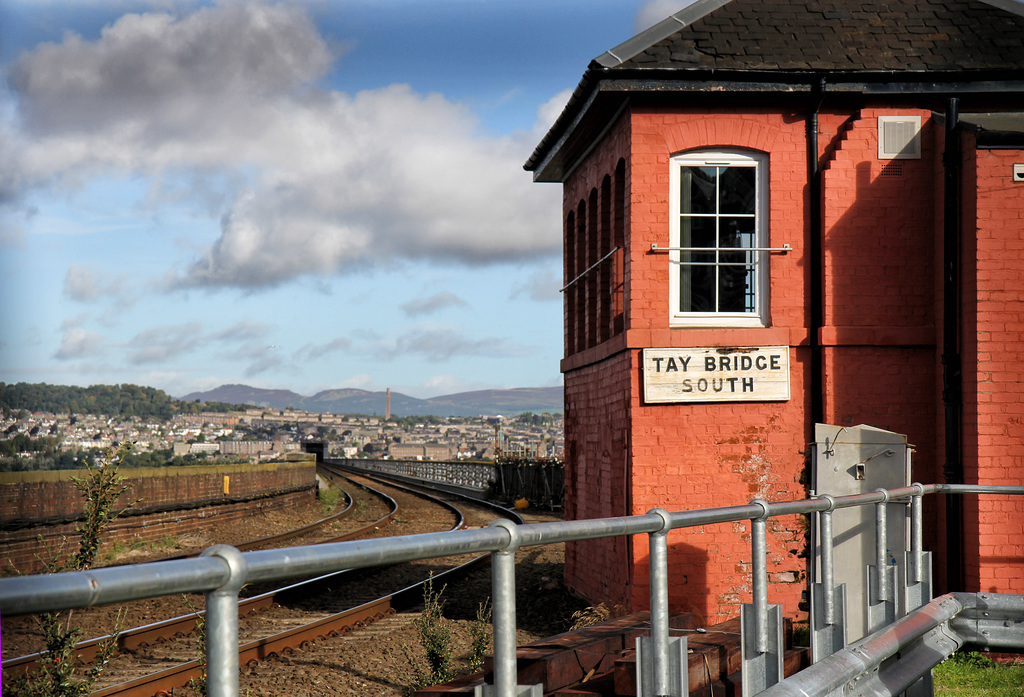
This 'new' double-track bridge was designed by William Henry Barlow. It was built by William Arrol & Co. 18 metres (59 ft) upstream of, and parallel to, the original bridge. The foundation stone was laid on 6 July 1883 and construction involved 25,000 metric tons of iron and steel, 70,000 metric tons of concrete, ten million bricks (weighing 37,500 metric tons and three million rivets. Fourteen men lost their lives during its construction, most by drowning.
The original Tay Bridge was designed by noted railway engineer Thomas Bouch, It was a lattice-grid design, combining cast and wrought iron. The bridge was opened for passenger traffic on 1 June 1878. On the night of 28 December 1879 at 7.15 pm, the bridge collapsed after its central spans gave way during high winter gales. A train with six carriages carrying seventy-five passengers and crew, crossing at the time of the collapse, plunged into the icy waters of the Tay. All seventy-five were lost.
The stumps of the original bridge piers, seen here, are still visible above the surface of the Tay even at high tide.
* ઇଓ * ⇄ Yαɾα, Team, Bergfex, James and 45 other people have particularly liked this photo
- Keyboard shortcuts:
Jump to top
RSS feed- Latest comments - Subscribe to the comment feeds of this photo
- ipernity © 2007-2026
- Help & Contact
|
Club news
|
About ipernity
|
History |
ipernity Club & Prices |
Guide of good conduct
Donate | Group guidelines | Privacy policy | Terms of use | Statutes | In memoria -
Facebook
X

Amelia club has replied to Ulrich John club(thank you for the info)
Amelia club has replied to Jaap van 't Veen clubAmelia club has replied to Marie-claire GalletAmelia club has replied to Cämmerer zu NauAmelia club has replied to Ruesterstaudewww.handmann.phantasus.de/g_brueckamtay.html
Amelia club has replied to LutzP clubHere's the link:
www.mcgonagall-online.org.uk/gems/the-tay-bridge-disaster
There are some interesting illustrations on the page, and a newspaper article.
LutzP club has replied to Amelia clubAmelia club has replied to LutzP clubGudrun club has replied to Amelia clubAmelia club has replied to John CassAmelia club has replied to Edward BowthorpeAmelia club has replied to Daniela Brocca clubAmelia club has replied to BoroBest wishes ... Steve
The remaining stumps of the old piers really make this image special...........serving as a poignant reminder of the power of nature.
I found it with a parallel English translation: www.lieder.net/lieder/get_text.html?TextId=71713
Best wishes, Doug
Best TOZ
Sign-in to write a comment.