

Günter Klaus' photos with the keyword: Asiatischer Marienkäfer
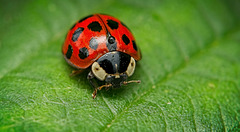
Der Asiatischer Marienkäfer (Harmonia axyridis) au…
| 13 Oct 2025 |
|
|
|
Heuer habe ich sehr wenige Marienkäfer gesehen auf meiner Naturrunde,dieser hat aber sehr schön posiert für mich und ich hoffe,auch Glück vorbei gebracht,was er auch Euch schicken soll :))
Pip1-5: Nahaufnahmen des Käfers
This year, I saw very few ladybugs on my nature walk, but this one posed beautifully for me, and I hope it brought you some good luck too :))
Pip1-5: Close-ups of the beetle
Cette année, j'ai vu très peu de coccinelles lors de ma promenade nature, mais celle-ci a posé magnifiquement pour moi, et j'espère qu'elle vous a porté chance aussi :))
Pip1-5 : Gros plans sur le scarabée
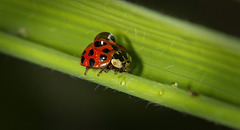
Ich weiß nicht,heut geht alles so zäh und schwer :…
| 18 Sep 2024 |
|
|
|
Ist ja immer wieder spannend,wie solch kleine Wasserperlen auf so kleinen Insekten oben bleiben,wie hier beim Asiatischen Marienkäfer (Harmonia axyridis) :))
Pip1-3: Nahaufnahmen des Marienkäfers
It's always fascinating to see how such small beads of water stay on such small insects, like here with the Asian ladybird (Harmonia axyridis) :))
Pip1-3: Close-ups of the ladybird
C'est toujours excitant de voir de si petites perles d'eau rester au-dessus de si petits insectes, comme ici avec la coccinelle asiatique (Harmonia axyridis) :))
Pip1-3 : Gros plans sur la coccinelle
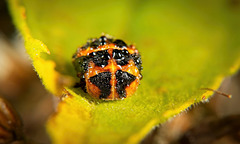
Die Puppe eines Asiatischen Marienkäfer (Harmonia…
| 05 Nov 2023 |
|
|
|
Als ich meine Runde machte,sah ich auf so einen zarten Grashalm einen kleinen roten Punkt,wo ich nicht wußte,was es war,es bewegte sich nicht und weil es nur klein war,sah man auch fast keine Details,ich wußte nicht,wo Vorne und Hinten war,erst am PC konnte ich meine Entdeckung benennen,da es sich um einen Puppe eines Marienkäfers handelte!Ich habe das auch erst das erstemal entdeckt,eine Larve habe ich schon öfters gesehen,sie hat ja eine schwarze Grundfärbung und ein paar orange Stellen an den Seiten des Hinterleibs,nach etwa 2 Wochen verpuppen sich die Larven und nach etwas 6 Tagen schlüpfen dann die fertigen Asiatischen Marienkäfer (Harmonia axyridis),ist ja schon spannend immer,wie in der Natur alles seinen Lauf nimmt,da habe ich dann ein paar Nahaufnahmen gemacht :))
Hauptbild: die vordere Ansicht der Puppe des Käfers
Pip1-4: Puppe des Asiatische Marienkäfer (Harmonia axyridis)
As I made my rounds, I saw a small red dot on a delicate blade of grass, I didn't know what it was, it didn't move and because it was only small, you could hardly see any details, I didn't know where There was front and back, it was only on the PC that I was able to name my discovery, as it was a ladybird pupa! I only discovered this for the first time, I have seen a larva several times, it has a black basic color and a few orange spots on the sides of the abdomen, after about 2 weeks the larvae pupate and after about 6 days the finished Asian lady beetles (Harmonia axyridis) hatch, it's always exciting how everything takes its course in nature, I have that then took a few close-ups :))
Main image: the front view of the beetle's pupa
Pip1-4: Pupa of the Asian ladybird (Harmonia axyridis)
En faisant ma tournée, j'ai vu un petit point rouge sur un brin d'herbe délicat, je ne savais pas ce que c'était, il ne bougeait pas et comme il était petit, on ne voyait presque aucun détail, je ne l'ai pas fait. Je ne sais pas où il y avait le recto et le verso, ce n'est que sur PC que j'ai pu nommer ma découverte, car c'était une chrysalide de coccinelle ! Je n'ai découvert ça que pour la première fois, j'ai vu une larve plusieurs fois, elle a une couleur de base noire et quelques taches orange sur les côtés de l'abdomen, après environ 2 semaines les larves se nymphosent et après environ 6 jours les coccinelles asiatiques finies (Harmonia axyridis) éclosent, c'est toujours excitant de voir comment tout suit son cours dans la nature, J'ai ensuite pris quelques gros plans :))
Image principale : la vue de face de la chrysalide du coléoptère
Pip1-4 : Nymphe de la coccinelle asiatique (Harmonia axyridis)
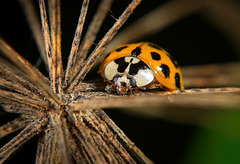
Der Asiatische Marienkäfer (Harmonia axyridis) hat…
| 16 Sep 2023 |
|
|
|
Gestern auf meiner Runde habe ich diesen Marienkäfer nochmals in der Vergänglichkeit von so einer Pflanze entdeckt :))
Pip1-3: verschiedene Ansichten des Marienkäfers
Yesterday on my rounds I discovered this ladybug again in the transience of such a plant :))
Pip1-3: different views of the ladybug
Hier lors de ma tournée j'ai encore découvert cette coccinelle dans la fugacité d'une telle plante :))
Pip1-3 : différentes vues de la coccinelle
Der Asiatische Marienkäfer hat sich mal gezeigt :)…
| 20 May 2023 |
|
|
|
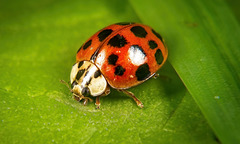
Dieser kleine Marienkäfer ist mir mal vor meine Linse gekrabbelt,das markante Erkennungsmerkmal des Asiatischen Marienkäfers ist das Halsschild. Es ist hell-gelblich gefärbt und zeigt die charakteristische Zeichnung in Form eines schwarzen „M“ bzw. „W“. Die Färbung des Asiatischen Marienkäfers ist sehr variabel. Ihre Färbung reicht von orange ohne Flecken bis zu schwarz mit roten Flecken. Seine Deckflügel sind hellgelb bis dunkelrot. Meist hat er 19 schwarze Flecken
Pip: asiatischer Marienkäfer,der das Blatt runtergekrabbelt kam
This small ladybird once crawled in front of my lens. The distinctive feature of the Asian ladybird is its neck shield. It is light yellowish in colour and shows the characteristic markings in the form of a black "M" or "W". The colouration of the Asian ladybird is very variable. Its colouration ranges from orange without spots to black with red spots. Its upper wings are light yellow to dark red. Mostly it has 19 black spots
Pip: Asian ladybird,which came crawling down the leaf
Cette petite coccinelle est arrivée devant mon objectif, le signe distinctif de la coccinelle asiatique est son collier. Il est de couleur jaune clair et présente un dessin caractéristique en forme de "M" ou de "W" noir. La coloration de la coccinelle asiatique est très variable. Sa coloration va de l'orange sans taches au noir avec des taches rouges. Ses ailes sont jaune clair à rouge foncé. La plupart du temps, elle a 19 taches noires
Pip : Coccinelle asiatique qui a descendu la feuille en rampant
Jump to top
RSS feed- Günter Klaus' latest photos with "Asiatischer Marienkäfer" - Photos
- ipernity © 2007-2026
- Help & Contact
|
Club news
|
About ipernity
|
History |
ipernity Club & Prices |
Guide of good conduct
Donate | Group guidelines | Privacy policy | Terms of use | Statutes | In memoria -
Facebook
X
