

Günter Klaus' photos with the keyword: Rothhalsiger Getreidekäfer
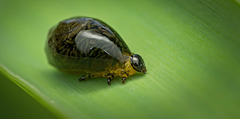
Ein Naturschauspiel der besonderen Art :)) A natur…
| 14 Sep 2025 |
|
|
|
Ich habe nur so einen dunklen braunen Punkt auf einen Blatt gesehen und wußte nicht,um was es sich handelt,ich fotografiere ja fast alles,weil ich daheim dann auch recherieren kann,es gab nicht viel im Internet drüber,aber auf einer Seite und in Videos sah ich,dass es sich um Larve von einen Rothhalsiges Getreidehähnchen (Oulema melanopus) handelt!und ich habe eine Aufklärung gefunden:
Junge Larven und ihre Kotschilde. Sie speichern den Kot als Abschreckung für Fressfeinde (Mund voller Kot).
Hier ist das Larvenstadium, einer parasitoide Wespe legt dann ihre Eier in die Larve des Käfers . Es ist das madenartige Ding.
Die Eier schlüpfen in der Larve und beginnen zu fressen, während sie noch lebt, bevor sie herausplatzen und sie töten. Diese Parasiten werden oft zur biologischen Schädlingsbekämpfung eingesetzt, da der Getreideblattkäfer als Schädling gilt und regelmäßig Nutzpflanzen befällt !!Man sieht es toll im Vollbild,was sich da im Käfer abspielt :))
Pip1-5: Nahaufnahmen der Larve mit den Parasiten
I just saw a dark brown spot on a leaf and didn't know what it was. I photograph almost everything so I can research it at home. There wasn't much information about it online, but on one website and in videos, I saw that it was the larva of a red-necked grain beetle (Oulema melanopus)! And I found an explanation:
Young larvae and their fecal shields. They store the feces as a deterrent to predators (mouth full of feces).
Here is the larval stage; a parasitoid wasp then lays its eggs inside the beetle's larva. It's the maggot-like thing.
The eggs hatch inside the larva and begin feeding while it's still alive before bursting out and killing it. These parasites are often used for biological pest control, as the cereal leaf beetle is considered a pest and regularly infests crops! You can clearly see what's going on inside the beetle in full screen :))
Pip1-5: Close-ups of the larva with the parasites
Je viens de voir une tache brun foncé sur une feuille et je ne savais pas ce que c'était. Je photographie presque tout pour pouvoir faire des recherches à la maison. Il n'y avait pas beaucoup d'informations à ce sujet en ligne, mais sur un site web et dans des vidéos, j'ai vu qu'il s'agissait de la larve d'un cucujide à cou rouge (Oulema melanopus) ! Et j'ai trouvé une explication :
Des jeunes larves et leurs boucliers fécaux. Elles stockent les excréments pour dissuader les prédateurs (la bouche pleine d'excréments).
Voici le stade larvaire ; une guêpe parasitoïde pond ensuite ses œufs à l'intérieur de la larve du cucujide. C'est une sorte d'asticot.
Les œufs éclosent à l'intérieur de la larve et commencent à se nourrir alors qu'elle est encore vivante avant d'exploser et de la tuer. Ces parasites sont souvent utilisés pour la lutte biologique, car le cucujide est considéré comme un ravageur et infeste régulièrement les cultures ! On peut clairement voir ce qui se passe à l'intérieur du scarabée en plein écran :))
Pip1-5 : Gros plans de la larve avec les parasites
Jump to top
RSS feed- Günter Klaus' latest photos with "Rothhalsiger Getreidekäfer" - Photos
- ipernity © 2007-2026
- Help & Contact
|
Club news
|
About ipernity
|
History |
ipernity Club & Prices |
Guide of good conduct
Donate | Group guidelines | Privacy policy | Terms of use | Statutes | In memoria -
Facebook
X
