

Günter Klaus' photos with the keyword: Nachfalter
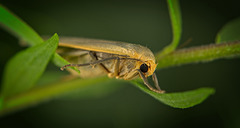
Das Weißgraue Flechtenbärchen (Eilema caniola) mit…
| 21 Dec 2025 |
|
|
|
Es ist ein Schmetterling,der zu den Nachtfaltern gehört.Sein Kopf und Halskragen sind gelb. Die Vorderflügel sind weißgrau gefärbt, um den Körper gewickelt und am Rand mit einem schmalen hellgelben Kostalstreifen versehen.Es gibt mehrere Generationen,die man von Mai bis Okktober sieht :))
Pip1-5: Nahaufnahmen des Falters
It's a moth, belonging to the family of nocturnal moths. Its head and collar are yellow. The forewings are whitish-gray, wrapped around the body, and have a narrow, pale yellow costal stripe along the edge. There are several generations, which can be seen from May to October :))
Pip1-5: Close-up photos of the moth
C'est un papillon de nuit. Sa tête et son collet sont jaunes. Ses ailes antérieures, gris blanchâtre, enveloppent le corps et présentent une fine bande costale jaune pâle sur le bord. Il existe plusieurs générations, observables de mai à octobre :))
Pip1-5 : Photos rapprochées du papillon
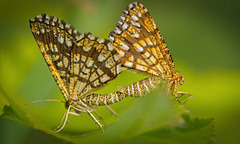
Die Gitterspanner (Chiasmia clathrata) haben sich…
| 15 Sep 2025 |
|
|
|
Der Schmetterling gehört zu den Nachtfaltern und seine Flügel sind schmutzigweiß bis gelbbraun und mit einem dunkelbraunen bis schwarzen Netz überzogen,es gibt im Jahr immer 2 Generatiionen,die dann von April bis September fliegen,ich habe diese Beiden an einen Grashalm entdeckt und ich konnte sie in aller Ruhe fotogrfaieren :))
Pip1-5: Nahaufnahmen des Schmetterlings
The butterfly is a moth, and its wings are off-white to yellowish-brown and covered with a dark brown to black net. There are always two generations per year, which fly from April to September. I spotted these two on a blade of grass and was able to photograph them in peace :))
Pip1-5: Close-ups of the butterfly
Ce papillon est un papillon nocturne, dont les ailes sont blanc cassé à brun jaunâtre et recouvertes d'un filet brun foncé à noir. Il y a toujours deux générations par an, qui volent d'avril à septembre. J'ai repéré ces deux-là sur un brin d'herbe et j'ai pu les photographier tranquillement. :))
Pip1-5 : Gros plans du papillon
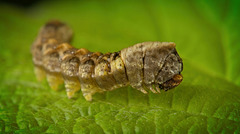
Ich bin leider auch ein Aschenputtel :)) Unfortuna…
| 07 Aug 2025 |
|
|
|
Die Raupe der Breitflügelige Bandeule (Noctua comes) wird leider keinen Schönheitswettbewerb gewinnen,hahaha,da ist der Falter dann schon etwas schöner! Die Vorderflügel sind in unterschiedlichen Brauntönen gefärbt. Die Zeichnung ist variabel. Die Hinterflügel sind gelb und weisen ein schwärzliches Saumband sowie einen mattschwarzen Mittelmond auf,die Falter sieht man von Juli bis September!Die Raupen ernähren sich von unterschiedlichen Pflanzen!
Pip1-5: Nahaufnahmen der Raupe
The caterpillar of the Broad-winged Moth (Noctua comes) isn't going to win any beauty contests, hahaha, but the butterfly is a bit prettier! The forewings are colored in various shades of brown. The pattern is variable. The hindwings are yellow with a blackish marginal band and a matte black central lobe. The moths can be seen from July to September! The caterpillars feed on a variety of plants!
Pip1-5: Close-ups of the caterpillar
La chenille du phalène à larges ailes (Noctua comes) ne va pas gagner de concours de beauté, hahaha, mais le papillon est un peu plus joli ! Les ailes antérieures sont colorées de différentes nuances de brun. Le motif est variable. Les ailes postérieures sont jaunes avec une bande marginale noirâtre et un lobe central noir mat. On peut observer ces papillons de juillet à septembre ! Les chenilles se nourrissent de plantes variées !
Pip1-5 : Gros plans de la chenille
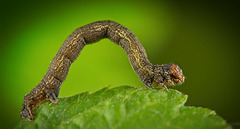
Die Raupe des Federfühler-Herbstspanner (Colotois…
| 23 Jul 2025 |
|
|
|
Dieser Falter ist ein Nachtfalter,wo man diese Raupen von Mai bis Juli an verschiedenen Laubbäumen entdecken kann!Der Falter hat auffällige, federartige Fühler, besonders bei den Männchen. Daher auch der Name Federfühler-Herbstspanner.Die Falter sind stark behaart,weil sie auch eine Flugzeit bis November machen können :))
Pip1-5: Nahaufnahmen der Raupe
This moth is a nocturnal moth, and its caterpillars can be found on various deciduous trees from May to July! The moth has striking, feathery antennae, especially in the males. Hence the name "feather-feathered autumn moth." The moths are heavily hairy because they can fly until November. :))
Pip1-5: Close-ups of the caterpillar
Ce papillon est un papillon nocturne et ses chenilles peuvent être trouvées sur divers arbres à feuilles caduques de mai à juillet. Le papillon possède des antennes plumeuses remarquables, en particulier chez les mâles. D'où le nom de « Papillon d'automne à plumes ». Les papillons sont très poilus car ils peuvent voler jusqu'en novembre. :))
Pip1-5 : Gros plans de la chenille
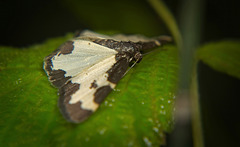
Der Vogelschmeiß-Spanner (Lomaspilis marginata) ha…
| 01 Aug 2024 |
|
|
|
Er gehört auch zu den Nachtfaltern,die Vorder und HInterflügel sind weiß mit schwarz-braunen Fleckenmuster!Man sieht ihn von Mai bis September,die Flecken am Flügel dienen auch zur Tarnung!
Pip1-4: Nahaufnahmen des Falters
It is also a moth, the front and rear wings are white with black and brown spots! You can see it from May to September, the spots on the wings also serve as camouflage!
Pip1-4: Close-ups of the butterfly
C'est aussi un papillon de nuit, les ailes avant et arrière sont blanches avec des taches noires et brunes. Vous pouvez l'observer de mai à septembre, les taches sur l'aile servent aussi de camouflage !
Pip1-4 : Photos en gros plan du papillon
Jump to top
RSS feed- Günter Klaus' latest photos with "Nachfalter" - Photos
- ipernity © 2007-2026
- Help & Contact
|
Club news
|
About ipernity
|
History |
ipernity Club & Prices |
Guide of good conduct
Donate | Group guidelines | Privacy policy | Terms of use | Statutes | In memoria -
Facebook
X
