

Günter Klaus' photos with the keyword: Totholz

Der Gewöhnliche Schwarzbrust (ROSELLINIA AQUILA) a…
| 10 Mar 2026 |
|
|
|
Auch diesen Baumpilz hab ich auch diesen Totholz entdeckt,wo ich den kleinen gelben Pilz und die Haarschnecke entdeckt habe!
Der Fruchtkörper ist schwarzbraun bis rötlichbraun, kugelförmig, Spitze mit Sporenöffnung, alt oft zusammenwachsend (verschmolzen) und man findet ihn oft auf Totholz :))
Pip1-4: Nahaufnahmen des Pilzes
I also discovered this tree fungus on this deadwood, where I found the small yellow mushroom and the hairy snail!
The fruiting body is blackish-brown to reddish-brown, spherical, with a spore opening at the tip, often fused together when old, and it's frequently found on deadwood :))
Pip1-4: Close-up photos of the fungus
J'ai aussi découvert ce champignon sur ce bois mort, où j'ai trouvé le petit champignon jaune et l'escargot poilu !
Le carpophore est brun noirâtre à brun rougeâtre, sphérique, avec une ouverture à spores à son extrémité. Il est souvent soudé avec l'âge et on le trouve fréquemment sur le bois mort :))
Pip1-4 : Photos en gros plan du champignon

Der Gelbe Scheinhaarstäubling (HEMITRICHIA CLAVATA…
| 05 Mar 2026 |
|
|
|
Auf so einen Totholz findet man immer interessante Naturentdeckungen,dieser kleine Pilz,der eine Größe von einen Stecknadelkopf hat,wirkt auf den Totholz nur als gelber Punkt,diese zarten Fasern sieht man draussen in der Natur nicht,aber mit der vorderen Ansicht sieht man,wie sich der Pilz entwickelt!
Pip1-5: Nahaufnahmen des Pilzes
You can always find interesting natural discoveries on deadwood like this. This tiny fungus, about the size of a pinhead, appears as just a yellow dot on the wood. You don't see these delicate fibers in nature, but the front view shows how the fungus develops!
Pip1-5: Close-up photos of the fungus
On peut toujours faire des découvertes naturelles intéressantes sur du bois mort comme celui-ci. Ce minuscule champignon, de la taille d'une tête d'épingle, apparaît comme un simple point jaune sur le bois. On ne voit pas ces fibres délicates dans la nature, mais la vue de face montre comment le champignon se développe !
Photos 1 à 5 : Gros plans du champignon

Der Tapioka Schleimpilz (Brefeldia maxima) am Toth…
| 10 Dec 2025 |
|
|
|
Der "Tapioka-Schleimpilz" ist der umgangssprachliche Name für die Art Brefeldia maxima, ein plasmodialer Schleimpilz, der durch sein charakteristisches, reinweißes Aussehen wie Tapiokapudding bekannt ist und weltweit verbreitet ist; Schleimpilze sind keine echten Pilze, sondern faszinierende Organismen, die harmlos sind und oft in feuchten Waldgebieten zu finden sind. Schleimpilze sind einzellige Organismen, die sich wie eine kriechende Masse bewegen können und sich von Bakterien und organischem Material ernähren,man findet sie ind er Natur vor allem auf Totholz :))
Pip1-2: Nahaufnahmen des Schleimpilzes
The "tapioca slime mold" is the common name for the species *Brefeldia maxima*, a plasmodial slime mold known for its characteristic, pure white, tapioca pudding-like appearance. It is found worldwide. Slime molds are not true fungi, but fascinating organisms that are harmless and often found in damp woodland areas. These single-celled organisms can move like a creeping mass and feed on bacteria and organic matter. In nature, they are primarily found on dead wood.
Pip1-2: Close-up photos of the slime mold
Le « myxomycète du tapioca » est le nom commun de l’espèce *Brefeldia maxima*, un myxomycète plasmodial reconnaissable à son aspect blanc pur, semblable à celui du tapioca. On le trouve partout dans le monde. Les myxomycètes ne sont pas de véritables champignons, mais des organismes fascinants et inoffensifs, souvent présents dans les zones boisées humides. Ces organismes unicellulaires peuvent se déplacer comme une masse rampante et se nourrissent de bactéries et de matières organiques. Dans la nature, on les trouve principalement sur le bois mort.
Pip1-2 : Photos en gros plan du myxomycète
Der Kelch-Scheinhaarstäubling (Hemitrichia calycul…
| 16 Apr 2025 |
|
|
|
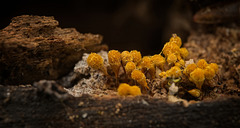
Ein Blick unter das Totholz zeigt einen immer interessante Motive,diese Pilze waren nur als kleine Punkte zu sehen,sie waren ca 2-3mm nur groß und daheim in Google konnte ich sie dann auch bestimmen,sie wachsen in Gruppen,wobei sie einzeln stehen oder im Stielbereich miteinander verwachsen sind. Sie erreichen eine Höhe von einem bis zwei Millimeter. Die Sporenkapseln (Sporokarpien) sind kugelig bis abgeflacht kreiselförmig und gelbbraun bis olivgelb gefärbt. Sie werden etwa 1 mm breit.Im letzten Pip kommt auch die kleine Größe der Pilze rüber!!
Pip1-4: Nahaufnahmen dieser Pilze
A look under the deadwood always reveals interesting motifs. These mushrooms were visible only as small dots, about 2-3 mm in size, and I was able to identify them at home using Google. They grow in groups, sometimes standing alone or fused together at the stem. They reach a height of one to two millimeters. The spore capsules (sporocarps) are spherical to flattened, gyro-shaped and yellow-brown to olive-yellow in color. They grow to about 1 mm wide. The last pip also highlights the small size of the mushrooms!
Pip 1-4: Close-ups of these mushrooms
Un coup d'oeil sous le bois mort montre toujours des motifs intéressants, ces champignons n'étaient visibles que sous forme de petits points, ils ne mesuraient qu'environ 2 à 3 mm et chez moi sur Google j'ai pu les identifier, ils poussent en groupes, bien qu'ils puissent se tenir seuls ou soient fusionnés dans la zone de la tige. Ils atteignent une hauteur d'un à deux millimètres. Les capsules de spores (sporocarpes) sont sphériques à aplaties, en forme de sommet et de couleur jaune-brun à jaune olive. Ils mesurent environ 1 mm de large. Le dernier pépin montre également la petite taille des champignons !!
Pip1-4 : Gros plans de ces champignons
Jump to top
RSS feed- Günter Klaus' latest photos with "Totholz" - Photos
- ipernity © 2007-2026
- Help & Contact
|
Club news
|
About ipernity
|
History |
ipernity Club & Prices |
Guide of good conduct
Donate | Group guidelines | Privacy policy | Terms of use | Statutes | In memoria -
Facebook
X
