

Esther's photos with the keyword: bog
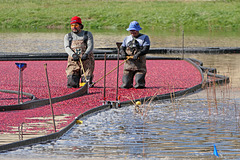
Coraling the cranberries
| 10 Nov 2025 |
|
|
|
"Harvest
The cranberry harvest takes place once a year from mid-September through early November. There are two methods of harvesting cranberries.
Dry Harvesting
Dry harvesting uses walk-behind machines to comb the berries off the vines into burlap bags. Berries are then removed from the bogs by either bog vehicles or helicopters. The fruit is delivered to fresh fruit receiving stations where it is graded and screened based on color and ability to bounce (soft berries will not bounce). Dry harvested cranberries are used to supply the fresh fruit market. These cranberries are most often used for cooking and baking....
Wet Harvesting
Cranberries have pockets of air inside the fruit. Because of this, cranberries float in water, and thus, the bogs can be flooded to aid in removal of fruit from the vines. Water reels, nicknamed “egg-beaters” are used to stir up the water in the bogs. By this action, cranberries are dislodged from the vines and float to the surface of the water. Wooden or plastic “booms” are used to round up the berries, which are then lifted by conveyor or pumped into a truck to take them to the receiving station for cleaning. More than 90% of the crop is wet harvested. Wet harvested cranberries are used for juices, sauces, sweetened dried cranberries, ingredients in other processed foods or in nutraceutical products."
www.cranberries.org/fall
The workers stand knee deep in the cold water and pull the boom around to coral the floating cranberries in a smaller area so that they can be pumped into the truck.
Sunday Challenge: Environmental Photograph
AP1101547
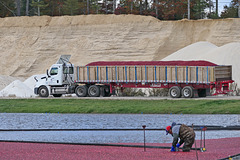
50,000 pounds of cranberries
| 10 Nov 2025 |
|
|
|
"Harvest
The cranberry harvest takes place once a year from mid-September through early November. There are two methods of harvesting cranberries.
Dry Harvesting
Dry harvesting uses walk-behind machines to comb the berries off the vines into burlap bags. Berries are then removed from the bogs by either bog vehicles or helicopters. The fruit is delivered to fresh fruit receiving stations where it is graded and screened based on color and ability to bounce (soft berries will not bounce). Dry harvested cranberries are used to supply the fresh fruit market. These cranberries are most often used for cooking and baking. Click here to learn more about dry harvesting.
Wet Harvesting
Cranberries have pockets of air inside the fruit. Because of this, cranberries float in water, and thus, the bogs can be flooded to aid in removal of fruit from the vines. Water reels, nicknamed “egg-beaters” are used to stir up the water in the bogs. By this action, cranberries are dislodged from the vines and float to the surface of the water. Wooden or plastic “booms” are used to round up the berries, which are then lifted by conveyor or pumped into a truck to take them to the receiving station for cleaning. More than 90% of the crop is wet harvested. Wet harvested cranberries are used for juices, sauces, sweetened dried cranberries, ingredients in other processed foods or in nutraceutical products."
www.cranberries.org/fall
Each truck carries about 50,000 pounds of cranberries. It takes several trucks to empty a typical cranberry bog.
AP1101558
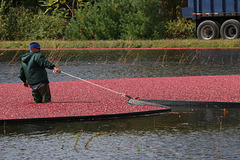
Moving the cranberries (Explored)
| 09 Oct 2019 |
|
|
|
Until the 1960s, cranberries, which grow low to the ground, were picked in a time consuming method. Today, wet or water harvesting is the primary method of harvesting cranberries. The bogs in which the cranberries grow are flooded with 1 - 1 1/2 feet of water the night before the harvest. The next day, the farmers use equipment called egg beaters to knock the berries off of the vines. The berries have air pockets in them and they float to the surface. The farmers then "coral" the berries by wading through the bog and forcing the fruit into one area with large rakes. The berries are then further confined with floating booms and suctioned onto a truck. They are taken to a factory where they are washed and canned or used in drinks and sauces. Berries that are dry harvested are often sold as fresh cranberries because they are handled less harshly in the harvesting process.
AIMG 4954
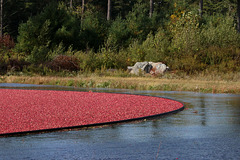
Corralled cranberries
| 09 Oct 2019 |
|
|
|
Until the 1960s, cranberries, which grow low to the ground, were picked in a time consuming method. Today, wet or water harvesting is the primary method of harvesting cranberries. The bogs in which the cranberries grow are flooded with 1 - 1 1/2 feet of water the night before the harvest. The next day, the farmers use equipment called egg beaters to knock the berries off of the vines. The berries have air pockets in them and they float to the surface. The farmers then "coral" the berries by wading through the bog and forcing the fruit into one area with large rakes. The berries are then further confined with floating booms and suctioned onto a truck. They are taken to a factory where they are washed and canned or used in drinks and sauces. Berries that are dry harvested are often sold as fresh cranberries because they are handled less harshly in the harvesting process.
AIMG 3180
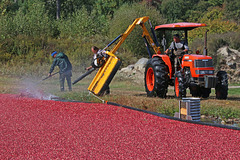
Coralling the cranberries
| 09 Oct 2019 |
|
|
|
The tractor is pulling the boom around the cranberries while the workers use a blower and a rake to push the cranberries from the side of the bog.
Until the 1960s, cranberries, which grow low to the ground, were picked in a time consuming method. Today, wet or water harvesting is the primary method of harvesting cranberries. The bogs in which the cranberries grow are flooded with 1 - 1 1/2 feet of water the night before the harvest. The next day, the farmers use equipment called egg beaters to knock the berries off of the vines. The berries have air pockets in them and they float to the surface. The farmers then "coral" the berries by wading through the bog and forcing the fruit into one area with large rakes. The berries are then further confined with floating booms and suctioned onto a truck. They are taken to a factory where they are washed and canned or used in drinks and sauces. Berries that are dry harvested are often sold as fresh cranberries because they are handled less harshly in the harvesting process.
AIMG 4932
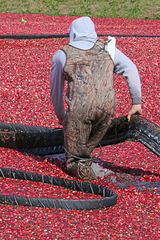
Handing the booms
| 09 Oct 2019 |
|
|
|
Until the 1960s, cranberries, which grow low to the ground, were picked in a time consuming method. Today, wet or water harvesting is the primary method of harvesting cranberries. The bogs in which the cranberries grow are flooded with 1 - 1 1/2 feet of water the night before the harvest. The next day, the farmers use equipment called egg beaters to knock the berries off of the vines. The berries have air pockets in them and they float to the surface. The farmers then "coral" the berries by wading through the bog and forcing the fruit into one area with large rakes. The berries are then further confined with floating booms and suctioned onto a truck. They are taken to a factory where they are washed and canned or used in drinks and sauces. Berries that are dry harvested are often sold as fresh cranberries because they are handled less harshly in the harvesting process.
AIMG 4929
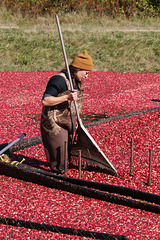
Raking the cranberries
| 09 Oct 2019 |
|
|
|
Until the 1960s, cranberries, which grow low to the ground, were picked in a time consuming method. Today, wet or water harvesting is the primary method of harvesting cranberries. The bogs in which the cranberries grow are flooded with 1 - 1 1/2 feet of water the night before the harvest. The next day, the farmers use equipment called egg beaters to knock the berries off of the vines. The berries have air pockets in them and they float to the surface. The farmers then "coral" the berries by wading through the bog and forcing the fruit into one area with large rakes. The berries are then further confined with floating booms and suctioned onto a truck. They are taken to a factory where they are washed and canned or used in drinks and sauces. Berries that are dry harvested are often sold as fresh cranberries because they are handled less harshly in the harvesting process.
AIMG 3186
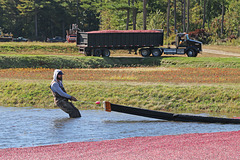
Pulling the Boom
| 09 Oct 2019 |
|
|
It takes a lot of work to fill a truck with cranberries.
Until the 1960s, cranberries, which grow low to the ground, were picked in a time consuming method. Today, wet or water harvesting is the primary method of harvesting cranberries. The bogs in which the cranberries grow are flooded with 1 - 1 1/2 feet of water the night before the harvest. The next day, the farmers use equipment called egg beaters to knock the berries off of the vines. The berries have air pockets in them and they float to the surface. The farmers then "coral" the berries by wading through the bog and forcing the fruit into one area with large rakes. The berries are then further confined with floating booms and suctioned onto a truck. They are taken to a factory where they are washed and canned or used in drinks and sauces. Berries that are dry harvested are often sold as fresh cranberries because they are handled less harshly in the harvesting process.
AIMG 3180
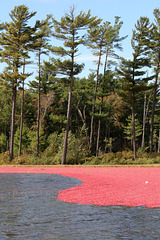
Flooded Bog (Explored)
| 08 Oct 2019 |
|
|
|
Until the 1960s, cranberries, which grow low to the ground, were picked in a time consuming method. Today, wet or water harvesting is the primary method of harvesting cranberries. The bogs in which the cranberries grow are flooded with 1 - 1 1/2 feet of water the night before the harvest. The next day, the farmers use equipment called egg beaters to knock the berries off of the vines. The berries have air pockets in them and they float to the surface. The farmers then "coral" the berries by wading through the bog and forcing the fruit into one area with large brooms. The berries are then further confined with floating booms and suctioned onto a truck. They are taken to a factory where they are washed and canned or used in drinks and sauces. Berries that are dry harvested are often sold as fresh cranberries because they are handled less harshly in the harvesting process.
AIMG 3194
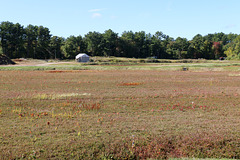
Unflooded cranberry bog
| 08 Oct 2019 |
|
|
Until the 1960s, cranberries, which grow low to the ground, were picked in a time consuming method. Today, wet or water harvesting is the primary method of harvesting cranberries. The bogs in which the cranberries grow are flooded with 1 - 1 1/2 feet of water the night before the harvest. The next day, the farmers use equipment called egg beaters to knock the berries off of the vines. The berries have air pockets in them and they float to the surface. The farmers then "coral" the berries by wading through the bog and forcing the fruit into one area with large brooms. The berries are then further confined with floating booms and suctioned onto a truck. They are taken to a factory where they are washed and canned or used in drinks and sauces. Berries that are dry harvested are often sold as fresh cranberries because they are handled less harshly in the harvesting process.
AIMG 3193
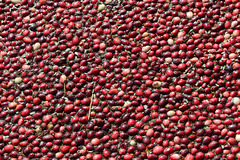
Floating cranberries
| 08 Oct 2019 |
|
|
|
Until the 1960s, cranberries, which grow low to the ground, were picked in a time consuming method. Today, wet or water harvesting is the primary method of harvesting cranberries. The bogs in which the cranberries grow are flooded with 1 - 1 1/2 feet of water the night before the harvest. The next day, the farmers use equipment called egg beaters to knock the berries off of the vines. The berries have air pockets in them and they float to the surface. The farmers then "coral" the berries by wading through the bog and forcing the fruit into one area with large brooms. The berries are then further confined with floating booms and suctioned onto a truck. They are taken to a factory where they are washed and canned or used in drinks and sauces. Berries that are dry harvested are often sold as fresh cranberries because they are handled less harshly in the harvesting process.
AIMG 3132

Giant tire - Spring Rain Farm
| 08 Oct 2019 |
|
|
|
Until the 1960s, cranberries, which grow low to the ground, were picked in a time consuming method. Today, wet or water harvesting is the primary method of harvesting cranberries. The bogs in which the cranberries grow are flooded with 1 - 1 1/2 feet of water the night before the harvest. The next day, the farmers use equipment called egg beaters to knock the berries off of the vines. The berries have air pockets in them and they float to the surface. The farmers then "coral" the berries by wading through the bog and forcing the fruit into one area with large brooms. The berries are then further confined with floating booms and suctioned onto a truck. They are taken to a factory where they are washed and canned or used in drinks and sauces. Berries that are dry harvested are often sold as fresh cranberries because they are handled less harshly in the harvesting process.
AIMG 3175

Spring Rain Farm
| 08 Oct 2019 |
|
|
|
Until the 1960s, cranberries, which grow low to the ground, were picked in a time consuming method. Today, wet or water harvesting is the primary method of harvesting cranberries. The bogs in which the cranberries grow are flooded with 1 - 1 1/2 feet of water the night before the harvest. The next day, the farmers use equipment called egg beaters to knock the berries off of the vines. The berries have air pockets in them and they float to the surface. The farmers then "coral" the berries by wading through the bog and forcing the fruit into one area with large brooms. The berries are then further confined with floating booms and suctioned onto a truck. They are taken to a factory where they are washed and canned or used in drinks and sauces. Berries that are dry harvested are often sold as fresh cranberries because they are handled less harshly in the harvesting process.
AIMG 3174

Spring Rain Farm
| 08 Oct 2019 |
|
|
|
Until the 1960s, cranberries, which grow low to the ground were picked in a time consuming method. Today, wet or water harvesting is the primary method of harvesting cranberries. The bogs in which the cranberries grow are flooded with 1 - 1 1/2 feet of water the night before the harvest. The next day, the farmers use equipment called egg beaters to knock the berries off of the vines. The berries have air pockets in them and they float to the surface. The farmers then "coral" the berries by wading through the bog and forcing the fruit into one area with large brooms. The berries are then further confined with floating booms and suctioned onto a truck. They are taken to a factory where they are washed and canned or used in drinks and sauces. Berries that are dry harvested are often sold as fresh cranberries because they are handled less harshly in the harvesting process.
AIMG 3173

Spring melt
| 29 Jan 2016 |
|
|
|
Talkeetna Air Taxi - Denali Flight and Glacier Landing
When the interior Alaskan surface snow melts, it can not penetrate the permafrost, leaving numerous ponds and bogs that are home to black spruce trees and mosquitoes.
AIMG 5648

Haunted forest
| 22 Nov 2015 |
|
|
|
On the road to Talkeetna, Alaska - Black Spruce forest. Black Spruce trees can be found from northern Massachusetts through Alaska. They can survive very harsh conditions where other trees would die. They are usually found in boggy, organic soil and the tolerate temperatures that can drop as low as -62° to -34° C (-79° to -30° F).
AIMG 5516
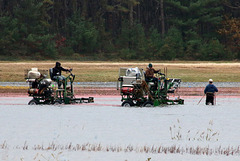
Dislodging the cranberries
| 19 Oct 2013 |
|
|
|
Harvesting cranberries, Wareham, MA.
To "wet harvest" cranberries, the bogs are flooded with water from nearby ponds. A harvesting machine is then driven through. This machine knocks the cranberries off the plant and they float to the surface. Workers pulling booms corral the cranberries and they are sucked by hose onto a truck to take them to the processing plant. Whole cranberries that are not destined to be immediately processed are picked in dry fields in a labor intensive and weather dependent process.
AIMG 0364

Awash in cranberries
| 19 Oct 2013 |
|
|
|
Harvesting cranberries, Wareham, MA.
To "wet harvest" cranberries, the bogs are flooded with water from nearby ponds. A harvesting machine is then driven through. This machine knocks the cranberries off the plant and they float to the surface. Workers pulling booms corral the cranberries and they are sucked by hose onto a truck to take them to the processing plant. Whole cranberries that are not destined to be immediately processed are picked in dry fields in a labor intensive and weather dependent process.
AIMG 0343
Jump to top
RSS feed- Esther's latest photos with "bog" - Photos
- ipernity © 2007-2025
- Help & Contact
|
Club news
|
About ipernity
|
History |
ipernity Club & Prices |
Guide of good conduct
Donate | Group guidelines | Privacy policy | Terms of use | Statutes | In memoria -
Facebook
X
