

Esther's photos with the keyword: god
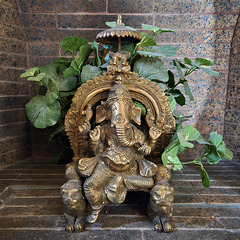
Ganesha
| 16 Nov 2025 |
|
|
|
Ganesha is a major Hindu deity. He can easily be identified by his elephant head and (frequently) multiple arms. He is a son of Shiva and Parvati and is widely worshipped in Hinduism, Buddhism, and Jainism, especially in connection with any new endeavor or undertaking. He is revered as the remover of obstacles and the god of beginnings, wisdom, and luck. He is a patron of writers, travelers, students, and business.
Sunday Challenge: Inspired by Asia
A20251116 143215-1
Ai apaec
| 03 Mar 2015 |
|
|
|
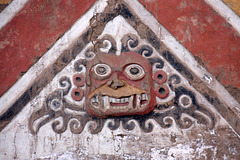
Carving of Ai apaec at Huaca de la Luna near Trujillo, Peru.
"Ai apaec (from the Mochica Aiapæc [a.ja.pøk] or [aiapøk]), also called decapitador was the chief deity of the Mochica culture, was one of their gods punishers, the most feared and adored, is also called the headsman. Ai Apaec was worshiped as the creator god, protector of the Moche, a provider of water, food and military triumphs. Aiapaec means 'doer' in Mochica language.
The most common representation of Ai Apaec is that seen in the murals of the Temples of the moon and sun (picture), which presents an anthropomorphic face with feline fangs and surrounding ocean waves.
Ai apaec was represented in several ways, depending on the period, place, and support used. In metallurgy, for example, Ai apaec is often seen as a spider with eight legs and an anthropomorphic face with jaguar fangs. In ceramics the divinity is often more anthropomorphic, usually with his head in his hands and sometimes with two snakes sprouting from his head (hair??). In sculpture he is shown with a staff.
It is said that during human sacrifices, prisoners were decapitated and their heads given to Ai apaec."
en.wikipedia.org/wiki/Ai_apaec
AIMG 1433
Ai apaec
| 03 Mar 2015 |
|
|
|
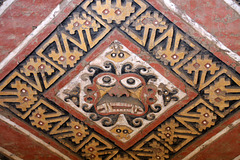
Carving of Ai apaec at Huaca de la Luna near Trujillo, Peru.
"Ai apaec (from the Mochica Aiapæc [a.ja.pøk] or [aiapøk]), also called decapitador was the chief deity of the Mochica culture, was one of their gods punishers, the most feared and adored, is also called the headsman. Ai Apaec was worshiped as the creator god, protector of the Moche, a provider of water, food and military triumphs. Aiapaec means 'doer' in Mochica language.
The most common representation of Ai Apaec is that seen in the murals of the Temples of the moon and sun (picture), which presents an anthropomorphic face with feline fangs and surrounding ocean waves.
Ai apaec was represented in several ways, depending on the period, place, and support used. In metallurgy, for example, Ai apaec is often seen as a spider with eight legs and an anthropomorphic face with jaguar fangs. In ceramics the divinity is often more anthropomorphic, usually with his head in his hands and sometimes with two snakes sprouting from his head (hair??). In sculpture he is shown with a staff.
It is said that during human sacrifices, prisoners were decapitated and their heads given to Ai apaec."
en.wikipedia.org/wiki/Ai_apaec
AIMG 1435
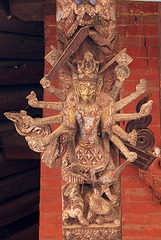
Temple strut 1
| 26 Jan 2011 |
|
Bhaktapur in Nepal was founded in the 12th century and was the capital city of the Greater Malla Kingdom until the 15th century. Thereafter, it was an independent kingdom from then until the 18th century until it became part of Nepal. It is located about 20 km east of Kathmandu in the Kathmandu Valley.
ODT: Mystical figure
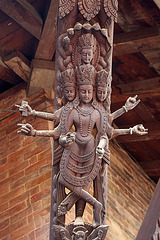
Temple strut 2
| 26 Jan 2011 |
|
Bhaktapur in Nepal was founded in the 12th century and was the capital city of the Greater Malla Kingdom until the 15th century. Thereafter, it was an independent kingdom from then until the 18th century until it became part of Nepal. It is located about 20 km east of Kathmandu in the Kathmandu Valley.
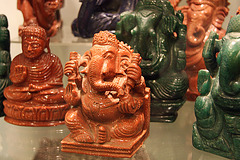
Ganesha
| 20 Aug 2010 |
|
Agra, India is known for its stone carvers and its inlaid stonework. After all, it is the site of the Taj Mahal.
ODT: Set
AIMG_6193
Jump to top
RSS feed- Esther's latest photos with "god" - Photos
- ipernity © 2007-2026
- Help & Contact
|
Club news
|
About ipernity
|
History |
ipernity Club & Prices |
Guide of good conduct
Donate | Group guidelines | Privacy policy | Terms of use | Statutes | In memoria -
Facebook
X
