

Esther's photos with the keyword: capital
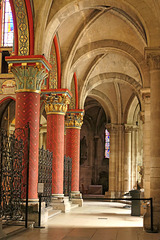
Unique columns
| 09 May 2025 |
|
|
|
"The Church of Saint-Germain-des-Prés is a Catholic parish church located in the Saint-Germain-des-Prés quarter of Paris. It was originally the church of a Benedictine abbey founded in 558 by Childebert I, the son of Clovis, King of the Franks. The abbey was destroyed by the Vikings, rebuilt, and renamed in the 8th century for Saint Germain, a 6th century bishop. It was rebuilt with elements in the new Gothic style in the 11th century, and was given the earliest flying buttresses in the Ile de France in the 12th century. It is considered the oldest existing church in Paris"
en.wikipedia.org/wiki/Saint-Germain-des-Pr%C3%A9s_(abbey)
It was badly damaged during the French Revolution and recreated/reimagined in the mid-1800's as a medieval church. The interior is strikingly beautiful and the organ is awe inspiring.
AP1089367
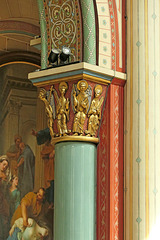
Ornate capitals
| 09 May 2025 |
|
|
|
"The Church of Saint-Germain-des-Prés is a Catholic parish church located in the Saint-Germain-des-Prés quarter of Paris. It was originally the church of a Benedictine abbey founded in 558 by Childebert I, the son of Clovis, King of the Franks. The abbey was destroyed by the Vikings, rebuilt, and renamed in the 8th century for Saint Germain, a 6th century bishop. It was rebuilt with elements in the new Gothic style in the 11th century, and was given the earliest flying buttresses in the Ile de France in the 12th century. It is considered the oldest existing church in Paris"
It was badly damaged during the French Revolution and recreated/reimagined in the mid-1800's as a medieval church. The interior is strikingly beautiful and the organ is awe inspiring.
AP1089364
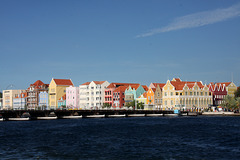
Handelskade and the Queen Emma Pontoon Bridge
| 25 Nov 2013 |
|
|
|
Willemstad (population of 140,000) is the capital of Curaçao, an island located in the Southern Caribbean that is part of the Kingdom of the Netherlands.
AIMG 9311
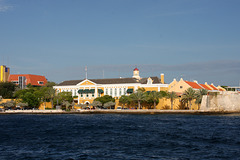
Government buildings
| 25 Nov 2013 |
|
|
|
Willemstad (population of 140,000) is the capital of Curaçao, an island located in the Southern Caribbean that is part of the Kingdom of the Netherlands.
AIMG 9310
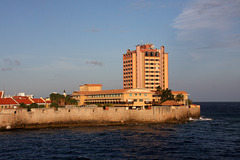
Plaza Hotel
| 25 Nov 2013 |
|
|
Willemstad (population of 140,000) is the capital of Curaçao, an island located in the Southern Caribbean that is part of the Kingdom of the Netherlands.
The fourteen story Plaza Hotel is so close to the entrance of the harbor where large tankers and freighters pass, that it carries maritime collision insurance.
AIMG 9328
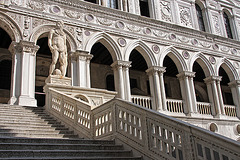
And Neptune watches over
| 01 Sep 2012 |
|
|
|
Sansovino’s statute of Neptune, which represents Venice’s power by land and by sea, has watched over the Giants’ Staircase in the Doge's Palace since 1567.
"The Doge's Palace (Italian: Palazzo Ducale) is a palace built in Venetian Gothic style, and one of the main landmarks of the city of Venice, northern Italy. The palace was the residence of the Doge of Venice, the supreme authority of the Republic of Venice, opening as a museum in 1923. Today it is one of the 11 museums run by the Fondazione Musei Civici di Venezia."
en.wikipedia.org/wiki/Doge%27s_Palace,_Venice
AIMG_4816
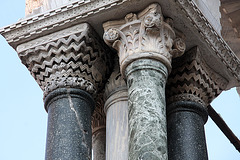
Ornate capitals
| 18 Aug 2012 |
|
St. Mark's Basilica in Venice, Italy "is the most famous of the city's churches and one of the best known examples of Byzantine architecture. It lies at the eastern end of the Piazza San Marco, adjacent and connected to the Doge's Palace. Originally it was the chapel of the Doge, and has only been the city's cathedral since 1807, when it became the seat of the Patriarch of Venice, archbishop of the Roman Catholic Archdiocese of Venice, formerly at San Pietro di Castello. For its opulent design, gilded Byzantine mosaics, and its status as a symbol of Venetian wealth and power, from the 11th century on the building has been known by the nickname Chiesa d'Oro (Church of gold)"
"The first St Mark's was a temporary building in the Doge's Palace, constructed in 828, when Venetian merchants stole the supposed relics of Mark the Evangelist from Alexandria. This was replaced by a new church on its present site in 832; from the same century dates the first St Mark's Campanile (bell tower). The new church was burned in a rebellion in 976, rebuilt in 978 and again to form the basis of the present basilica since 1063. The basilica was consecrated in 1094, the same year in which the body of Saint Mark was supposedly rediscovered in a pillar by Vitale Faliero, doge at the time. The building also incorporates a low tower (now housing St Mark’s Treasure), believed by some to have been part of the original Doge's Palace. Within the first half of the 13th century the narthex and the new façade were constructed, most of the mosaics were completed and the domes were covered with higher wooden, lead-covered domes in order to blend in with the Gothic architecture of the redesigned Doge's Palace."
"While the basic structure of the building has been much altered, its decoration changed greatly over time. The succeeding centuries, especially the fourteenth, all contributed to its adornment, and seldom did a Venetian vessel return from the Orient without bringing a column, capitals, or friezes, taken from some ancient building, to add to the fabric of the basilica. Gradually, the exterior brickwork became covered with various marbles and carvings, some much older than the building itself (see Four Tetrarchs, below). The last interventions concerned Baptistery and St Isidor’s Chapel (1300s), the carvings on the upper profile of the facade and the Sacristy (1400s), the Zen Chapel (1500s). This cathedral is a prime example of Gothic architecture due to the fact of its appearance from a distance."
en.wikipedia.org/wiki/St_Mark%27s_Basilica
AIMG_4744
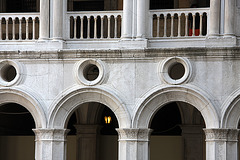
Royal arches
| 27 Aug 2012 |
|
The Doge's Palace (Italian: Palazzo Ducale) is a palace built in Venetian Gothic style, and one of the main landmarks of the city of Venice, northern Italy. The palace was the residence of the Doge of Venice, the supreme authority of the Republic of Venice, opening as a museum in 1923. Today it is one of the 11 museums run by the Fondazione Musei Civici di Venezia.
en.wikipedia.org/wiki/Doge%27s_Palace,_Venice
AIMG_4783
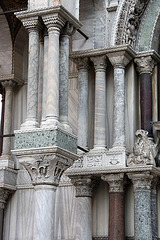
Marvelous marble
| 18 Aug 2012 |
|
St. Mark's Basilica in Venice, Italy "is the most famous of the city's churches and one of the best known examples of Byzantine architecture. It lies at the eastern end of the Piazza San Marco, adjacent and connected to the Doge's Palace. Originally it was the chapel of the Doge, and has only been the city's cathedral since 1807, when it became the seat of the Patriarch of Venice, archbishop of the Roman Catholic Archdiocese of Venice, formerly at San Pietro di Castello. For its opulent design, gilded Byzantine mosaics, and its status as a symbol of Venetian wealth and power, from the 11th century on the building has been known by the nickname Chiesa d'Oro (Church of gold)"
"The first St Mark's was a temporary building in the Doge's Palace, constructed in 828, when Venetian merchants stole the supposed relics of Mark the Evangelist from Alexandria. This was replaced by a new church on its present site in 832; from the same century dates the first St Mark's Campanile (bell tower). The new church was burned in a rebellion in 976, rebuilt in 978 and again to form the basis of the present basilica since 1063. The basilica was consecrated in 1094, the same year in which the body of Saint Mark was supposedly rediscovered in a pillar by Vitale Faliero, doge at the time. The building also incorporates a low tower (now housing St Mark’s Treasure), believed by some to have been part of the original Doge's Palace. Within the first half of the 13th century the narthex and the new façade were constructed, most of the mosaics were completed and the domes were covered with higher wooden, lead-covered domes in order to blend in with the Gothic architecture of the redesigned Doge's Palace."
"While the basic structure of the building has been much altered, its decoration changed greatly over time. The succeeding centuries, especially the fourteenth, all contributed to its adornment, and seldom did a Venetian vessel return from the Orient without bringing a column, capitals, or friezes, taken from some ancient building, to add to the fabric of the basilica. Gradually, the exterior brickwork became covered with various marbles and carvings, some much older than the building itself (see Four Tetrarchs, below). The last interventions concerned Baptistery and St Isidor’s Chapel (1300s), the carvings on the upper profile of the facade and the Sacristy (1400s), the Zen Chapel (1500s). This cathedral is a prime example of Gothic architecture due to the fact of its appearance from a distance."
en.wikipedia.org/wiki/St_Mark%27s_Basilica
AIMG_4740
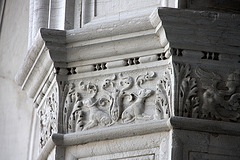
Capital design
| 27 Aug 2012 |
|
The Doge's Palace (Italian: Palazzo Ducale) is a palace built in Venetian Gothic style, and one of the main landmarks of the city of Venice, northern Italy. The palace was the residence of the Doge of Venice, the supreme authority of the Republic of Venice, opening as a museum in 1923. Today it is one of the 11 museums run by the Fondazione Musei Civici di Venezia.
en.wikipedia.org/wiki/Doge%27s_Palace,_Venice
AIMG_4785
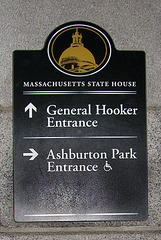
Hooker entrance
| 24 Jun 2012 |
|
Sign outside the Massachusetts State House. I've always found this sign to be amusing. Not many state houses have special entrances for hookers (slang for prostitutes). It actually refers to the statute of General Joseph Hooker, a Union army officer during the Civil War, which is nearby.
AIMG_1487
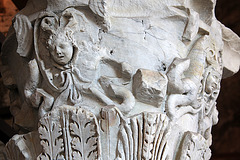
Coloseum capitals
| 08 Nov 2011 |
|
The Coloseum in Rome is the largest ampitheater built by the Roman empire, seating 50,000 patrons. Construction began in 72 AD and was completed in 80 AD, although alterations were made over the years.
ODT: White on white
AIMG_2252
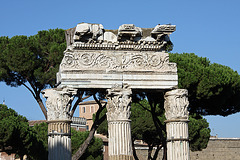
That which remains
Jump to top
RSS feed- Esther's latest photos with "capital" - Photos
- ipernity © 2007-2026
- Help & Contact
|
Club news
|
About ipernity
|
History |
ipernity Club & Prices |
Guide of good conduct
Donate | Group guidelines | Privacy policy | Terms of use | Statutes | In memoria -
Facebook
X
