

Esther's photos with the keyword: adobe
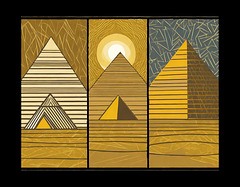
Graphic pyramids (Explored)
| 21 Jan 2024 |
|
|
|
Sunday Challenge: diptych/triptych or polyptych
I tried creating a triptych in Photoshop Elements but was not totally satisfied with the results. The ones I created in Adobe Firefly were much more interesting.
Firefly triptych of Egyptian pyramids 49952 (2)
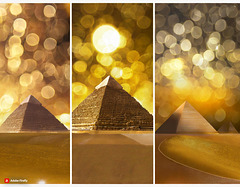
Pyramids and bokeh
| 21 Jan 2024 |
|
|
|
Sunday Challenge: diptych/triptych or polyptych
I tried creating a triptych in Photoshop Elements but was not totally satisfied with the results. The ones I created in Adobe Firefly were much more interesting.
Firefly triptych of Egyptian pyramids 49952

More ancient adobe carvings

Ancient adobe carvings
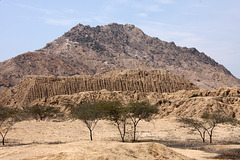
View of El Purgatorio and an adobe pyramid
| 24 Apr 2015 |
|
|
|
"Túcume is a pre-Hispanic site in Peru, south of the La Leche River on a plain around La Raya Mountain. It covers an area of over 540 acres (220 ha) and encompassing 26 major pyramids and mounds. The area is referred to as Purgatorio (purgatory) by local people.
This site was a major regional center, maybe even the capital of the successive occupations of the area by the Lambayeque/Sican (800-1350 AD), Chimú (1350–1450 AD) and Inca (1450–1532 AD). Local shaman healers (curanderos) invoke power of Tucume and La Raya Mountain in their rituals, and local people fear these sites. Hardly anyone other than healers venture out in this site at night."
en.wikipedia.org/wiki/T%C3%BAcume
AIMG 3667
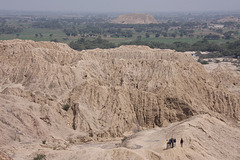
View from El Purgatorio (197m)
| 24 Apr 2015 |
|
|
|
"Túcume is a pre-Hispanic site in Peru, south of the La Leche River on a plain around La Raya Mountain. It covers an area of over 540 acres (220 ha) and encompassing 26 major pyramids and mounds. The area is referred to as Purgatorio (purgatory) by local people.
This site was a major regional center, maybe even the capital of the successive occupations of the area by the Lambayeque/Sican (800-1350 AD), Chimú (1350–1450 AD) and Inca (1450–1532 AD). Local shaman healers (curanderos) invoke power of Tucume and La Raya Mountain in their rituals, and local people fear these sites. Hardly anyone other than healers venture out in this site at night."
en.wikipedia.org/wiki/T%C3%BAcume
AIMG 3675
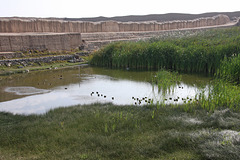
The reservoir inside the walls
| 10 Apr 2015 |
|
|
|
Tschudi Palace, Chan Chan, Peru
"Chan Chan was constructed by the Chimor (the kingdom of the Chimú), a late intermediate period civilization which grew out of the remnants of the Moche civilization. The adobe city of Chan Chan, the largest in the world, was built around 850 CE and lasted until its conquest by the Inca Empire in 1470. It was the imperial capital where 30,000 people lived."
en.wikipedia.org/wiki/Chan_Chan
AIMG 1548
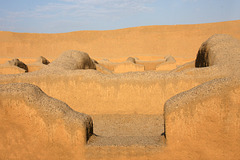
Chan Chan in the magic light
| 10 Apr 2015 |
|
|
|
Tschudi Palace, Chan Chan, Peru
"Chan Chan was constructed by the Chimor (the kingdom of the Chimú), a late intermediate period civilization which grew out of the remnants of the Moche civilization. The adobe city of Chan Chan, the largest in the world, was built around 850 CE and lasted until its conquest by the Inca Empire in 1470. It was the imperial capital where 30,000 people lived."
en.wikipedia.org/wiki/Chan_Chan
AIMG 1560
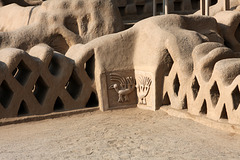
Decorative birds
| 08 Apr 2015 |
|
|
|
Tschudi Palace, Chan Chan, Peru
"Chan Chan was constructed by the Chimor (the kingdom of the Chimú), a late intermediate period civilization which grew out of the remnants of the Moche civilization. The adobe city of Chan Chan, the largest in the world, was built around 850 CE and lasted until its conquest by the Inca Empire in 1470. It was the imperial capital where 30,000 people lived."
en.wikipedia.org/wiki/Chan_Chan
AIMG 1548
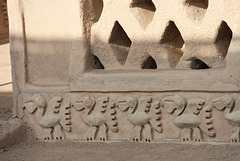
Decorative pelicans
| 08 Apr 2015 |
|
|
|
Tschudi Palace, Chan Chan, Peru
"Chan Chan was constructed by the Chimor (the kingdom of the Chimú), a late intermediate period civilization which grew out of the remnants of the Moche civilization. The adobe city of Chan Chan, the largest in the world, was built around 850 CE and lasted until its conquest by the Inca Empire in 1470. It was the imperial capital where 30,000 people lived."
en.wikipedia.org/wiki/Chan_Chan
AIMG 1546
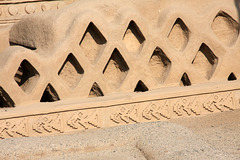
Decorative fish
| 08 Apr 2015 |
|
|
|
Tschudi Palace, Chan Chan, Peru
"Chan Chan was constructed by the Chimor (the kingdom of the Chimú), a late intermediate period civilization which grew out of the remnants of the Moche civilization. The adobe city of Chan Chan, the largest in the world, was built around 850 CE and lasted until its conquest by the Inca Empire in 1470. It was the imperial capital where 30,000 people lived."
en.wikipedia.org/wiki/Chan_Chan
AIMG 1551
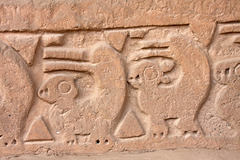
Squirrels
| 06 Apr 2015 |
|
|
|
Tschudi Palace, Chan Chan, Peru
"Chan Chan was constructed by the Chimor (the kingdom of the Chimú), a late intermediate period civilization which grew out of the remnants of the Moche civilization. The adobe city of Chan Chan, the largest in the world, was built around 850 CE and lasted until its conquest by the Inca Empire in 1470. It was the imperial capital where 30,000 people lived."
en.wikipedia.org/wiki/Chan_Chan
AIMG 1537
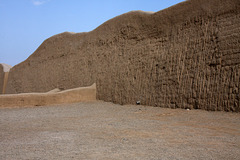
Entering Chan Chan
| 06 Apr 2015 |
|
|
|
Chan Chan, Peru.
"Chan Chan was constructed by the Chimor (the kingdom of the Chimú), a late intermediate period civilization which grew out of the remnants of the Moche civilization. The adobe city of Chan Chan, the largest in the world, was built around 850 CE and lasted until its conquest by the Inca Empire in 1470. It was the imperial capital where 30,000 people lived."
en.wikipedia.org/wiki/Chan_Chan
AIMG 1533

Adobe walls
| 06 Apr 2015 |
|
|
|
Tschudi Palace, Chan Chan, Peru
"Chan Chan was constructed by the Chimor (the kingdom of the Chimú), a late intermediate period civilization which grew out of the remnants of the Moche civilization. The adobe city of Chan Chan, the largest in the world, was built around 850 CE and lasted until its conquest by the Inca Empire in 1470. It was the imperial capital where 30,000 people lived."
en.wikipedia.org/wiki/Chan_Chan
AIMG 1543
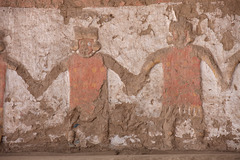
Dancing men
| 16 Mar 2015 |
|
|
|
Wall murals at Huaca de la Luna. Huaca de la Luna, which is located near Trujillo, Peru, was built between 600 and 900 AD by the Moche people.
AIMG 1445
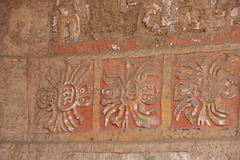
Spiders
| 16 Mar 2015 |
|
|
|
Wall murals at Huaca de la Luna. Huaca de la Luna, which is located near Trujillo, Peru, was built between 600 and 900 AD by the Moche people.
AIMG 1446
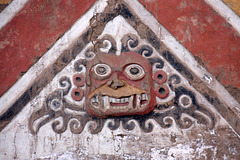
Ai apaec
| 03 Mar 2015 |
|
|
|
Carving of Ai apaec at Huaca de la Luna near Trujillo, Peru.
"Ai apaec (from the Mochica Aiapæc [a.ja.pøk] or [aiapøk]), also called decapitador was the chief deity of the Mochica culture, was one of their gods punishers, the most feared and adored, is also called the headsman. Ai Apaec was worshiped as the creator god, protector of the Moche, a provider of water, food and military triumphs. Aiapaec means 'doer' in Mochica language.
The most common representation of Ai Apaec is that seen in the murals of the Temples of the moon and sun (picture), which presents an anthropomorphic face with feline fangs and surrounding ocean waves.
Ai apaec was represented in several ways, depending on the period, place, and support used. In metallurgy, for example, Ai apaec is often seen as a spider with eight legs and an anthropomorphic face with jaguar fangs. In ceramics the divinity is often more anthropomorphic, usually with his head in his hands and sometimes with two snakes sprouting from his head (hair??). In sculpture he is shown with a staff.
It is said that during human sacrifices, prisoners were decapitated and their heads given to Ai apaec."
en.wikipedia.org/wiki/Ai_apaec
AIMG 1433
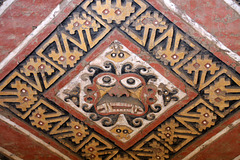
Ai apaec
| 03 Mar 2015 |
|
|
|
Carving of Ai apaec at Huaca de la Luna near Trujillo, Peru.
"Ai apaec (from the Mochica Aiapæc [a.ja.pøk] or [aiapøk]), also called decapitador was the chief deity of the Mochica culture, was one of their gods punishers, the most feared and adored, is also called the headsman. Ai Apaec was worshiped as the creator god, protector of the Moche, a provider of water, food and military triumphs. Aiapaec means 'doer' in Mochica language.
The most common representation of Ai Apaec is that seen in the murals of the Temples of the moon and sun (picture), which presents an anthropomorphic face with feline fangs and surrounding ocean waves.
Ai apaec was represented in several ways, depending on the period, place, and support used. In metallurgy, for example, Ai apaec is often seen as a spider with eight legs and an anthropomorphic face with jaguar fangs. In ceramics the divinity is often more anthropomorphic, usually with his head in his hands and sometimes with two snakes sprouting from his head (hair??). In sculpture he is shown with a staff.
It is said that during human sacrifices, prisoners were decapitated and their heads given to Ai apaec."
en.wikipedia.org/wiki/Ai_apaec
AIMG 1435
Jump to top
RSS feed- Esther's latest photos with "adobe" - Photos
- ipernity © 2007-2026
- Help & Contact
|
Club news
|
About ipernity
|
History |
ipernity Club & Prices |
Guide of good conduct
Donate | Group guidelines | Privacy policy | Terms of use | Statutes | In memoria -
Facebook
X
