

Earthwatcher's photos with the keyword: Westphalian
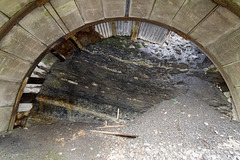
Chavery Coal and roof measures, Duckmanton Railway…
| 03 Feb 2010 |
|
A view of the strata exposed in the steel arch shelter in the Duckmanton Railway Cutting, near Chesterfield, north east Derbyshire. The Chavery Coal is visible in the lower left. This is overlain by shaly mudstones containing ironstone bands and nodules. Fossils in the roof mudstones include non-marine bivalves ( Anthracosia ) and and ostracods ( Geisina ).
The railway cutting is a site of international geological importance, as it contains the stratotype section for the Anthracoceras vanderbeckei (Clay Cross) marine band which is the boundary between the Langsettian and Duckmantian Stages of the Carboniferous, informally the junction between the Lower and Middle Coal Measures.
The site is managed by the Derbyshire Wildlife Trust and is accessible by permit only.
www.derbyshirewildlifetrust.org.uk/reserves/duckmanton-railway-cutting
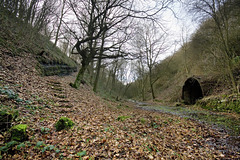
Duckmanton Railway Cutting SSSI
| 02 Feb 2010 |
|
This is the Duckmanton Railway Cutting Site of Special Scientific Interest, near Chesterfield, north-east Derbyshire. The arch structure on the right is a shelter built to preserve and allow access to the the Chavery Coal and its overlying roof mudstones. The same coal seam is visible in the bank at the top of the steps on the left. This was worked (illegally) by desperate miners during the 1984-85 miners' strike. (Chris Darmon, pers. comm.)
The railway cutting is a site of international geological importance, as it contains the stratotype section for the Anthracoceras vanderbeckei (Clay Cross) marine band which is the boundary between the Langsettian and Duckmantian Stages of the Carboniferous, informally the junction between the Lower and Middle Coal Measures.
Camera viewpoint is approx. SK 4224 7037, looking westwards.
The site is managed by the Derbyshire Wildlife Trust and is accessible by permit only.
www.derbyshirewildlifetrust.org.uk/reserves/duckmanton-railway-cutting
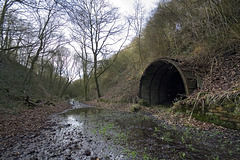
Duckmanton Railway Cutting SSSI (2)
| 03 Feb 2010 |
|
Another view of the Duckmanton Railway Cutting Site of Special Scientific Interest, near Chesterfield, Derbyshire.
The arch structure on the right is a shelter built to preserve and allow access to the the Chavery Coal and its overlying roof mudstones.
The railway cutting is a site of international geological importance, as it contains the stratotype section for the Anthracoceras vanderbeckei (Clay Cross) marine band which is the boundary between the Langsettian and Duckmantian Stages of the Carboniferous, informally the junction between the Lower and Middle Coal Measures.
The site is managed by the Derbyshire Wildlife Trust and is accessible by permit only.
www.derbyshirewildlifetrust.org.uk/reserves/duckmanton-railway-cutting
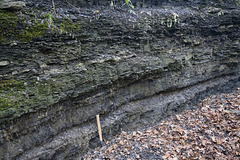
Chavery Coal and roof strata, Duckmanton Railway C…
| 03 Feb 2010 |
|
|
This is the Duckmanton Railway Cutting Site of Special Scientific Interest, near Chesterfield, north-east Derbyshire. In the lower part of the section is the Chavery Coal, overlain by shaly mudstones containing non-marine bivalves and ostracods. This exposure of the Chavery coal was worked (illegally) by desperate miners during the 1984-85 miners' strike. (Chris Darmon, pers. comm.)
The railway cutting is a site of international geological importance, as it contains the stratotype section for the Anthracoceras vanderbeckei (Clay Cross) marine band which is the boundary between the Langsettian and Duckmantian Stages of the Carboniferous, informally the junction between the Lower and Middle Coal Measures.
The site is managed by the Derbyshire Wildlife Trust and is accessible by permit only.
www.derbyshirewildlifetrust.org.uk/reserves/duckmanton-railway-cutting
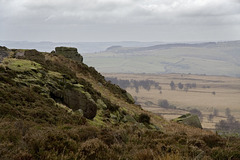
White (Edge) Christmas
| 28 Dec 2008 |
|
Originally uploaded for the Guesswhere UK group.
Where was I standing on Christmas Day in the morning?
Answer: On White Edge on the Eastern Edges in the Peak District National Park.
White Edge 1
| 29 Feb 2008 |
|
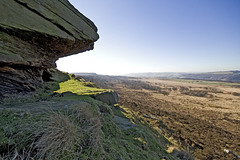
This is a view southwards along the low escarpment of White Edge in the Eastern Edges area of the Peak District National Park.
Unlike most of the Eastern Edges which are formed of Namurian 'Millstone Grit', White Edge is comprised of Crawshaw Sandstone which is stratigraphically just above the base of the Coal Measures.
I love the feeling of wide open spaces in the this area, yet we are only a few miles SW of Sheffield.
Erosion surface
| 29 Feb 2008 |
|
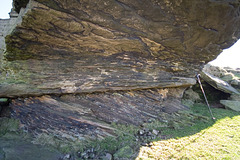
Cross-bedded Crawshaw Sandstone (Coal Measures) on White Edge in the Eastern Edges area of the Peak District National Park.
A prominent erosion surface is visible in the centre, where the cross-bedding of the underlying sand unit has been truncated by the overlying sand unit.
Guidepost 1
| 29 Feb 2008 |
|
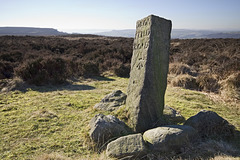
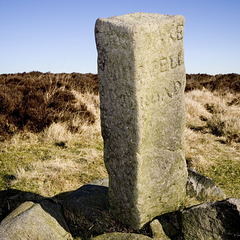
This guidepost is one of several in the the Big Moor - Longshaw area. They were erected to guide travellers and packhorse teams across the eastern part of the Peak District in the early years of the 18th century. This one stood at what was once an important cross roads but is now not even used as a recreational footpath.
The guidepost is made of coarse gritstone - probably Crawshaw Sandstone, from nearby White Edge. Each of the four sides bears a carved inscription indicating the route which the side faces. This one says:
DRONFEILD ROAD (facing east)
SHEFFEILD ROAD (facing north)
BAKEWELL ROAD (facing south)
and facing west:
TIDESWELL ROAD
1709
I guess that the bench mark on the Dronfield face was added much later, perhaps late 19th century or early 20th century?
Guidepost 2
| 29 Feb 2008 |
|
This guidepost is one of several in the the Big Moor - Longshaw area. They were erected to guide travellers and packhorse teams across the eastern part of the Peak District in the early years of the 18th century. This one stood at what was once an important cross roads but is now not even used as a recreational footpath.
The guidepost is made of coarse gritstone - probably Crawshaw Sandstone, from nearby White Edge. Each of the four sides bears a carved inscription indicating the route which the side faces. This one says:
DRONFEILD ROAD (facing east)
SHEFFEILD ROAD (facing north)
BAKEWELL ROAD (facing south)
and facing west:
TIDESWELL ROAD
1709
White Edge 2
| 29 Feb 2008 |
|
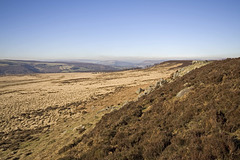
This is a view northwards along the low escarpment of White Edge in the Eastern Edges area of the Peak District National Park. The Derwent valley is visible in the left middle distance. In the far distance on the middle-left skyline is the Kinderscout plateau; Win Hill is in the centre distance and Bamford Edge at about 0.6, 0.6.
The brown smoke haze is a result of controlled burning of the heather moorland in the Strines area to the west of Sheffield.
Unlike most of the Eastern Edges which are formed of Namurian 'Millstone Grit', White Edge is comprised of Crawshaw Sandstone which is stratigraphically just above the base of the Coal Measures.
Alternative White Edge 2
| 29 Feb 2008 |
|
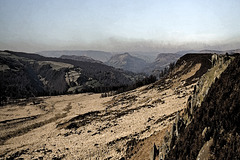
This is an experimental treatment of the previous photo.
The vertical scale has been exaggerated three-fold and then Photoshop 'watercolour' filter applied. Normally I don't bother much with these filters (too much of a gimmick) but in this case I think it works well and might even be considered artistic?? The resulting image, apart from being interesting in its own right, clearly enhances the geological framework of this area. The incised V-shaped notch of the Derwent Valley cut down through a much earlier (Tertiary?) erosion platform is well seen. In the far distance on the middle-left skyline is the Kinderscout plateau; Win Hill is in the centre distance and Bamford Edge at about 0.7, 0.6.
The brown smoke haze is a result of controlled burning of the heather moorland in the Strines area to the west of Sheffield.
White Edge 3
| 29 Feb 2008 |
|
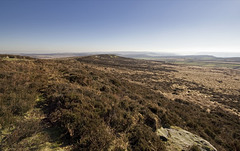
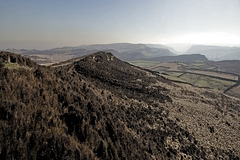
This is a view southwards along the low escarpment of White Edge in the Eastern Edges area of the Peak District National Park. The top of Curbar and Baslow Edges are visible off to the right with the Derwent Valley just visible in the distance. To the left of White Edge is Big Moor.
Unlike most of the Eastern Edges which are formed of Namurian 'Millstone Grit', White Edge is comprised of Crawshaw Sandstone which is stratigraphically just above the base of the Coal Measures.
I love the feeling of wide open spaces in the this area, yet we are only a few miles SW of Sheffield.
Alternative White Edge 4
| 29 Feb 2008 |
|
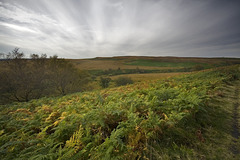
This is an experimental treatment of the previous photo.
The vertical scale has been exaggerated three-fold and then the Photoshop 'watercolour' filter applied. Normally I don't bother much with these filters (too much of a gimmick) but in this case I think it works well and might even be considered artistic?? The resulting image, apart from being interesting in its own right, clearly enhances the geological framework of this area. The incised V-shaped notch of the Derwent Valley cut down through a much earlier (Tertiary?) erosion platform is well seen.
This is a view southwards along the low escarpment of White Edge in the Eastern Edges area of the Peak District National Park. The top of Curbar and Baslow Edges are visible off to the right with the Derwent Valley just visible in the distance. To the left of White Edge is Big Moor.
Unlike most of the Eastern Edges which are formed of Namurian 'Millstone Grit', White Edge is comprised of Crawshaw Sandstone which is stratigraphically just above the base of the Coal Measures.
I love the feeling of wide open spaces in the this area, yet we are only a few miles SW of Sheffield.
Swine Sty and Big Moor
| 24 Nov 2007 |
|
Originally uploaded for the Guesswhere UK group.
This is a view over the Barbrook Valley towards Swine Sty and Big Moor, on the Eastern Edges in the Peak District National Park. The area around Swine Sty is the site of an extensive Neolithic - Early Bronze Age settlement and field system.
The camera location is in South Yorkshire; the distant moorland is in Derbyshire. The county boundary runs along the Barbrook valley in the middle distance.
The distant scarps are comprised mainly of Crawshaw Sandstone in the lowest part of the Coal Measure sequence; the lower slopes are of Rough Rock at the uppermost part of the Namurian 'Millstone Grit' sequence.
Recumbent fold near Little Haven, Pembrokeshire, w…
| 04 Jun 2007 |
|
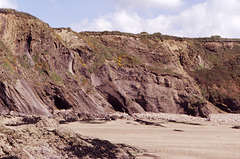
This photo shows the cliffs in the small sandy bay known as The Settlands between Little Haven and Broad Haven in Pembrokeshire, west Wales.
The rocks here are Upper Carboniferous Coal Measures and are part of the western extremity of the Pembrokeshire coalfield. The strata have been severely deformed by compressional tectonics during the Hercynian (Variscan) earth movements. In the centre of the photograph the rocks are folded into a recumbent fold, with the axis near horizontal - a sort of tilted " < " shape. A thrust fault separates this fold from the steeply dipping, inverted rocks on the LH side. These form the headland known as The Rain .
Scanned from a Kodachrome 64 transparency.
Jump to top
RSS feed- Earthwatcher's latest photos with "Westphalian" - Photos
- ipernity © 2007-2026
- Help & Contact
|
Club news
|
About ipernity
|
History |
ipernity Club & Prices |
Guide of good conduct
Donate | Group guidelines | Privacy policy | Terms of use | Statutes | In memoria -
Facebook
X
