

cammino's photos with the keyword: Apatura ilia

Startklar - Ready to fly
| 08 Jun 2026 |
|
|
|
Die Aufnahme entstand am Rand eines Auwalds. Der Kleine Schillerfalter (Apatura ilia) steht auf der Vorwarnliste der Roten Liste Deutschland. Eine Besonderheit: Der Kleine Schillerfalter saugt keinen Blütennektar. Männchen: Zur Mineralstoffaufnahme saugen sie an Aas, Kot, Baumsäften, feuchten Bodenstellen, Pfützen auf Waldwegen. Weibchen: saugen Honigtau von Blattläusen und an überreifen Früchte.
de.wikipedia.org/wiki/Kleiner_Schillerfalter
roth.bund-naturschutz.de/natur-vor-der-haustuer/artenportraits/espe/schillerfalter
The photo was taken at the edge of a riparian forest. The Lesser Purple Emperor (Apatura ilia) is listed on the early warning list of Germany’s Red List. One special characteristic: The species does not feed on flower nectar. Males: To obtain minerals, they feed on carrion, dung, tree sap, moist soil patches, and puddles on forest paths. Females: They feed on honeydew from aphids and on overripe fruit.
Das Blinken des Schillerfalters - The blinking of…
| 29 Jul 2025 |
|
|
|
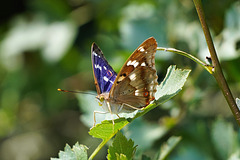
Kürzlich gelang es mir beim Kleinen Schillerfalter (Apatura ilia) zu zeigen, dass die blaue Farbe der Flügeloberseiten nicht als Pigmentierung vorliegt, sondern erst entsteht, wenn Licht in einem bestimmten Winkel auf die Flügeloberseite trifft (also optischer Effekt). Im oberen Bild sind die Flügel fast geschlossen: Braunfärbung. Im unteren Bild sind die Flügel stärker geöffnet und das blaue "Blinken" erfolgt. Der Kleine Schillerfalter ist kein Wiesenfalter, sondern ein Wald- bzw. Waldrandbewohner. Man findet ihn praktisch nie an Blüten, sondern eher an stark riechenden Substanzen wie Aas und Kot. Der Kleine Schillerfalter steht in Deutschland auf der Vorwarnliste der Roten Liste.
de.wikipedia.org/wiki/Kleiner_Schillerfalter
Recently, I was able to demonstrate in the case of the Lesser Purple Emperor (Apatura ilia) that the blue color on the upper side of its wings is not due to pigmentation, but rather only appears when light hits the upper side of the wings at a specific angle (i.e., an optical effect). In the upper image, the wings are almost closed: brown coloration. In the lower image, the wings are more open, and the blue “flashing” occurs. The Lesser Purple Emperor is not a meadow butterfly, but rather an inhabitant of forests and forest edges. You will almost never find it on flowers, but rather on strongly smelling substances such as carrion and feces. In Germany, the Lesser Purple Emperor is on the warning list of the Red List (threatened species).
Ein Schmetterling, der blinken kann - A blinking b…
| 18 Jul 2025 |
|
|
|
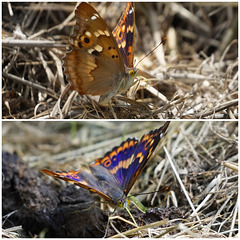
Eigentlich ist die Oberfläche der Flügel beim Kleinen Schillerfalter (Apatura ilia) dunkelbraun. Beim männlichen Falter gibt es aber eine Besonderheit: Wenn die Flügel auf- und zugeklappt werden und bei einer bestimmten Lichteinstrahlung, sehen sie leuchtend blau aus. Das Schillern entsteht durch Lichtbrechung an speziellen Schuppenstrukturen auf den Flügeln -ein sogenannter struktureller Farbeffekt, kein Pigment ist dafür verantwortlich. Bei Weibchen ist dieses Schillern praktisch nicht zu sehen. Der Große Schillerfalter zeigt den gleichen Farbeffekt.
Die Aufnahme entstand an einem Waldrand. Der Kleine Schillerfalter steht auf der Vorwarnliste der Roten Liste Deutschland.
de.wikipedia.org/wiki/Kleiner_Schillerfalter
roth.bund-naturschutz.de/natur-vor-der-haustuer/artenportraits/espe/schillerfalter
Actually, the surface of the wings of the Lesser Purple Emperor (Apatura ilia) is dark brown. However, there is a special feature in the male butterfly: when the wings are opened and closed, and under certain lighting conditions, they appear to glow with a bright blue color. This iridescence is caused by light refraction on special scale structures on the wings – a so-called structural color effect, not by pigment. In females, this shimmering is practically not visible. The Purple Emperor (Apatura iris) shows the same color effect.
The photo was taken at the edge of a forest. The Lesser Purple Emperor butterfly is on the warning list of the German Red List.
Der schillernde Falter - The dazzling butterfly
| 26 Aug 2024 |
|
|
|
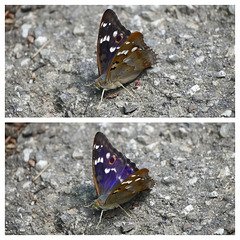
Man glaubt es nicht. Bei den beiden Faltern in der obigen Collage handelt es sich um ein und dasselbe Individuum des Kleinen Schillerfalters (Apatura ilia) ! Dieser ziemlich große Tagfalter ist eigentlich recht unauffällig (oberes Bild). Wenn er aber in einem bestimmten Winkel zum einfallenden Sonnenlicht steht, strahlen die Oberseiten seiner Flügel in einem intensiven Tintenblau (unteres Bild). Sobald er sich wieder etwas dreht, verschwindet die blaue Farbe wieder. Man nimmt also ein eigenartiges "Blinken" wahr. Die Farbe wird durch Interferenz hervorgerufen (s. spektrum-Artikel) und nicht durch Farbstoffe und wird nur im männlichen Geschlecht gezeigt.
Den Kleinen Schillerfalter sieht man nur gelegentlich auf sonnigen Waldwegen, er steht in der Vorwarnliste der Roten Liste Deutschland. Diese Art besucht keine Blüten. Die Männchen saugen gern an Tierkot (wie im Foto) oder an Aas, die Weibchen saugen gern Honigtau von Blattläusen oder an überreifen Früchten.
www.spektrum.de/lexikon/biologie/schillerfalter/59243
de.wikipedia.org/wiki/Kleiner_Schillerfalter
You wouldn't believe it. The two butterflies in the in the collage above are one and the same individual of the lesser purple emperor (Apatura ilia) ! This rather large butterfly is actually quite inconspicuous (photo above). However, when it stands at a certain angle to the incident sunlight, the upper sides of its wings shine in an intense ink blue colour (lower photo). As soon as it turns slightly, the blue colour disappears again. A peculiar "flashing" colour is thus perceived. The colour is caused by interference (see spektrum article) and not by dyes and is only seen in males.
The lesser purple emperor is only seen occasionally on sunny forest paths and is on the early warning list of the German Red List. This species does not visit flowers. The males like to suck on animal faeces (as in the photo) or on carrion, the females like to suck honeydew from aphids or on overripe fruit.
Kleiner Schillerfalter - Apatura ilia - Lesser pur…
| 16 Feb 2023 |
|
|
|
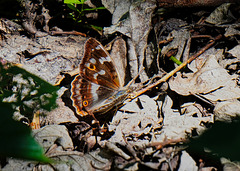
Der Kleine Schillerfalter ist ein Großschmetterling, der zwar bunt gefärbt ist, aber dennoch wenig auffällt. Er lebt nämlich in Lichtungen und Schneisen von Laubwäldern, in denen die Futterpflanzen seiner Raupen vorkommen, nämlich Weiden und Pappeln. Wenn er auf Wegen oder auf dem Waldboden sitzt, ist er kaum zu erkennen, es sei denn, es ist ein männlicher Falter, bei dem je nach Lichteinfall eine deutliche blaue Färbung auf der Flügeloberseite zu erkennen ist (siehe PiP, entnommen aus de.wikipedia.org/wiki/Datei:Batolec_%C4%8Derven%C3%BD_(Apatura_ilia)_.jpg
In Deutschland gilt dieser wunderschöne Falter als bedroht, vor allem wegen der Vernichtung seiner Lebensräume. Die Aufnahme dieses weiblichen Schillerfalters entstand in einem Laubmischwald.
Kleiner Schillerfalter
de.wikipedia.org/wiki/Kleiner_Schillerfalter
The Lesser Purple emperor is a large butterfly that is brightly colored, but is not very noticeable. It lives in clearings and aisles of deciduous forests where the food plants of its caterpillars are found, namely willows and poplars. When sitting on paths or on the forest floor, it can hardly be seen, unless it is a male moth which, depending on the light, has a distinct blue tint on the upper surface of its wings (see PiP, taken from de.wikipedia.org/wiki/Datei:Batolec_%C4%8Derven%C3%BD_(Apatura_ilia)_.jpg
In Germany, this beautiful moth is considered threatened, mainly because of the destruction of its habitat. The photo of this female Apatura ilia was taken in a deciduous forest.
Jump to top
RSS feed- cammino's latest photos with "Apatura ilia" - Photos
- ipernity © 2007-2026
- Help & Contact
|
Club news
|
About ipernity
|
History |
ipernity Club & Prices |
Guide of good conduct
Donate | Group guidelines | Privacy policy | Terms of use | Statutes | In memoria -
Facebook
X
