

cammino's photos with the keyword: Jun
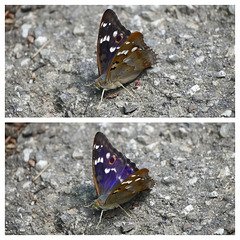
Das Blinken des Schillerfalters - The blinking of…
| 29 Jul 2025 |
|
|
|
Kürzlich gelang es mir beim Kleinen Schillerfalter (Apatura ilia) zu zeigen, dass die blaue Farbe der Flügeloberseiten nicht als Pigmentierung vorliegt, sondern erst entsteht, wenn Licht in einem bestimmten Winkel auf die Flügeloberseite trifft (also optischer Effekt). Im oberen Bild sind die Flügel fast geschlossen: Braunfärbung. Im unteren Bild sind die Flügel stärker geöffnet und das blaue "Blinken" erfolgt. Der Kleine Schillerfalter ist kein Wiesenfalter, sondern ein Wald- bzw. Waldrandbewohner. Man findet ihn praktisch nie an Blüten, sondern eher an stark riechenden Substanzen wie Aas und Kot. Der Kleine Schillerfalter steht in Deutschland auf der Vorwarnliste der Roten Liste.
de.wikipedia.org/wiki/Kleiner_Schillerfalter
Recently, I was able to demonstrate in the case of the Lesser Purple Emperor (Apatura ilia) that the blue color on the upper side of its wings is not due to pigmentation, but rather only appears when light hits the upper side of the wings at a specific angle (i.e., an optical effect). In the upper image, the wings are almost closed: brown coloration. In the lower image, the wings are more open, and the blue “flashing” occurs. The Lesser Purple Emperor is not a meadow butterfly, but rather an inhabitant of forests and forest edges. You will almost never find it on flowers, but rather on strongly smelling substances such as carrion and feces. In Germany, the Lesser Purple Emperor is on the warning list of the Red List (threatened species).
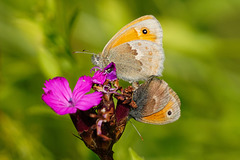
Wiesenvögelchen in Kopula - Small heaths in copula
| 03 Aug 2024 |
|
|
|
Das recht häufig in Europa vorkommende Kleine Wiesenvögelchen (Coenonympha pamphilus) wird auch als Kleiner Heufalter bezeichnet, weil es in allen möglichen Graslandschaften vorkommt. Man kann die Tagfalter vom Frühjahr bis in den Herbst beobachten. Die Eiablage erfolgt an vielen Grasarten, die Raupe überwintert. Im Bild ein Pärchen in Kopulation auf einer Blüte der Kartäusernelke (Dianthus carthusianorum). Der größere Schmetterling ist das Weibchen, der deutlich kleinere ist das Männchen.
www.dorsetbutterflies.com/species/small-heath
de.wikipedia.org/wiki/Kleines_Wiesenv%C3%B6gelchen
The Small heath (Coenonympha pamphilus) is quite common in Europe and occurs in all kinds of grassland. You can observe these butterflies from spring to autumn. Eggs are laid on many grass species and the caterpillar hibernates. The photo shows a couple in copulation on a flower of the Carthusian Pink (Dianthus carthusianorum). The larger butterfly is the female, the significantly smaller one is the male.
Jump to top
RSS feed- cammino's latest photos with "Jun" - Photos
- ipernity © 2007-2026
- Help & Contact
|
Club news
|
About ipernity
|
History |
ipernity Club & Prices |
Guide of good conduct
Donate | Group guidelines | Privacy policy | Terms of use | Statutes | In memoria -
Facebook
X
