

cammino's photos with the keyword: Mannstreu
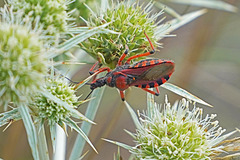
Vorsicht: Stichgefahr - Warning: Can sting
| 02 Oct 2025 |
|
|
|
Die auffällig rot-schwarz gefärbte Rote Mordwanze (Rhynocoris iracundus) kann man gelegentlich in der Krautschicht von trocken-warmen Lebensräumen finden. Sie ernährt sich räuberisch von verschiedenen Insekten. Dazu wird die Beute gefangen, Gift mit ihrem kräftigen Stech-Saugrüssel in den Körper injiziert und anschließend ausgesaugt. Sie greift auch Beute an, die größer ist als sie selbst. Achtung: Die Tiere nicht fangen, denn sie stechen auch Menschen und der Stich soll schmerzhafter als ein Bienenstich sein!
Die Aufnahme entstand in einem fränkischen Naturschutzgebiet.
de.wikipedia.org/wiki/Rote_Mordwanze
The strikingly red-and-black colored Red Assassin Bug (Rhynocoris iracundus) can occasionally be found in the herb layer of dry, warm habitats. It is a predatory species that feeds on various insects. To do this, it captures its prey, injects venom into the body with its strong piercing-sucking rostrum, and then sucks it out. It will even attack prey larger than itself.
Caution: Do not try to catch these insects - they can also sting humans, and the sting is said to be more painful than a bee sting!
The photo was taken in a Franconian nature reserve.
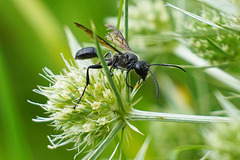
Der Grillenkiller - The cricket killer
| 29 Aug 2024 |
|
|
|
Der Stahlblaue Grillenjäger (Isodontia mexicana) ist eine Grabwespe, die eigentlich in Mittel- und Nordamerika heimisch ist und etwa 1960 nach Europa eingeschleppt wurde. In Deutschland wurde diese Insektenart 1998 erstmalig nachgewiesen und hat sich seitdem auch bei uns verbreitet. Die Brutbiologie kann man im Wikipedia-Artikel nachlesen.
Der Stahlblaue Grillenjäger besucht gerne Blüten von Goldruten- (Solidago) Arten und Mannstreu (Eryngium), siehe Foto.
de.wikipedia.org/wiki/Stahlblauer_Grillenj%C3%A4ger
The Mexican grass-carrying wasp (Isodontia mexicana) is wasp that is actually native to Central and North America and was introduced to Europe around 1960. This insect species was first recorded in Germany in 1998 and has since spread here. The breeding biology can be found in the Wikipedia article. The Mexican grass-carrying wasp likes to visit flowers of goldenrod (Solidago) and Eryngium species, see photo.
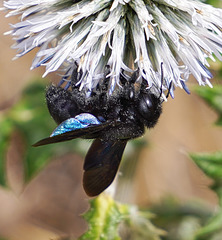
Die Komplexaugen der Insekten - The compound eyes…
| 05 Aug 2022 |
|
|
|
Beim Betrachten des Bildes dieser Blauen Holzbiene (Xylocopa violacea) fällt das große Komplexauge (Facettenauge) auf, von denen jedes Insekt ein Paar besitzt. Diese Augen sind jeweils aus vielen Einzelaugen aufgebaut und liefern zwar ein relativ unscharfes Bild der Umgebung, aber auf schnelle Bewegungen sind sie außerordentlich empfindlich.
www.deutschland-summt.de/faq_leser/facettenauge.html
www.bienenjournal.de/glossar/ocellus
When looking at the picture of this violet carpenter bee (Xylocopa violacea) , one notices the large compound eye , of which each insect has a pair. These eyes are each composed of many units calles ommatidia and, although they provide a relatively blurred image of the surroundings, they are extremely sensitive to rapid movements.
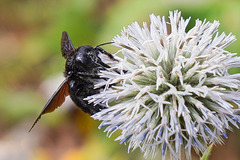
Mit fünf Augen sieht man besser - You see better w…
| 05 Aug 2022 |
|
|
|
Insekten, wie auch diese Blaue Holzbiene (Xylocopa violacea) , besitzen nicht nur 1 Paar Komplexaugen (Facettenaugen) , sondern darüber hinaus noch drei kleinere, die oberhalb der beiden Komplexaugen mittig und symmetrisch angebracht sind. In der Notiz im Bild habe ich diese 3 sogenannten Punktaugen (Ocelli) markiert. Bienen und andere Insekten haben somit 5 Augen !
Laut eines Artikels im Bienenjournal vom 27.11.2020 können "Ocelli vermutlich die Lichtintensität wahrnehmen. Damit dienen sie möglicherweise der Messung der der Tageslänge und der aktuellen Tageszeit. Zudem sind die Bienen mithilfe der Ocelli vermutlich in der Lage den Horizont wahrzunehmen und damit ihre horizontale Flugbahn auszurichten. Die Forschung hat darauf noch keine sichere Antwort gefunden."
www.bienenjournal.de/glossar/ocellus
Insects, like this violet carpenter bee (Xylocopa violacea) , not only have 1 pair of compound eyes (compound eyes) , but also three smaller ones, which are above the two compound eyes in the middle and are attached symmetrically. I marked these 3 so-called ocelli in the note in the picture. Bees and other insects have 5 eyes !
According to an article in the bee journal from November 27th, 2020, "Ocelli can probably perceive the light intensity. They may thus be used to measure the length of the day and the current time of day. In addition, the bees are probably able to use the ocelli to perceive the horizon and thus their horizontal trajectory The research has not yet found a definite answer."
Jump to top
RSS feed- cammino's latest photos with "Mannstreu" - Photos
- ipernity © 2007-2026
- Help & Contact
|
Club news
|
About ipernity
|
History |
ipernity Club & Prices |
Guide of good conduct
Donate | Group guidelines | Privacy policy | Terms of use | Statutes | In memoria -
Facebook
X
