

cammino's photos with the keyword: Kormoran
Das Naturschutzgebiet Unteres Odertal - The nature…
| 13 Jul 2024 |
|
|
|
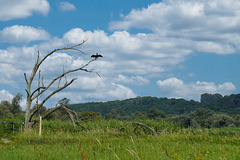
Ein Eldorado für Vögel, Fische und viele seltene Pflanzen ist das Naturschutzgebiet Unteres Odertal . Bei meinem Besuch dort konnte ich schon bald den Weißstorch, Schwarzstorch, Kormoran, Kranich und die Grauammer (Emberiza calandra) entdecken. Für Naturliebhaber ist ein Besuch hier fast ein "Muss". Im Bild ein Kormoran , der nach nach dem Fischen sein Gefieder trocknet.
"Das untere Odertal ist Deutschlands einziger Auennationalpark und zugleich das erste grenzüberschreitende Großschutzgebiet mit Polen. Der Naturraum des unteren Odertals mit seiner einzigartigen Tier- und Pflanzenwelt verbindet Deutschland und Polen. Der Nationalpark Unteres Odertal, das Landschaftsschutzgebiet Nationalparkregion Unteres Odertal und die polnischen Landschaftsschutzparks (Park Krajobrazowy) Dolina Dolnej Odry und Cedynia bilden gemeinsam den Schutzgebietsverbund Unteres Odertal. Die Verwaltung des Nationalparks und die Verwaltung der westpommerschen Landschaftsschutzparks arbeiten beim Schutz und der Weiterentwicklung des Gebiets eng zusammen."
www.nationalpark-unteres-odertal.eu/grenzueberschreitend
de.wikipedia.org/wiki/Nationalpark_Unteres_Odertal
"The lower Oder valley is Germany’s only wetland national park and also the first large, cross-border protected area in partnership with Poland. The natural environment of the lower Oder valley with its unique flora and fauna interlinks Germany and Poland. The Lower Oder Valley National Park, the protected landscape of the Lower Oder Valley National Park region and the Polish landscape conservation parks (Park Krajobrazowy) Dolina Dolnej Odry and Cedynia together form the Lower Oder Valley Nature Reserve. The management of the national park and the West Pomeranian landscape conservation parks work closely together in the protection and development of the area."
The Lower Oder Valley nature reserve is an Eldorado for birds, fish and many rare plants. During my visit there, I soon spotted the white stork, black stork, cormorant, crane and corn bunting (Emberiza calandra). For nature lovers, a visit here is almost a "must".
The photo shows a cormorant drying its feathers after fishing.
Die linke und die rechte Fraktion - The right and…
| 24 Feb 2022 |
|
|
|
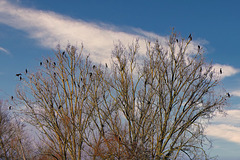
Im Bild einige alte Weidenbäume, die von Kormoranen (Phalacrocorax carbo) als Rastplatz aufgesucht werden. Eine Kormoran-Nahaufnahme, die ich in Berlin machen konnte, befindet sich im PiP. Erstaunlich ist, dass sich zwei Gruppen gebildet haben, die deutlich räumlich getrennt sind. Das Bild entstand im Vogelschutzgebiet Garstadt, in dem auch die vorausgegangenen Bilder entstanden sind. Anfügen möchte ich noch, dass bei der Heimfahrt von dieser Wanderung am 13.2.2022 ganz in der Nähe von uns ein Weißstorch auf einer Wiese gesichtet worden ist. Es ist bekannt, dass seit einigen Jahren viele Störche nicht mehr nach Afrika ziehen, sondern in Spanien überwintern. Auch weiß man, dass mittlerweile einige Störche bei uns im relativ milden Winter überwintern. Vielleicht auch ein Zeichen für den Klimawandel?
www.zdf.de/nachrichten/panorama/stoerche-winter-deutschland-afrika-100.html
The picture shows some old willow trees that are used by cormorants (Phalacrocorax carbo) as a resting place. A cormorant close-up I was able to take in Berlin is in the PiP. It is astonishing that two groups have formed which are clearly spatially separated. The picture was taken at the Garstadt bird sanctuary, where the previous pictures were also taken. I would like to add that on our way home from this hike on 13.2.2022 we spotted a white stork in a nearby meadow. It is known that for some years now many storks no longer migrate to Africa, but spend the winter in Spain. We also know that some storks now spend the winter in our relatively mild climate. Perhaps this is also a sign of climate change?
Jump to top
RSS feed- cammino's latest photos with "Kormoran" - Photos
- ipernity © 2007-2026
- Help & Contact
|
Club news
|
About ipernity
|
History |
ipernity Club & Prices |
Guide of good conduct
Donate | Group guidelines | Privacy policy | Terms of use | Statutes | In memoria -
Facebook
X
