

Martin M. Miles' photos with the keyword: Arnsberg
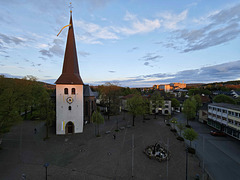
Hüsten - St. Petri
| 07 Aug 2025 |
|
|
Neheim-Hüsten existed from 1941 to 1974. It was created by merging the town of Neheim and the municipality of Hüsten. The town was incorporated into Arnsberg in 1975 and continues to exist as a single district.
Hüsten was first mentioned in a document in 802, making it one of the oldest communities in Westphalia. The parish of St. Petri was first mentioned in 1179. In 1360, Count Gottfried IV of Arnsberg granted the town civil rights. In 1604, almost all the houses and stables burned down. In 1613, nearly half of the population died of the plague. In 1807, a major fire destroyed Hüsten.
The industrial revolution reached the town with the founding (1839/1846) of a heavy industrial company ("Hüstener Gewerkschaft"). In 1839, the Hüsten rolling mill was founded. Until the closure of this operation in 1966, Hüsten was as closely associated, both positively and negatively, with the "Gewerkschaft." From 1871 to 1911 the population increased from 1578 to 6609 inhabitants.
The history of St. Petri Church dates back to the 9th century, the time of Christianization. St. Petri church in Hüsten was thus one of the main parishes in the Sauerland region. The parish originally encompassed the entire Röhrtal valley and the present-day Arnsberg city area. As late as 1179, Hüsten was still officially the mother church of the Oelinghausen nunnery, founded in 1174.
The first church building was made of wood. A stone structure followed around 1150. The building was a Romanesque pillar basilica. It had a central nave and two side aisles. The tower still dates from that building. After a fire in the 15th century, the church was rebuilt in the original style. In the 17th century, the tower was raised several meters.
By the 19th century, the building had finally proved too small. Initial plans for a new building date back to 1831. However, due to financial difficulties, construction did not begin until 1861. The old building was demolished except for the tower.
The new building is a neo-Gothic hall church.
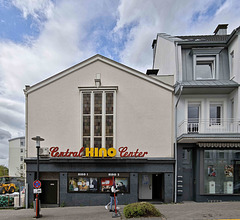
Neheim - Central Kino Center
| 06 Aug 2025 |
|
|
Neheim-Hüsten existed from 1941 to 1974. It was created by merging the town of Neheim and the municipality of Hüsten. The town was incorporated into Arnsberg in 1975 and continues to exist as a single district.
Neheim was first documented in 1202. The town was fortified in the 13th century. On July 25, 1358, the town was granted town rights by Count Gottfried IV of Arnsberg.
The first metalworking factories were established in the 1830s. Over time, entrepreneurs increasingly specialized in the production of kerosene lamps and their accessories. This industry experienced a boom, particularly after the connection to the railway in the 1870s. However, this phase ended, partly due to competition from electric lighting. Some entrepreneurs responded by switching to the new technology even before the First World War.
When the dam wall of the Möhne Dam burst during a bombing raid on May 17, 1943, a flood wave up to 12 meters high also destroyed the buildings in Neheim near the river. There were deaths among the civilian population and many victims among the people in the forced labor camp.
Central Kino Center is one of the two remaining cinemas in Neheim.

Neheim - St. Johannes Baptist
| 06 Aug 2025 |
|
Neheim-Hüsten existed from 1941 to 1974. It was created by merging the town of Neheim and the municipality of Hüsten. The town was incorporated into Arnsberg in 1975 and continues to exist as a single district.
Neheim was first documented in 1202. The town was fortified in the 13th century. On July 25, 1358, the town was granted town rights by Count Gottfried IV of Arnsberg.
The first metalworking factories were established in the 1830s. Over time, entrepreneurs increasingly specialized in the production of kerosene lamps and their accessories. This industry experienced a boom, particularly after the connection to the railway in the 1870s. However, this phase ended, partly due to competition from electric lighting. Some entrepreneurs responded by switching to the new technology even before the First World War.
When the dam wall of the Möhne Dam burst during a bombing raid on May 17, 1943, a flood wave up to 12 meters high also destroyed the buildings in Neheim near the river. There were deaths among the civilian population and many victims among the people in the forced labor camp.
In April 1807, Neheim burned down, leaving only a few houses. The church was also destroyed. The construction of a new church, built in the style of a pillar basilica, was not completed until 1822.
Due to the exceptionally strong population growth, a larger church became necessary shortly thereafter. The current neo-Romanesque church building was to be built in two phases. In the first phase, the transept, choir, and two east towers were built as an extension to the existing church from 1822. After a 17-year interruption, the nave and west tower were built in the second phase between 1910 and 1913, replacing the church completed in 1822.
Jump to top
RSS feed- Martin M. Miles' latest photos with "Arnsberg" - Photos
- ipernity © 2007-2026
- Help & Contact
|
Club news
|
About ipernity
|
History |
ipernity Club & Prices |
Guide of good conduct
Donate | Group guidelines | Privacy policy | Terms of use | Statutes | In memoria -
Facebook
X
