

tarboat's photos with the keyword: peak forest canal
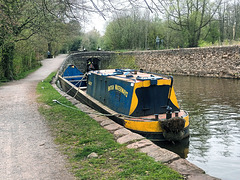
Gailey
| 07 Feb 2024 |
|
|
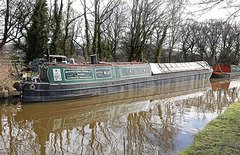
Former Fellows, Morton & Clayton motor boat 'Gailey' lies against the towpath on Marple Locks on the Peak Forest Canal. This 1937 built boat is now used as a maintenance boat in the Canal & River Trust heritage fleet.
Royalty Class
| 03 May 2023 |
|
|
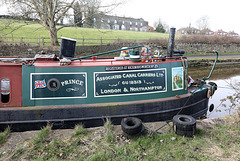
Prince is one of two Royalty Class boats built in 1931 by James Pollock Sons & Co Ltd of Faversham. Kent, for Associated Canal Carriers Ltd. Seen here at Tramway Wharf in Marple on the Peak Forest Canal.
Marple locks
| 27 Apr 2023 |
|
|
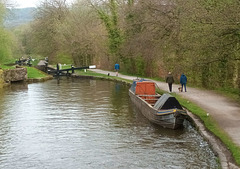
Fomer Fellows, Morton & Clayton motor boat 'Gailey' lies against the towpath on Marple Locks on the Peak Forest Canal. This 1937 built boat is now used as a maintenance boat in the Canal & River Trust heritage fleet.
Yeo
| 31 Mar 2023 |
|
|
|
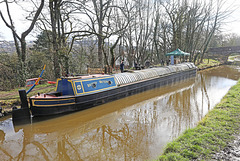
This is the River Class butty Yeo, built by EC Jones & Son of Brentford in 1959 for British Transport Waterways, a division of the British Transport Commission. The River Class boats were a new design of narrowboat, designed to be cheap and simple to construct and to have 20% extra carrying capacity over more traditional boats. They were built of welded steel sections and used blue glass fibre hatch covers instead of cloth covers.
Prince
| 20 Mar 2023 |
|
Prince is one of two Royalty Class boats built in 1931 by James Pollock Sons & Co Ltd of Faversham. Kent, for Associated Canal Carriers Ltd. Seen here at Tramway Wharf in Marple on the Peak Forest Canal.
Maintenance boats
| 16 Feb 2022 |
|
|
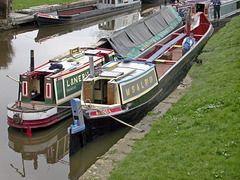
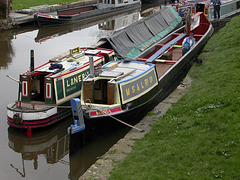
A pair of maintenance boats built for duties on the Ashton, Peak Forest and Macclesfield Canals. Maria was built by Jinks at Marple in 1915 at a cost of £155. It replaced another boat of the same name built at the same yard for the Buxton Lime Company.
Joel was originally built as a horse boat for the Buxton Lime Company in 1918. Sold out of service to the London and North Eastern Railway Company in 1926 she was subsequently rebuilt in 1929 as a motor boat fitted with a Kelvin 9HP petrol engine. This was the first motor boat in the maintenance fleet and always betrayed its' origins as a horse boat through the short, low horse boat style cabin cum engineroom with no gunwhales and the long rear deck and consequent long tiller. By 1946 the boat was in need of rebuilding and it was replaced by a new motor boat built at Gorton. It entered service in British Waterways colours in August 1948, retaining the fleet number 9. It may well be that a number of parts from the original boat were incorporated in the new Joel and that for accountancy purposes it was actually classed as a rebuild rather than a new boat. The boatbuilder at Gorton at this time, one Tommy Challinor, is said to have lacked the confidence to build a new boat from scratch and consequently always rebuilt or modified existing boats so they were like the aged broom that had 3 handles and 4 heads. Powered by a new 15hp twin cylinder Kelvin petrol/paraffin engine this was a fast boat which served until the Ashton canal became derelict in the early 1960's.
Both boats were abandoned on the Ashton Canal by the early 1970s but were rescued by enthusiasts who formed the Ashton Packet Boat Company and undertook extensivel rebuilds. They continue to keep these rare wooden narrowboats in good order.

Marple
| 14 Sep 2020 |
|
|
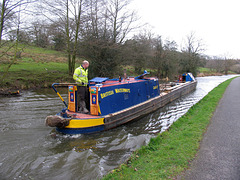
A pleasant afternoon working the tarboat up the locks at Marple on the Peak Forest Canal. On the approach to lock 3 our Jefferson observes the action.
Transshipment
| 21 May 2020 |
|
|
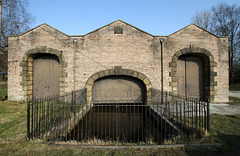
Southern end of the transshipment warehouse at the terminus of the Peak Forest Canal in Whaley Bridge. It is listed Grade II*.
The first warehouse at the head of the Whaley Bridge Branch of the Upper Peak Forest Canal was built in 1801 and it is attributed to Thomas Brown who was the Resident Engineer for the construction of the canal. This was a three-storey building of gritstone construction positioned at 90 degrees to the canal. It was five bays wide with the central bay straddling the canal. There was an arched shipping hole in the central bay that permitted two boats to enter, side-by-side, so that they could be loaded and unloaded undercover.
The potential of the Peak Forest Canal was considerably enhanced when it became the northern terminus of the Cromford and High Peak Railway in 1831, offering a route for Midlands carriers from the Cromford Canal to reach Manchester and the North West via the Peak Forest Canal. The capacity of the 1801 warehouse was adequate for effective day-to-day operation until the railway brought about a considerable increase in traffic for the Peak Forest Canal at Whaley Bridge and it was deemed that the existing storage facilities were no longer adequate and neither was there a connection with the railway. Consequently, it was decided to increase the storage capacity and make a railway connection by adding an extension of gritstone constructionto the original building.
The extension was built in 1832 and a stone tablet over the central bay of the south elevation, is inscribed with the date, '1832'. It was built by Manchester contractor David Bellhouse Junior.
The Ordnance Survey map of 1875 shows the railway approaching the north and south elevations of the warehouse on the east side. However, this was later changed to a single-track line entering the western bay of the extension through a doorway in the south elevation. This line had a curious arrangement in that it did not provide direct access from the main railway line. Rather, it curved in from the siding of the Bingswood Print Works and an amount of shunting by horses would have been required before waggons from the main line could enter the warehouse. A possible explanation for this arrangement is the possibility that a considerable amount of goods associated with the print works were carried on this line.
The original 1801 warehouse and the 1832 extension remained intact until 1915 when, for reasons now lost, the top floor of the warehouse was removed. The remaining north, east and west elevations of the original building were then re-modelled and re-roofed to match the 1832 extension.
The water feed from the Toddbrook and Combs Reservoirs reaches the canal through the warehouse, emerging from a culvert behind the metal fence.
Thanks to Peter Whitehead for the information.
Gailey
| 16 Mar 2019 |
|
|
Gailey was originally built as a butty boat by Fellows Morton and Clayton at their Saltley Dock in 1899.It was converted to a motor boat at Yarwoods in Northwich in 1937. The boat continues in service as part of the Canal & River Trust maintenance fleet. It is seen here between Disley and Marple on the Peak Forest Canal.
Lock 13
| 21 Oct 2010 |
|
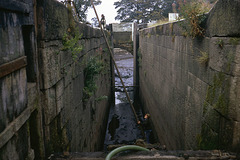
Lock 13 at Marple proved to be the very devil of a job to clear of mud when the Peak Forest Canal Society set about it with barrow hoist and men with shovels. Each time we started work something would break. The pump would stop working or the hoist failed, or some other disaster would befall the job. Instead of a weekend it took several weeks before it was finally emptied of that black mud. This photo was taken at the beginning of the Lock 13 saga in September 1972.

Marple aqueduct
| 29 Sep 2007 |
|
Outram's Marple Aqueduct is difficult to view from the sides of the Goyt valley as the trees are thick.
Joel and Maria
| 29 Sep 2007 |
|
Two boats from the maintenance fleet used on the Ashton, Peak Forest and Macclesfield Canals. Joel and Maria, both beautifully restored are seen here at Marple.
Jump to top
RSS feed- tarboat's latest photos with "peak forest canal" - Photos
- ipernity © 2007-2026
- Help & Contact
|
Club news
|
About ipernity
|
History |
ipernity Club & Prices |
Guide of good conduct
Donate | Group guidelines | Privacy policy | Terms of use | Statutes | In memoria -
Facebook
X
