

Jaap van 't Veen's photos with the keyword: abbey

France: Le Bec-Hellouin, Abbaye Notre-Dame du Bec
| 28 Sep 2026 |
|
|
|
Abbaye Notre-Dame du Bec (Abbey of Our Lady of Bec, also called Bec Abbey) is a Benedictine monastic foundation. The construction of the abbey started in 1034 by a man called Hellouin and continued through 1035. In the 12th century it was the most influential abbey of Anglo-Norman kingdom.
Bec Abbey was damaged during the Wars of Religion and left a ruin in the French Revolution but the 15th-century Tour Saint-Nicolas from the medieval monastery is still standing.
In 1948 the abbey was re-established as the Abbaye Notre-Dame du Bec by a community of Benedictine monks of the Olivetan Congregation, who effected some restorations. Abbaye Notre-Dame du Bec is the property of the French State, but there are still monks living in the abbey.

France - Fatouville-Grestain, abbey
| 30 Jul 2025 |
|
|
|
de Conteville. The abbey was officially closed in 1757. The church buildings were demolished around 1766 and the rest of the abbey was destroyed in 1790.
At the end of the 12th century, the abbey owned seven country houses, twelve churches, a priory, three estates and several parishes, which together formed a domain of 5,830 hectares.
The abbey complex is located in a wooded park - surrounded by a boundary wall, parts of which date back to the Middle Ages - through which the Saint-Benoît spring with healing water flows. Today, only a few of the original buildings remain: a perfectly intact 12th-century vaulted refectory and a pillar from the abbey church with a commemorative plaque (added in 1928). From the 18th century the complex still has a beautiful stone barn, a little chapel and a manor.
Since 1960, the current owners have been committed to restoring this place. Nowadays the abbey is open for visitors and is offering a rich cultural programme of guided tours, conferences, concerts, theatre and exhibitions.
Austria - Reichersberg Abbey
| 09 Dec 2019 |
|
|
|
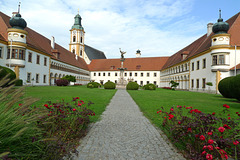
Stift Reichersberg (Reichersberg Abbey) was founded in 1084. After the early death of their only son, Gebhard, who reportedly drowned in the nearby river Inn, nobleman Wernher von Reichersberg and his wife Dietburga founded a monastery near their castle. The advice to bring Augustinian Canons to Reichersberg probably came from Archbishop Gebhard von Salzburg, the brother-in-law of the founder. The first canons came from Saxony. The founder himself also ended up in the monastery after the death of his wife.
Times of prosperity and adversity varied in the course of the following centuries. In 1624 the relatively small romanesque-gothic monastery complex was completely destroyed by a devastating fire. During the next years of the 17th century it was replaced by baroque new buildings, which today belong to the most important baroque buildings in Upper Austria.
The complex is grouped around two courtyards. The most important buildings are located along the 123 meter long outer courtyard, an architectural jewel with arcades and the marble fountain. The fountain is crowned with a figure of St. Michael, the patron of the monastery.
The abbey church of St. Michael was consecrated in 1644. The furnishings are late 18th century, with frescoes, marble side-altars and a beautiful pulpit; in 1883 the organ was widened.
During the Napoleonic Wars (1803–1815) it had to struggle for its existence. In 1810 the monastery was placed under administration and seven years later monastic activities resumed.
By ceding the Innviertel to Austria ("Peace of Teschen", 1779), the Reicherberg monastery escaped secularisation, but had to fight hard for its existence during the Napoleonic Wars (1803–1815): in 1809 the monastery fell to the French, then again to Bavaria, until it was finally reassigned to Austria in April 1816. In spite of great material and personal hardship, a regular monastic life was again possible.
During World War II (1939-1945) the monastery was forced to provide a home for a flying school, but avoided being closed down. Nowadays the abbey is still owned and inhabited by Augustinian Canons.
Sweden - Alvastra kloster
| 19 Jan 2016 |
|
|
|
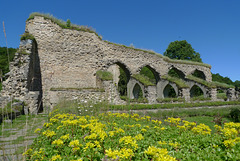
Alvastra Abbey was founded by Cistercian monks from Clairvaux in France in the year of 1143 after a donation of land from King Sverker I of Sweden. It was the first Cistercian settlement in Sweden. The monastery is one of the oldest and was the largest of the country.
Alvastra Abbey flourished for nearly 400 years, but after the Swedish Lutheran reformation in the 1530s, the monastery was demolished, never to be rebuilt. Construction materials - limestone from the nearby Omberg - were used among other things for building Vadstena Castle.
The ruins have been restored and preserved in several phases. Nowadays it is one of the most important cultural sights in the province of Östergötland and open for visitors.
Nederland - Klooster Ter Apel
| 29 Mar 2014 |
|
|
|
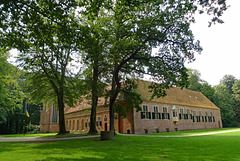
In 1464 Jacobus Wilthingh donated his rural estate ‘Apell’ to the Order of the Holy Cross. The construction of the monastery took almost hundred years (1465 - 1561). After the reformation in the Netherlands the latest prior of the monastery of the Holy Cross Brothers became in 1594 the first Protestant clergyman.
After the year of 1600 the monastery underwent many changes and some parts were demolished, but a large part of the original buildings remained. Between 1930 and 1933 the remaining parts were preserved and restored by the city of Groningen. Since 1992 it is one of ‘the top 100 Unesco monumental buildings’ in the Netherlands. It houses nowadays a museum of religious art and the history of the monastery.
Monastery Ter Apel or as it is called officially: Monastery Domus Novae Lucis (Home of the New Light) has a beautiful setting in the woodlands around the village of Ter Apel. .
Jump to top
RSS feed- Jaap van 't Veen's latest photos with "abbey" - Photos
- ipernity © 2007-2026
- Help & Contact
|
Club news
|
About ipernity
|
History |
ipernity Club & Prices |
Guide of good conduct
Donate | Group guidelines | Privacy policy | Terms of use | Statutes | In memoria -
Facebook
X
