

Argentina - Buenos Aires, Noel Palace
Austria - Salzburg, Petersfriedhof
Austria - Schärding
Argentina - Salinas Grandes (Jujuy)
Austria - Sankt Wolfgang, pilgrimage church
Austria - Salzburg, Hohensalzburg
Argentina: Purmamarca - Cuesta de Lipán - Salinas…
Austria - Sankt Gilgen
Austria - Hohensalzburg, Fürstenzimmer
Nederland - Amsterdam, Ons’ Lieve Heer op Solder
Austria - Fuschlsee
Argentina - Salta, Convento de San Bernardo
Slovenia - Ljubljana, Triple Bridge
Chile - Easter Island, Rano Raraku
Nederland - Lemmer, Woudagemaal
Greece - Konitsa - Aoos Gorge
Argentina - Cabra Corral lake
Greece - Konitsa bridge
Greece - (Old) Sagiada
Greece - Konitsa, Moni Stomiou
Slovenia - Bled, Pilgrimage Church
Austria - Kleinwalsertal/Mittelberg, Sankt Jodok K…
Slovenia - Škofja Loka
Germany - Passau, Dom St. Stephan
Argentina - Pucará de Juella
Greece - Nikopolis
Switzerland - Werdenberg
Greece - Grivas castle
Germany - Schloss Steinfurt
Argentina - Buenos Aires, Puerto Madero
Portugal - Lisbon, Igreja de São Domingos
Portugal - Lisbon, Igreja de São Roque
Argentina - Humahuaca, Monumento a los Héroes de l…
Portugal - Belem, Mosteiro dos Jerónimos
Portugal - Lisbon, Igreja de Santo António
Portugal - Lisbon, Alfama
Portugal - Lisbon, São Vicente de Fora
Argentina - Maimará, cemetery
Portugal - Sé de Lisboa, or Igreja de Santa Maria…
Portugal - Lisbon, Castelo de São Jorge
Argentina - Maimará, Paleta del Pintor
Austria - Wolfgangsee
Slovelia - Krma valley
Argentina - Quebrada de las Conchas
Germany - Kloster Gnadenberg
Location
Lat, Lng:
You can copy the above to your favourite mapping app.
Address: unknown
You can copy the above to your favourite mapping app.
Address: unknown
See also...
See more...
Keywords
Authorizations, license
-
Visible by: Everyone -
All rights reserved
-
1 118 visits
Austria - Reichersberg Abbey
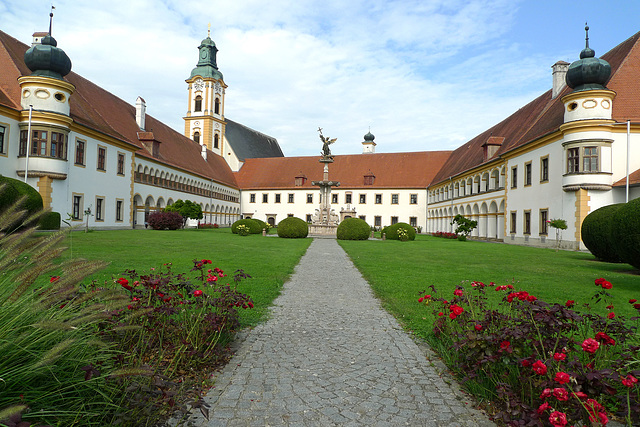

Stift Reichersberg (Reichersberg Abbey) was founded in 1084. After the early death of their only son, Gebhard, who reportedly drowned in the nearby river Inn, nobleman Wernher von Reichersberg and his wife Dietburga founded a monastery near their castle. The advice to bring Augustinian Canons to Reichersberg probably came from Archbishop Gebhard von Salzburg, the brother-in-law of the founder. The first canons came from Saxony. The founder himself also ended up in the monastery after the death of his wife.
Times of prosperity and adversity varied in the course of the following centuries. In 1624 the relatively small romanesque-gothic monastery complex was completely destroyed by a devastating fire. During the next years of the 17th century it was replaced by baroque new buildings, which today belong to the most important baroque buildings in Upper Austria.
The complex is grouped around two courtyards. The most important buildings are located along the 123 meter long outer courtyard, an architectural jewel with arcades and the marble fountain. The fountain is crowned with a figure of St. Michael, the patron of the monastery.
The abbey church of St. Michael was consecrated in 1644. The furnishings are late 18th century, with frescoes, marble side-altars and a beautiful pulpit; in 1883 the organ was widened.
During the Napoleonic Wars (1803–1815) it had to struggle for its existence. In 1810 the monastery was placed under administration and seven years later monastic activities resumed.
By ceding the Innviertel to Austria ("Peace of Teschen", 1779), the Reicherberg monastery escaped secularisation, but had to fight hard for its existence during the Napoleonic Wars (1803–1815): in 1809 the monastery fell to the French, then again to Bavaria, until it was finally reassigned to Austria in April 1816. In spite of great material and personal hardship, a regular monastic life was again possible.
During World War II (1939-1945) the monastery was forced to provide a home for a flying school, but avoided being closed down. Nowadays the abbey is still owned and inhabited by Augustinian Canons.
Times of prosperity and adversity varied in the course of the following centuries. In 1624 the relatively small romanesque-gothic monastery complex was completely destroyed by a devastating fire. During the next years of the 17th century it was replaced by baroque new buildings, which today belong to the most important baroque buildings in Upper Austria.
The complex is grouped around two courtyards. The most important buildings are located along the 123 meter long outer courtyard, an architectural jewel with arcades and the marble fountain. The fountain is crowned with a figure of St. Michael, the patron of the monastery.
The abbey church of St. Michael was consecrated in 1644. The furnishings are late 18th century, with frescoes, marble side-altars and a beautiful pulpit; in 1883 the organ was widened.
During the Napoleonic Wars (1803–1815) it had to struggle for its existence. In 1810 the monastery was placed under administration and seven years later monastic activities resumed.
By ceding the Innviertel to Austria ("Peace of Teschen", 1779), the Reicherberg monastery escaped secularisation, but had to fight hard for its existence during the Napoleonic Wars (1803–1815): in 1809 the monastery fell to the French, then again to Bavaria, until it was finally reassigned to Austria in April 1816. In spite of great material and personal hardship, a regular monastic life was again possible.
During World War II (1939-1945) the monastery was forced to provide a home for a flying school, but avoided being closed down. Nowadays the abbey is still owned and inhabited by Augustinian Canons.
Günter Klaus, Petar Bojić, , Maria Lovasz and 60 other people have particularly liked this photo
- Keyboard shortcuts:
Jump to top
RSS feed- Latest comments - Subscribe to the comment feeds of this photo
- ipernity © 2007-2026
- Help & Contact
|
Club news
|
About ipernity
|
History |
ipernity Club & Prices |
Guide of good conduct
Donate | Group guidelines | Privacy policy | Terms of use | Statutes | In memoria -
Facebook
X

Happy new week also:)
belle semaine Jaap !
Have a nice week
The details are also very beautiful!
Superb, Jaap!
Thanks also for the note!
It is a very serious building full of past and ascetic meanings.
Very well shown.
tolle Aufnahmen.
Spannend.
Weard
It has an amazing history too............your narrative was interesting and well researched as always.
bonne journée Jaap !
friendly greetings → Marek-Ewjan
Wünsche noch einen schönen Nachmittag,ganz liebe Grüße Güni :))
Sign-in to write a comment.