

Kicha's photos with the keyword: Educator
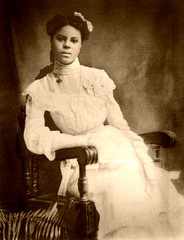
Lucille Berkely Buchanan
| 18 Oct 2023 |
|
Though Lucille Berkeley Buchanan was the first African American woman to graduate from the University of Colorado, her name and legacy were nearly lost to CU (Colorado University) history.
Thanks to the dogged detective work of a CU professor and the grass-roots support of students and faculty, this trailblazer is being remembered — and honored — with an endowed scholarship and, separately, an undergraduate essay prize.
Seven years ago, someone gave Polly McLean, an associate professor of journalism, a surprising newspaper clipping. The first black woman to graduate from CU had died in 1989 and was buried in an unmarked grave in Denver, it said.
Buchanan’s graduation date was 1918. But the first black woman to graduate from CU had long been identified as Ruth Cave Flowers, who graduated in 1924 and who later overcame significant racial barriers to become a school teacher.
As university archives, genealogical records, property records and other sources confirmed, Buchanan was actually the first, and her life was remarkable in its own right.
Born in 1884 in a mule barn southwest of Denver, Buchanan was the daughter of emancipated Virginia slaves. In 1905, her father built the Queen Anne house in which she spent her later years. It sat on land her mother bought from circus mogul P.T. Barnum.
Buchanan got a teaching certificate in 1905 from the Colorado State College for Education at Greeley. After teaching for a decade, she studied for a year at the University of Chicago. Then she came to CU. So it was that in June 1918, she became the first black woman to earn a degree from CU.
The moment was historic but sad; officials would not let her climb onstage to accept her diploma.
Afterward, she taught in the Chicago Public School system. She retired in 1949 and returned to Denver and the home her father had built. She died in a nursing home at the age of 105.
CU's German Program announced the first annual Lucile Berkeley Buchanan Undergraduate Essay Prize in spring of 2008.
The prize honors the fact that Buchanan was a German major, and it carries a $200 prize for the best paper originally written for a CU German class.
Source: Colorado University at Boulder

Miss Pope: The Rosa Parks of DC
| 16 Oct 2023 |
|
Half a century before the civil rights movement, Barbara Pope boarded a train and challenged Virginia’s Jim Crow law. Soon, her story was mostly forgotten.
Ann Chinn grew up hearing family stories that her grandmother’s sister Barbara Pope had been a published writer. But recollections were short on details; it was so long ago. Chinn, 74, only knew that her great-aunt wrote stories.
In fact, Barbara Pope, a D.C. native, ranks among the most stunning forgotten American lives. She was, in addition to being a high school teacher, an author of fiction about social change at the turn of the 20th century, and her literary voice was celebrated on the international stage by no less than W.E.B. Du Bois. Her stories probed relationships among men and women, Black and White, with a modern voice and a sharp eye for detail and character. In her story “The New Woman,” the main character is a smart, industrious and beautiful Black woman who asks her husband if she can clerk for him in his law office, as she did for her father. “The bargain was that you would practice law and I take charge of the home,” she tells him, “but neither of us must be selfish, and each will call on the other for assistance when needed.”
But perhaps her greatest accomplishment was the stand she took against racism in transportation nearly 50 years before Rosa Parks’s bus ride: In August 1906, Pope boarded a train at Union Station and traveled into Virginia, in the process challenging Virginia’s Jim Crow law requiring segregation on trains and streetcars. She soon gained the support of Du Bois and his Niagara Movement, a precursor to the NAACP. And her case became one of the first steps along the path to the end of legal segregation — leading the way toward the NAACP’s hallmark 1954 Supreme Court victory in Brown v. Board of Education of Topeka.
Not long after her case, she left the public stage amid personal troubles and would become remembered mainly among scholars — more of a footnote in history than a history maker. Almost the only place you can find Pope’s work is in the Library of Congress on microfilm. In 2015, however, literary historian Jennifer Harris wrote a profile of Pope for Legacy, a journal of American women writers, that aimed to bring Pope back into the spotlight. Harris used her archivist investigator skills to unearth Pope’s fiction and seek out her story from surviving family members, including Chinn.
Chinn, who works as executive director of the nonprofit Middle Passage Ceremonies and Port Markers Project in Jacksonville, Fla., now draws a connection between the widespread protests following George Floyd’s death last year and the stand that Pope took more than a century ago. In both, Chinn says, “you’re seeing a movement and tactics and strategy in its formative stages.”
Pope was born in 1854 and grew up in a progressive family in Georgetown’s Black community. She began a teaching career in 1873 and taught for a year at Booker T. Washington’s Tuskegee Institute. She also advocated for reforms in the District’s Colored School System.
In the 1890s, Pope, who never married, started publishing fiction. Du Bois included some of her stories in an exhibition he organized for the Paris Exposition of 1900 that presented Black Americans in their own words and images. (A beautifully illustrated volume based on that exhibition came out in 2019 as “Black Lives 1900: W.E.B. Du Bois at the Paris Exposition.”) In those years, the Black community of D.C. was divided between Booker T. Washington’s supporters and younger backers of Du Bois. Against her father’s wishes, Pope in 1906 joined the Niagara Movement. She was among its first female members.
Her pathbreaking train ride toward a Virginia hot springs resort that summer didn’t start as a statement. When Pope went to buy her ticket, she simply wanted a peaceful ride, she told the ticket agent. She “had been annoyed before” by Virginia’s Jim Crow rule and “didn’t want to be annoyed that way” again, according to her testimony in court records.
She boarded at Union Station and saw the “colored” compartment was cramped and its seats faced backward. She took a seat in the main compartment instead. After they crossed the Potomac into Virginia, a White conductor came and said she had to move. She refused. He threatened her with arrest. She refused again.
When the train stopped at Falls Church, Pope was escorted off by constables and detained for hours at the mayor’s office. Even after posting bail, she was held for public humiliation in the train station, waiting for her hearing. The mayor set up a kangaroo court in the station. Pope was tried for “violating the separate car law of the State of Virginia” and fined $10 plus court costs.
Two weeks later, at the Niagara Movement’s annual meeting at Harpers Ferry, W.Va., Pope’s case was on the agenda. The group of more than 50 considered whether an appeal to overturn her conviction could be a test case. As an interstate traveler, was she subject to Virginia’s Jim Crow statutes? Du Bois had doubts about using the judiciary for social change — just three years earlier, he had written in “The Souls of Black Folk” that to place Black Americans “in the hands of Southern courts was impossible” — but the group at Harpers Ferry voted to fund Pope’s appeal in the Virginia circuit court anyway.
Few were surprised when Pope lost her appeal that October at an Alexandria circuit court, but with Niagara’s legal support, she took the case to Virginia’s Supreme Court of Appeals. In early 1907, that second appeal triumphed when the higher court annulled the initial judgment. “This means that the NIAGARA MOVEMENT has established that under the present statute Virginia cannot fine an interstate passenger who refuses to be Jim-Crowed,” Du Bois explained in an April 1907 fundraising letter.
Du Bois included the court’s full statement with his letter, and the Niagara Movement followed up with a civil suit demanding $50,000 in damages. In June 1907, the civil trial opened in D.C. The jury voted in Pope’s favor but awarded her just one penny. Still, the decision by the Supreme Court of the District of Columbia — which had both local and federal jurisdiction until Congress separated those powers in 1973 — showed that interstate travelers could successfully challenge Jim Crow in federal court.
Pope’s fortunes, however, took a turn for the worse. She lost her job and suffered from insomnia. One evening in September 1908, at age 54, she walked out onto Lovers’ Lane, beside Montrose Park in Georgetown, pinned a note addressed to the coroner to her dress, and hanged herself. The note said she felt her brain was “on fire.”
Jennifer Harris writes that the stigma around suicide helped erase the public record of Pope’s contributions: “[I]t was considered impolite to discuss suicides, so her story — and stories — faded into obscurity.” Nevertheless, historian Deborah Lee, who has studied Pope and the Niagara Movement, says that Pope, along with Du Bois, created “a cornerstone of the 20th-century civil rights movement.”
For her part, Ann Chinn is heartened that her great-aunt’s story is coming to light. “I hope that it will encourage researchers and historians to look for others lesser known but just as impactful,” she told me. “It’s not just the Malcolm Xs and the Martin Luther Kings. It’s your mother, your father, your teacher — those people whose names will never go into recorded history.”
Sources: The Washington Post Magazine article by David A Taylor (March 2021); photograph courtesy of Ann Chinn
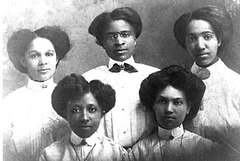
Palmer Institute Faculty Members
| 18 Oct 2023 |
|
Founder Dr. Brown is in the center wearing eyeglasses. [Palmer Inst. Archives]
Palmer Institute founded by Dr. Charlotte Hawkins Brown was the only school for African American children in the area. Most walked a long way to reach the one-room schoolhouse. Students who could not pay for their education worked at the school. But all of the students had daily chores because Hawkins believed that working gave them a sense of responsibility.
Charlotte Hawkins Brown soon became a leader in the African American community both in North Carolina and across the country. She often spoke out against the unfair treatment of African Americans, and she fought for equality. She also supported women’s rights, including the right to vote.
Brown built Palmer Memorial Institute into an outstanding private school. Palmer highlighted cultural education and offered classes in drama, music, art, math, literature, and foreign languages. It attracted students from across the United States and from other countries. Brown saw more than one thousand students graduate from Palmer during her fifty years as president.
Following her death in 1961, the school had a hard time withstanding some financial problems, and in 1971 a fire destroyed the administration and classroom building forcing them to close.
In 1987, it was reopened as the Charlotte Hawkins Brown memorial State Historic site.
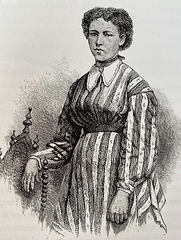
Julie Hayden
| 17 Oct 2023 |
|
The above image is of seventeen year old Julia Hayden, a Black schoolteacher who was shot to death by the White League within three days of starting to work at a school for freed people in Tennessee.
From the New National Era, October 15, 1874 --- Harper’s Weekly, one of America’s most read newspapers, humanized Hayden with a portrait, as well as a sketch of her life. The paper described her as a girl who had sought out education for herself, and who was enrolled in college at the time of her killing. She had wanted to spread education throughout the Black community and had been willing to risk going to a rural school where she would be exposed to the dangers of torture or assassination.
Using a photograph of Hayden, Harper’s created an etching of Julia Hayden that hundreds of thousands of Americans saw. So many of the brave Black men and women who brought literacy to former slaves and their children are nameless and faceless now, and their role in social revolution forgotten, but we know what Julia looked like because she died violently.
On August 22, 1874 two white men came to the house Miss Hayden was staying at and killed her.
Describing themselves as defenders of a “hereditary civilization and Christianity,” a group of Confederate veterans in Louisiana formed the White League on March 1, 1874. Their stated purpose was “the extermination of the carpetbag element” and restoration of white supremacy.
The White League, the latest manifestation of the Ku Klux spirit, was a growing force in Tennessee that summer and many African Americans saw her killing as part of the group’s war against Black literacy. Many white journalists disagreed, saying that the killers had merely wanted to rape the teenager, as had been their right during slave times, and that when she had resisted, they killed her. They argued, that this slaughter of a teacher, who had after all been born a slave, had nothing to do with race at all. It was only about a couple of white men wanting to have their pleasure with a Black girl.
The liberal magazine Harper's Weekly condemned the murder as a form of white resistance to the education of freed blacks, a contested issue in Tennessee at the time. In constrast, the New York Tribune considered the shooting merely an unfortunate case of mistaken identity, given black women's reputation for "wanting in chastity." The publication of the African Methodist Episcopal Church, the Christian Recorder, declared the Tribune's comments "insulting to every colored husband, father, and brother, in the land."
The press controversy reveals how politically charged the sexual respectability of black women had become in the aftermath of Emancipation. Southern white men still deemed all black women to be sexually available, a view that some northerners shared. Even if the men who approached her knew that Hayden was an educated, middle-class woman, they may have targeted her sexually because her school threatened to disrupt the local racial hierarchy. That the black press extended the insult to men and not women reflected aspirations that African American husbands, fathers, and brothers should be able to provide the kind of patriarchal protection that slavery had denied them. Reactions to the Hayden murder vividly display the political as well as personal stakes underlying contestations over the sexual rights of black women.
From the Montreal Star, September 8, 1874 issue: Julia Hayden the colored school teacher, one of the latest victims of the White Man's League, was only seventeen years of age. She was the daughter of respectable parents in Maury County, Tennessee, and had been carefully educated at the Central College, Nashville, a favorite place for the instruction of youth of both sexes of her race. Under the reign of slavery, Julia Hayden would probably have been taken from her parents and sent in a slave-coffle to New Orleans to be sold on its auction block. But Emancipation had prepared her for a different and less dreadful fate. With that strong desire for mental cultivation which has marked the colored race since their freedom, in all circumstances where there is an opportunity left them for its exhibition, the young girl had so improved herself as to become capable if teaching others. She went to Western Tennessee and took charge of a school. Three days after her arrival at Hartsville, at night, two white men, armed with guns, appeared at the house where she was staying and demanded the schoolteacher. She fled, alarmed, to the room of the mistress of the house. The White Leaguers pursued. They fired their guns through the door of the room, and the young girl fell dead within.
Eugene Laurence, in Harper's Weekly says: Her murderers escaped, nor is it likely that the death of Julia Hayden will ever be avenged, unless the nation insists upon the examination of the White Man's League. The fearful association extends through every Southern State, and one of its chief objects is to prevent the education and elevation of the colored race. It whips, intimidates, or murders their teachers from the Ohio to the Gulf, and its terrible outrages have already surpassed the horrors of the most vindictive civil war. Yet the colored people have already made a remarkable progress. Their faithful labors have nearly restored the usual productiveness of the South.
Sources: Harper's Weekly (Oct. 1874 [pgs. 856-57]; LOC; Zinn Education Project; The Reconstruction Era: Blog Exploring the World the Civil War created, Sept 2020 (Patrick Young, Esq.); Redefining Rape: Sexual Violence in the Era of Suffrage and Segregation By Estelle B. Freedman
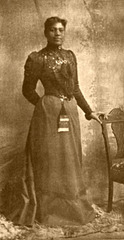
Emma Merritt
| 17 Oct 2023 |
|
Emma Frances Grayson Merritt was born on January 11, 1860, in Dumfries, Virginia, one of seven children, the third of four daughters of John and Sophia (Cook) Merritt. When she was three years of age, her parents moved to Washington, D.C.
Merritt was a teacher well before she received any higher education. She taught first grade in the public schools of the District of Columbia beginning in 1875, when she was 15. She continued to teach while completing the normal school program (1883-87) at Howard University. In 1897 she was appointed an elementary school principal. She continued intermittent study of the social sciences at Columbia (later named George Washington) University until the end of the century.
Merritt established the very first kindergarten in the United States for black children in 1897. She became director of primary instruction in the District of Columbia in 1898 and a supervising principal in 1927, remaining in that role until her retirement in 1930.
At historically black universities and colleges throughout the country, Merritt was a prized lecturer in the education of young children. She was an organizer and director of the Teachers' Benefit and Annuity Association in the District of Columbia and president of the capital branch of the NAACP, among many civic responsibilities.
She died on June 8, 1933, in Washington DC.
The location of the Emma F.G. Merritt Public School is on the site of the former Suburban Gardens Amusement Park in a building constructed in 1943. According to oral history given by former teachers, while the site has changed, the philosophy of self reliance has essentially remained the same. Now called Merritt Educational Center, the school is located at 5002 Hayes Street, NE., Washington D.C.,
Sources: Deanwood, A Model of Self-Sufficiency in Far Northeast Washington, DC, Deanwood History Project; Biographical Dictionary of Modern American Educators, by Frederik Ohles, Shirley M. Ohles, and John G. Ramsay; The Voice, vol. 1, 1904
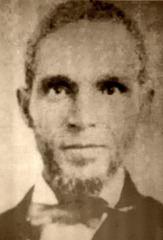
William P Newman
| 06 Sep 2016 |
|
|
Photo comes from the National Underground Railroad Freedom Center; Info: 'Cincinnati's Underground Railroad,' by Dr. Eric R. Jackson and Richard Cooper,
William P. Newman, who escaped slavery in Virginia during the 1830s, became the pastor of the Union Baptist Church (now located on Seventh Street in downtown Cincinnati) and served in that position from 1848 to 1850. Before this, he studied for many years at Oberlin College and was a fiery orator. He traveled to Canada several times as an antislavery lecturer. Newman was also instrumental in the establishment of black schools in the Buckeye state and as an agent of the Ladies Education Society of Ohio. However, when the Fugitive Slave Act of 1850 was enacted, Newman and his family moved to Ontario, Canada; he continued to fight for the freedom of African Americans, both enslaved and free persons of color, until he returned to Cincinnati in 1864. He died two years later.
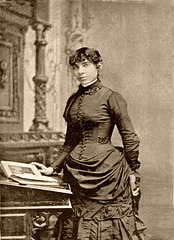
Lucretia H. Newman Coleman
| 24 Jul 2016 |
|
|
In her 1890 book, "Poor Ben: A Story of Real Life," based on the life of Benjamin William Arnett, the seventeenth bishop of the AME Church. In the dedication section she wrote: "I dedicate this work with sincere love for my race. To the colored young men and women of America, with the hope that it may contribute something to that Christian knowledge, which is the very breath of all true nobility." ~ The Author
Lucretia H. Newman Coleman lived in Appleton, Wisconsin for only a short time, from around 1867 to about 1876. Her family moved to Appleton, from Cincinnati after the death of the family’s patriarch, Baptist Minister and Abolitionist, Reverend William P. Newman in 1866.
She entered Lawrence University as a freshman in September, 1872, enrolling in a scientific course and staying for about two years. She was one of the earliest African American students to enroll at Lawrence. Some biographies state she graduated from Lawrence, but the University Archives has no record of her being awarded a degree. Lucretia was born in Dresden, Ontario, Canada around 1854. Her family moved from Canada to the West Indies, then back to Cincinnati and finally to Appleton. She married Robert J. Coleman in Des Moines, Iowa in 1884 and soon moved to Minneapolis where her daughter Roberta was born. Eventually she and Roberta moved to Chicago where her entry in 1920 census listed her occupation as dressmaker.
She had a distinguished career as an author in the 1880s and into the 1890s, writing articles published primarily in African American journals such as Our Women and Children and the A.M.E. Review, in addition to a biographical novel and poetry. In The Afro-American Press and Its Editors (1891), Irvine Penn states that her writings were “rich in minute comparisons, philosophic terms, and scientific principles.” Martin Dann writes in The Black Press 1827-1890: The Quest for National Identity (1971) that her poem “Lucille of Montana” (1883) was praised at the time as being “full of ardor, eloquence and noble thought.” A contemporary account in the journal The American Baptist said “As a writer, her fame is spreading, not only in one or two states, but throughout the United States. Should she continue with the same success in the past, she will be equal to Harriet Ward Beecher Stowe, if not her superior.” And in Noted Negro Women, Their Triumphs and Activities (1893), Monroe Alphus Majors writes she contributed to black journals with her “usual fascination for saying things in her own way.”
Bio: Neighborhood News (The Newsletter of the Old Third Ward Neighborhood Association, Inc.,) Winter 2016 editors Antoinette Powell and Linda Muldoon.
Jump to top
RSS feed- Kicha's latest photos with "Educator" - Photos
- ipernity © 2007-2026
- Help & Contact
|
Club news
|
About ipernity
|
History |
ipernity Club & Prices |
Guide of good conduct
Donate | Group guidelines | Privacy policy | Terms of use | Statutes | In memoria -
Facebook
X
