

Kicha's photos with the keyword: Educator

Haydee E Campbell
| 16 Oct 2023 |
|
She was an elementary school teacher at a school designated for 'colored pupils' which was located at 1241 South 3rd Street. Named for Alexandre Dumas (1802-1870), a French novelist, who is said to have had negro descent. (Report Board Ed. (1929 edition); School Director, (1938/1939).
Mrs. Haydee E. Campbell, nee Benchley a native Texan, was the first African American woman to receive formal kindergarten training under Susan Blow at the St. Louis Kindergarten Training School. In 1882 she became the supervising principal of the kindergartens for African-American children in the St. Louis Public Schools. The philosophy of the kindergarten program was based on the works of Freidrich Froebel (a German educationalist, is best known as the originator of the ‘kindergarten system’), which emphasized the value of play in how children learn. Ms. Campbell, Josephine Silone Yates, and other kindergarten advocates understood that “high-quality kindergarten training was the key to the success of the public kindergarten movement.” In 1896 Campbell became the National Kindergarten Organizer of the National Association of Colored Women (NACW) under the leadership of Mary Church Terrell. In Campbell’s first speech, “Why the National Association Should Devise Means for Establishing Kindergartens,” presented at the 1899 NACW Convention, she says:
"The plan of the Kindergarten system has been molded according to the nature of the child, and through it he may be led to a higher state of development of body, mind and soul and a fuller consciousness of this relationship to nature, to this fellow-man and to his God. This is the aim, the vital purpose of the Kindergarten education. The Kindergarten assists the natural growth of the child, developing the good that in him lies and helping him to receive from his environment the good it may contain. As tools to this end, Froebel has given us songs, games, stories, talks, gifts, occupations, lunch and garden work, and these are only tools to be subordinated always to the thought which directs their use." [Info: childrensdefense.org]
For some years past she has resided in St. Louis, Missouri. She distinguished herself by actually going before the school board of St. Louis, as an applicant for the position as principal or instructress for the kindergarten department. Here she was confronted with the task of making the highest average, and leaping the obstacle of white applicants who for so many years have stood in the way. She, with courage undaunted, went into the examination and, to the surprise of the board of examiners, the white applicants and the city of St. Louis, she captured the department with the highest average percentage ever made in St. Louis, for that work. Mrs. Campbell is a tireless worker, and it is never too cold, too wet, for her to do a charitable act. The people of St. Louis love her. She was a student of Oberlin.
Source: Noted Negro Women: Their Triumphs and Activities," by Monroe Alphus Majors (1893)
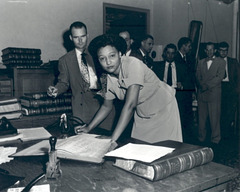
Ada Lois Sipuel Fisher
| 16 Oct 2023 |
|
Ada Lois Sipuel Fisher was born in Chickasha, Oklahoma in 1924 where she attended the segregated school of her time, Lincoln School. She married Warren Fisher in 1944 and had two children, Bruce and Charlene. After graduating from the segregated Langston University with top honors in 1945, Fisher volunteered to be the successful test case for admission to the University of Oklahoma Law School represented by NAACP attorney Thurgood Marshall and Oklahoma attorney Amos T. Hall.
When denied admission on the basis of race, Fisher filed a suit asserting that she must be admitted to the OU Law School since there was no comparable facility for African American students. Losing in state courts, Marshall argued the case before the Supreme Court which reversed the lower courts in 1948. The state quickly created a makeshift law school in the State Capitol with three part time instructors and one potential student. Fisher refused to attend. Further litigation was initiated to prove the two law schools were not equal.
In June of 1949, the University of Oklahoma Law School changed its admission policy and finally permitted Fisher to enroll. After graduating in 1951 and passing the State Bar the same year, she practiced law in Chickasha. In the '50s, she became a professor at Langston University where she taught for 32 years. She earned a master’s degree in history at OU in 1968.
Following her retirement from Langston University, she worked as Corporate Counsel for Automation Research System Limited in Alexandria, Virginia, the second largest African American owned computer corporation in the country at that time.
In 1981, the Smithsonian Institution designated her as one of the 150 outstanding black women who have had the most impact on the course of American history. In 1991, OU honored her with an Honorary Doctorate, and in 1992, more than 45 years after she was denied admission to the law school, Governor David Walters appointed Fisher to the University of Oklahoma Board of Regents. She died in 1995.
Sources: Uncrowned Community Builders; Photo comes from Barney Hillerman Collection

Christia Adair
| 16 Oct 2023 |
|
In 1920, Christia Adair took school children to meet the train when Republican Warren G. Harding was campaigning for the presidency. After seeing him shake hands only with the white children, she became a Democrat.
Christia Adair (1893 - 1989), was a teacher, a community leader, and a tireless activist for the rights of women and African-Americans. Born in Victoria on October 22, 1893, Adair spent her early years in Edna, then moved to Austin with her family in 1910. She attended college first at Samuel Huston (now Huston-Tillotson University) and then at Prairie View Normal and Industrial College (now Prairie View A&M.) After graduation she moved back to Edna, where she taught elementary school.
She married Elbert Adair in 1918, and they moved to Kingsville. There she opened a Sunday school, and also began her community activism. She joined a multiracial group opposed to gambling, and then became involved in the suffrage movement. At that time neither blacks nor women could vote, and anyone who knows her feminist history knows that there was some racism in the suffrage movement. Indeed, after the 19th Amendment was ratified in 1920, blacks were still turned away from the polls because of racist whites' tactic to deter them: the white primary. Since the South was wholly Democratic at that point, the primary basically decided the election. Thus excluding African-Americans from the primary effectively disenfranchised them. Adair had this to say:
"Back in 1918 Negroes could not vote and women could not vote either. The white women were trying to help get a bill passed in the legislature where women could vote. I said to the Negro women, "I don't know if we can use it now or not, but if there's a chance, I want to say we helped make it.
"We went to the polls at the white primary but could not vote...We kept after them until they finally said 'You cannot vote because you are a Negro.'"
This was a smart strategy, because that gave them grounds to sue. And sue they did. The Adairs had moved to Houston in 1925, and Christia had become very active in the Houston chapter of the NAACP. As executive secretary, she was a driving force behind the landmark lawsuit, Smith v. Allwright, which overturned the white primary - and helped set the stage for Brown v. Board of Education.
In the Jim Crow South, these activities made Adair and her colleagues targets for racist whites. The chapter received bomb threats with alarming regularity. The Houston police were not helpful. In fact, they were a hindrance. According to Adair's entry at the Handbook of Texas Online:
In 1957 Houston police attempted for three weeks to locate the chapter's membership list. While the official charge was battery - the illegal solicitation of clients by attorneys - Adair believed the real purpose was to destroy the organization and its advocacy of civil rights. She testified for five hours in a three-week trial over the attempted seizure of NAACP records. Two years later, on appeal to the Supreme Court, Thurgood Marshall again won a decision for the organization. Adair never admitted having membership lists or having member's names. In 1959 the chapter disbanded and she resigned as executive secretary, though she later helped rebuild the group's rolls to 10,000 members.
Now that's a hardcore sister. And she didn't stop there. She was a lifelong leader in the Methodist Episcopal Church and a precinct judge for more than 25 years. She also helped to...
* desegregate Houston's public buildings, city buses, and department stores
* win Blacks the right to serve on juries and be considered for county jobs
* convince newspapers to refer to blacks with the same courtesy titles used for
whites
* desegregate the Democratic Party in Texas
Any one of her achievements is impressive. Taken together, they're downright amazing. And folks noticed. Adair was recognized by many for her brave and principled activism. Zeta Phi Beta sorority named her Woman of the Year in 1952. In 1974 Houston NOW honored her for suffrage activism. In 1977 she was selected as one of four participants in the Black Women Oral History Project, sponsored by the Schlesinger Library at Radcliffe College. That same year the city of Houston named a park for her. And in 1984, she was named to the Texas Women's Hall of Fame. Adair died just a few years later at the age of 96, on New Year's Eve 1989, leaving behind her an indelible legacy of justice and equality.
Sources: NOW National Organization for Women; The Face of Our Past: Images of Black Women from Colonial America to the Present edited by Kathleen Thompson and Hilary Mac Austin

Rosa Dixon-Bowser
| 16 Oct 2023 |
|
Mrs. Rosa Dixon-Bowser (1855 - 1931), writer, educator, civic leader, and first African American teacher in Richmond, Virginia public school system.
Born a slave in Amelia County, Virginia the daughter of Henry Dixon, a carpenter, and Augusta A. Hawkins Dixon, a domestic servant. After freedom came in 1865, the family moved to Richmond and started a new life. Religion and education were the foundations of the family, and they joined Richmond's largest congregation, First African Baptist Church. She first taught in the Sunday school there. Her father recognized her aptitude and enrolled her in the Richmond public schools, where she initially received instruction from northern teachers of the Freedmen's Bureau.
The superintendent of the Freedmen's Bureau schools in Richmond, Ralza M. Manly, identified exemplary students and selected them for teacher training at the Richmond Normal and High School (after 1870 the Richmond Colored Normal School). Dixon became one of Manly's protégés and excelled in English, mathematics, music, and reading. She graduated with the second-highest marks in the class of 1872–1873 and remained in school for an additional year to study Greek, Latin, music, and teaching strategies.
In 1872 Dixon passed the examination for teacher certification and began her teaching career. On September 4, 1879, she married James Herndon Bowser, a fellow teacher who had been the valedictorian in her class at the Richmond Colored Normal School. Soon after their marriage he left teaching and worked instead as a clerk in the Richmond post office until his death from tuberculosis, on April 25, 1881. Their only child, Oswald Barrington Herndon Bowser, became a successful physician in Richmond.
For a time after her marriage and the birth of her son, Bowser taught music in her home and continued to teach in the Sunday school. Regarding the community as her extended family, she formed literary circles and taught childrearing and housekeeping techniques. In 1883 the city school board appointed Bowser to teach in the primary grades at Navy Hill School. The next year Bowser became supervisor of teachers at the Baker School in Richmond and in 1896 principal teacher as well in the night school for men. In addition, she taught classes in social skills at the Young Men's Christian Association in Jackson Ward, the heart of Richmond's African American community.
Bowser organized reading circles in order to give experienced teachers a forum for sharing information with new colleagues about their reading, their students, and their classroom strategies. The success of these groups led directly to the formation in 1887 of the Virginia Teachers' Reading Circle, the first professional African American educational association in the state. Bowser was president of the organization, in 1889 renamed the Virginia State Teachers Association, from 1890 to 1892. Over a period of more than thirty years she often taught at Peabody institutes, sessions of summer teaching courses at various black normal schools in Virginia.
The presidency of the association opened the door for Bowser to play major roles in other African American organizations, including the Hampton Negro Conferences and their successor, the Negro Organization Society. She chaired the conferences' Committee on Domestic Science from 1899 to 1902. At the July 1897 conference Bowser made one of her most notable speeches, "Some of Our Needs," and appealed to the conference to form girls' meetings to teach ladylike qualities and to sponsor mothers' clubs to advise young mothers on childrearing. In response to her appeal, additional girls' and mothers' meetings were organized in scores of Virginia communities. Bowser also called for reforms in education, increased teacher salaries, and improved housing and education for wayward children. She joined with such influential black Virginians as Janie Porter Barrett and Maggie Lena Mitchell Walker to form the Woman's Department of the Negro Reformatory Association of Virginia, which raised money for the development of the Industrial Home School for Colored Girls and the Virginia Manual Labor School for Colored Boys, both in Hanover County.
Although Bowser did not seek an active role in public affairs, in August 1895 she founded and became the first president of the Richmond Woman's League. By July 1896 she had led the league in raising $690 to pay the legal bills of three black Lunenburg County women who were appealing murder convictions, two of them death sentences. Bowser became involved in other social causes and supported the founding and funding of organizations for treatment of tuberculosis, improved medical facilities, and medical insurance. As a result of an alliance she forged, the Federated Insurance League joined with the Woman's League to support a Richmond branch of the Virginia Colored Anti-Tuberculosis League.
Bowser became active in the woman's club movement that swept the nation late in the nineteenth century. She joined the Woman's Era Club, of Boston, Massachusetts, an organization that raised money to create kindergartens for African American children, and for several years served as field editor, or reporter, from Virginia for its journal, the Woman's Era. In July 1896 she participated as a member of its successor organization, the National Federation of Afro-American Women, and as president of the Richmond Woman's League, in founding the National Association of Colored Women. Bowser was nominated for president of the new association but was not elected. She was also a founder of the Virginia State Federation of Colored Women's Clubs in 1908.
In 1912, working with Mary Church Terrell and Maggie Walker, Bowser attempted to aid a young girl sentenced to be electrocuted for murder. Their combined efforts included a direct appeal to the governor of Virginia to reopen the case and commute the sentence. Despite the backing of the National Association of Colored Women, the girl was executed. Bowser and the association also publicly opposed lynching and racial segregation and supported universal woman suffrage.
Bowser continued her community work, teaching in the public schools until she retired in 1923. She taught Sunday school classes at First African Baptist Church for more than fifty years, until diabetes forced her to relinquish the work. In recognition of her many contributions to education, the first branch of the Richmond public library to be opened to African Americans was named for Bowser in 1925. A Richmond vocational training school for boys later bore her name. Bowser died of complications from diabetes on February 7, 1931, at her home in Richmond and was buried in Evergreen Cemetery in that city.
Sources: Encyclopedia of Virginia, Veronica Alease Davis ; Schomburg Center for Research in Black Studies
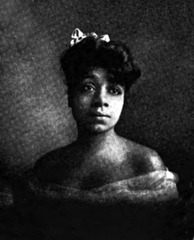
Atholene Peyton
| 16 Oct 2023 |
|
Miss Atholene Peyton (1880-1951), was the author of the earliest Kentucky cookbook written by an African American. Her father was Dr. W. T. Peyton, a well known practitioner and educator.
Her book, 'Peytonia Cook Book,' was published in Louisville in 1906. She had deep roots in the city. Peyton was an 1897 graduate of Louisville's Central Colored High School and then went on to the Colored Normal School. She served on the domestic science faculty of the segregated Central Colored High School and was the faculty sponsor of the Girls' Cooking Club. In one of her applications on file om the Jefferson County Public schools archives she noted under "honors": Wrote the first Negro Cook Book in Kentucky." Her career at Central Colored High School lasted from 1904 until her death in April 1951. Peyton also taught domestic science at the Neighborhood Home and Training School for Colored Boys and Girls, located on Fifteenth Street in Louisville. The Training School was supported by the Neighborhood Circle of the King's Daughters. Peyton also represented the Louisville schools at an event in Frankfort featuring Dr. Booker T Washington, held to commemorate the construction of a new dormitory at Kentucky State University, from which she earned a degree in 1935.
Peyton also served on the domestic science faculty of the summer Chautauqua of the National Training School for Women and Girls in Washington DC. This was organized by the Woman's Convention, an auxiliary of the National Baptist Convention, which was and remains an important African American religious organization. The president of the training school was the well known African American educator Nannie Helen Burroughs, who advocated for the improvement of African American women's marketable skills.
According to a news item in the Indianapolis Freeman (1907), The Peytonia Cook Book "has achieved a wonderful degree of popularity among the best authorities on the culinary art." The cookbook itself includes a warm introduction by Nannie Helen Burroughs.
Sources: Kentucky's Cookbook Heritage: Two Hundred Years of Southern Cuisine and Culture, written by John van Willigen (2014); Colored American Magazine (1906 edition)
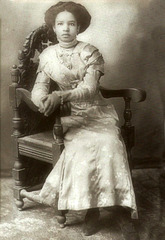
Ethelyn Taylor Chisum
| 16 Oct 2023 |
|
She was born to William Henry and Virgie Collins Taylor in Dallas, Texas, where she spent her formative years. Following graduation from Prairie View State Normal and Industrial College May 1913, where Ethelyn M. Taylor was senior class historian, she began her teaching career in the Rock Creek community of Smith County, Texas. Almost three years later she returned to Dallas and a lifetime as an educator, thirty-two years of which were spent as counselor at Booker T. Washington High School.
In 1923, she married Dr. John Chisum who was born in 1895, to Benjamin Chisum and Rosa Pauline White. Following his 1916 graduation as salutatorian of Dallas Colored High School, Dr. Chisum worked as a mortician prior to military service in France during World War I. It was a union that lasted fifty-five years until his death in 1979.
Community service was an integral part of life for Mrs. Chisum, with membership in Zeta Phi Beta Sorority, as well as the Priscilla Art Club, oldest club for Negro women in Dallas. She was a long time member and active worker of the New Hope Baptist Church while Rev. A. S. Jackson, Sr. was pastor; later Dr. and Mrs. Chisum joined Knight's Chapel A.M.E. Church. Mrs. Chisum was often chosen as a leader of Dallas organizations such as the Dallas Teachers Council, serving the group as president for ten years. Realizing the need for a YWCA to serve the black community, Mrs. Chisum was one of the founders in 1927 of the Maria Morgan Branch of YWCA. She was repeatedly honored by local organizations for community service as well as being listed in Who's Who in Education in America. In 1967, two years after retirement from the Dallas Independent School District, Mrs. Chisum joined the staff of Southern Methodist University to work with the Upward Bound program jointly sponsored by the university and the United States Department of Education. She continued her association with SMU until failing health forced her retirement in November of 1982. In an effort to upgrade the teaching profession, Mrs. Chisum often worked as an appointed committee member for the National Education Association as well as the Texas Education Association. Working alongside Dr. John Chisum, her husband of more than fifty years, Ethelyn Chisum strove to improve educational opportunities as well as the quality of life for the youth of Dallas until her death, January 27, 1983.
Source: The Face of Our Past: Images of Black Women from Colonial America to the Present edited by Kathleen Thompson and Hilary Mac Austin
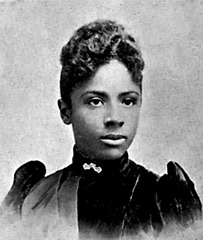
Mary A. Burwell
| 16 Oct 2023 |
|
For the special care of orphan children there is a peculiar fitness, not at all possessed by the majority, either as an acquired or as an inherited possession. As an earnest laborer in this field among the poor, needy children of the race few of our young women have been more active, according to opportunity, than "Little Mary" Burwell, who was born in Mecklenburg County, Virginia, of (recently) slave parents living in humble circumstances. Her mother, though in very poor health, was nevertheless kind and affectionate, and no doubt would have willingly done all possible in the discharge of her duty towards her only child. However, an uncle of this "only child" came on a visit and was so attracted by the lovable disposition of Mary, asked for her and, upon promise of educating her in the city schools of Raleigh, North Carolina his request was granted, and he and little Mary were soon in the "City of Oaks," where she entered the Washington School at about eight years of age. After spending some time in the primary school she entered Shaw University, from which she graduated after remaining therein six years, taking a diploma from the Estey Seminary course.
She was a member of several classes taught by the author, while upon the faculty of Shaw University, who was always impressed with her meek yet earnest disposition as a student. After graduating she taught for several years in the public schools. She was then called as lady teacher to the orphanage at Oxford, NC., which position she accepted and gave up her school out of a desire to do something to help that struggling asylum, notwithstanding she knew it to be heavily burdened with debt and without one dollar in its treasury. She said, ''Any assistance I can render in the work it will be my pleasure to do so."
Did she expect pay from this institution in the shape of a big salary? No none was offered, as there was nothing to offer her as an inducement. In June, 1890, she entered upon her new work without any promise of earthly reward. Then the asylum consisted of one wood building of three rooms, containing eight little children. It was indeed a poor home. Finding talent among these children, she began to train them for concerts with a hope of getting better quarters for them. In July, just about one month from the time she went there, she took them out to travel. They created much interest through the State.
The General Assembly of North Carolina gave the institution $1,000, and up to November, 1892, less than two and one-half years, she has raised an additional sum of more than $1,500, and has also solicited many annual contributors who will continue to give. So she has done much to help furnish and build additional rooms. Now, instead of one building with three rooms containing eight children, there are many new additional rooms, well furnished with comforts, enjoyed by forty children. Miss Burwell has given new life to things in general at the Colored Asylum at Oxford. She is yet young in years, and has visited most points of interest in the State with these children, holding concerts and soliciting aid for the school, having not a dollar with which to start except previous savings.
Source: Women of Distinction written in 1893 by Lawson Andrew Scruggs (Scruggs was one of the first three African American doctors licensed in North Carolina).

Tate Travel Club
| 18 Oct 2023 |
|
Merze Tate is the woman with the white hat holding the banner) formed her travel club in the 1940s.
Vernie Merze Tate grew up in west Michigan the only black student in her class. She graduated with honors from Western Michigan University and later was the first African-American to graduate from Oxford University in 1932. Tate traveled the globe as a writer, and eventually became a teacher at an all-black high school in Indiana. While there Tate started a travel club for her students.
She taught as a history teacher at Crispus Attucks High School in Indianapolis, Indiana from 1927-32.
As a teacher she wanted her students to see the world they learned about. Her determination led to her founding the school travel club which went to such places as Washington D.C., Niagara Falls, and Pennsylvania. One news article criticized her efforts of taking these students into the world, as they were not expected to be more than domestics. Tate proved them wrong. All of the members of the club were honor roll students and many went on to college.
Source: Western Michigan University Archives

Green Family
| 17 Oct 2023 |
|
This photograph shows Dr. and Mrs. Atkins and their children, from left: Jasper, Francis, Olie, Clarence, Russell, Miriam, and Harvey. The youngest daughter, Eliza, was born several years later. A son, Leland, died at an early age.
Simon Green Atkins, the founder and first president of Slater Industrial Academy (now Winston-Salem State University) was born June 11, 1863, in the village of Haywood in Chatham County, North Carolina, to Allen and Eliza Atkins. Atkins attended the town school and taught there before enrolling at St. Augustine's Normal Collegiate Institute in 1880. Following graduation, he taught briefly in Chatham County, N.C., before accepting an invitation from Livingston College President Joseph Charles Price to join the faculty there. While at Livingstone College, Atkins served as grammar school department head. During the last two years of his six-year tenure at Livingstone, he also served as treasurer of the college. In 1881, Atkins helped found the North Carolina Negro Teachers Association. He served the organization as president or secretary until 1927.
In 1889, Atkins married Oleona Pegram (1867-1936) of New Bern, North Carolina. Pegram was as a teacher at Scotia Women’s College (now Barber Scotia College) and Fisk University. A year later the town of Winston offered Atkins a job as principal at the Depot Street School, the largest public school for Blacks in N.C. Shortly after beginning his duties, Atkins approached the Winston Board of Trade and Chamber of Commerce to ask for assistance in starting a college for African-Americans. Upon hearing that the state intended to fund a colored agricultural college, Atkins began soliciting donations to locate the college in Winston. Armed with 50 acres of land, $2,000.00 donated from the local Black community, and an additional $500.00 from R.J. Reynolds, Atkins, with the Chamber’s support, went to Raleigh to lobby Winston’s case. However, as the citizens of Greensboro, North Carolina, offered 14 acres of land and $11,000.00, Greensboro was selected as the site of the school, now North Carolina A&T State University.
Atkins was more successful in his dream to build a community that could serve as a model for Black home ownership. In 1892, Atkins and his family became the first family to move into the new community, Columbian Heights, located on property formerly owned by the Inside Land and Improvement Company. Undaunted by his failure in Raleigh, Atkins persisted in his quest to build a school for Blacks in Columbian Heights. With the help of businessmen Henry E. Fries and William A. Blair, Atkins approached and received financial support from wealthy New England textile manufacturer and philanthropist John F. Slater. Thus, Slater Industrial Academy was founded in 1892 and began the next year as a one-room schoolhouse with one teacher and twenty-five students.
In 1897, Simon Green Atkins began service as the corresponding secretary of the American Negro Academy, the first scholarly organization for African-Americans. Atkins held this position until 1915, when the burdens of fundraising travel and administering Slater hindered his ability to produce the critical scholarly works called for by the organization. He was also a member of the AME Zion Church for more than fifty years; during twenty of those years, he served as the church’s secretary. In 1904, Atkins officially resigned his position at Slater to further pursue his ecumenical work with the church. He remained the school’s nominal head until 1913, when he officially resumed the presidency of Slater Industrial Academy and State Normal School. Atkins continued in this role until retiring at the end of the spring term in 1934, due to poor health. Following Atkins’ death in 1934, his son Francis L. Atkins took over the presidency.
Winston Salem State University
Annie Brooks Evans
| 17 Oct 2023 |
|
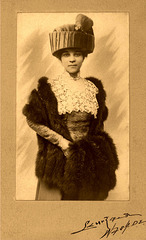
Annie Brooks Evans was a music school teacher in the Washington, DC public school system and also the mother of the internationally renowned opera singer Madame Lillian Evanti.
Sources: Addison N Scurlock, Photographer; Evans-Tibbs Collection, Anacostia Community Museum Archives, Smithsonian Institute, Gift of the Estate of Thurlow E. Tibbs, Jr.

Maude Brooks Cotton
| 17 Oct 2023 |
|
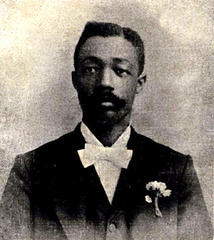
Maude Brooks Cotton (1872-1945), a native of Oberlin, Ohio, received her early school training at Knoxville College. Later she enrolled at the Oberlin Conservatory of Music, where she received a Bachelor of Music degree in 1896. In 1900 she was married to Reverend John Adam Cotton (1865 - 1943), and immediately journeyed in the mission field for the United Presbyterian Church. In 1903, she joined her husband in Henderson, North Carolina, where he was called to pastor and serve as president of the Henderson Normal School. Making him the second African American to do so. She was an active member of the organization and also wrote the words and music for the Federated Song. "We Are Lifting as We Climb." She was a charter member and local and state president of the Parent -Teachers Association. In 1943, she accompanied her husband to Knoxville College, where he was named the first black president and served until his death that same year. She was the mother of Carol C. Bowie, an educator. She is interred on the grounds of Jubilee Hospital.
Sources: Vance County, North Carolina, By Andre Vann, (2000); Beck Cultural Exchange Center, Knoxville, Tennessee; Knaffl Brothers, Knoxville, Tennessee;Courtesy of Andre D. Vann
Miles Vanderhorst Lynk
| 17 Oct 2023 |
|
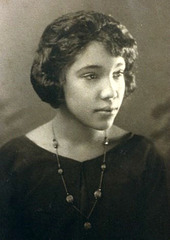
Physician, journalist, and educator Myles Lynk was born in Brownsville, Tennessee, on June 3, 1871, the son of former enslaved parents. His father was killed when Lynk was only six years old, and he was running the farm by the time he was eleven. His mother insisted that he attend school five months a year, and Lynk supplemented his education by reading at home in what he later called "Pine Knot College." He began teaching in Fayette County when he was seventeen, saving his money for further education. Lynk graduated from Meharry Medical College in 1891.
Lynk became the first black physician in Jackson, Tennessee and founded the first medical journal published by an African American, The Medical and Surgical Observer, published monthly from 1892 to 1894. He also published a literary magazine from 1898 to 1900. Lynk was a cofounder of the National Medical Association for African American Physicians in 1895.
In 1900 Lynk founded the University of West Tennessee, with departments of medicine, law, dentistry, pharmacy, and nursing. In 1907 the school moved to Memphis. Dr. Fanny Kneeland, one of the first women to practice medicine in Memphis, was a member of the faculty. The Jane Terrell Baptist Hospital provided clinical training. When the school closed in 1924, it had issued 216 medical degrees.
Lynk was also a founder of the Bluff City Medical Society and an active member of Collins Chapel CME Church. He wrote several books and numerous articles.
In 1893 Lynk married Beebe Stephen, a Lane College graduate who taught chemistry and medical Latin. They were married for fifty-five years. After her death in 1948, he married Ola Herin Moore. Lynk died on December 29, 1956.
Sources: The Tennessee Encyclopedia of History and Culture, by Pierre Magnuss; Memphis Museum; The Black Troopers: Or the Daring Heroism of the Negro Soldiers in the Spanish-American War by Miles V Lynk (published 1889)

Helen Louise Dillet Johnson
| 18 Oct 2023 |
|
Helen Louise Dillet Johnson (1842 - 1917), was a mom, musician, and public school teacher. And the first black female teacher in Florida at a grammar school and then at Edwin M. Stanton School.
She imparted to her children her considerable love and knowledge of English literature and the European tradition in music. Her husband James Johnson was born a free man in Richmond, Virginia in 1830.
Helen's father, Stephen Dillet was of French Haitian blood. Her mother (the former Mary Symonett), took her to New York to embark upon a singing career.
When James Johnson migrated to New York, he too was interested in music, heard Helen Louise sing and it was love at first sight.
When the Civil War created so much unrest, Helen Louise and her mother, returned to Nassau, and James Johnson followed. They were married in Christ Church Cathedral on April 22, 1864.
Bringing his wife back to America after the war and settling in Jacksonville, their first child was born, a girl, Marie Louise, on July 10, 1868. On July 17, 1871, James William (in 1913 he changed his middle name to Weldon), was born and on August 11, 1873, John Rosamond arrived.
She died in 1917 in New York City.
Sources: Yale Collection of American Literature, Beinecke Rare Book and Manuscript Library ; The James Weldon Johnson Papers in the Beinecke Library, Yale University
A Woman of Many Firsts: Vernie Merze Tate
| 16 Oct 2023 |
|
She was the first African American graduate of Western Michigan Teachers College, first African American woman to attend the University of Oxford, first African American woman to earn a Ph.D. in government and international relations from Harvard University (then Radcliffe College), as well as one of the first two female members to join the Department of History at Howard University.
Vernie Merze Tate was born on February 6, 1905 in Blanchard, Michigan. The grandchild of the first Negro settlers in Mecosta County, Michigan, she lived a country life, however she longed to see the world outside the pine trees and dirt roads which surrounded her.
In 1927 she graduated from Western State Teacher’s College (later Western Michigan University) with the school’s highest academic record at that time.
Despite her stellar academic record, Colored teachers were not hired to teach secondary education. With the assistance of the college’s administration, she would go on to teach at Crispus Attucks High School in Indianapolis, Indiana. The school, founded by the city’s Klu Klux Klan, was an effort to segregate races. Tate, along with others, was hired by the school’s African American principal with the intent to teaching Colored students to excel beyond the founders’ intentions.
As African Americans fought through Jim Crow laws stifled the life of many, Tate decided to explore the world and use her talents and gifts on a broader scale. She would travel the world, twice; serve as an international reporter for the Afro American Newspaper in Baltimore, work as a photographer, filmmaker and researcher for the U.S. State Department, all while being a college professor.
Her educational background would include being professor and dean for Barber-Scotia College, Bennett College, Morgan State College, and Howard University where she worked from 1942-1977.
She died in 1996 at the age of 91, however her legacy lives on. She has left millions to institutes of higher learning who looked beyond her race and gender to provide her with a stellar education. Western Michigan University, Radcliffe College-Harvard University, and Howard University received everything from million-dollar contributions, to archival documents upon her death.
Tate never married, or had children. Her four siblings did marry, however, none had children. Members of her family include distant cousins who are proud of the legacy she left behind.
Source: Western Michigan Archives
Mary Alexander
| 16 Oct 2023 |
|
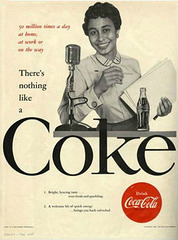
Ask Mary Alexander who she is, and she’ll proudly share her many titles: wife, mother, grandmother, former teacher and high school principal. “We were married three years before I realized I was married to a Coca-Cola model,” says her husband of three decades, Henry Alexander.
Affectionately called “Miss Mary” by some, she’s as humble as they come. So humble, in fact, that Coca-Cola didn’t know the identity of the young woman pictured in those groundbreaking ads until more than a half-century after they were produced.
Mary grew up on a farm in Ballplay, a small community in the northeast corner of Alabama. One of 10 children, she spent most of her days hoeing fields in the Southern heat.
“I had my first Coke at around 7 or 8 years old,” Mary remembers. “After a long, hard day of working on the farm, that was our treat at the end. We’d get an ice-cold Coca-Cola.”
She became only the second person in her family to attend college, enrolling at Clark College in Atlanta. During her junior year, the housemother of her dorm approached her and explained that Coca-Cola was trying to recruit African-Americans for a new advertising campaign. She suggested Mary try out.
Having no modeling experience, Mary hesitated, but agreed after the Dean insisted once more. She interviewed and was selected.
“I was surprised that they chose me,” she says. “Girls there were from Atlanta and New York. I was just a simple country girl!”
As word spread around campus, Mary’s excitement quickly turned into uneasiness. She describes her first photo shoot as “nerve-wracking.”
“I went back to my room and cried a little bit,” she recalls. “I was afraid this wasn’t what I should be doing. My parents were very strict, and I wanted to make sure they were okay with it.”
When the final ads came out, however, the mood changed.
“We told the whole family and spread it around campus,” Mary says. “It was surreal… I was just so happy.” She earned $600 total for approximately 15 ads, enough to pay for a full year of her college tuition.
While Mary’s face graced newspapers, magazines, billboards and New York subway stations, she fell out of touch with The Coca-Cola Company. The ads marked both the beginning and end of her modeling career, though she would go on to achieve plenty of other firsts.
After college, she moved to Detroit to pursue a master’s degree for a career in education. The job market was tough for an African-American woman in the midst of the Civil Rights Movement, but after nearly three years of applying to positions and working as a real estate secretary, Mary landed a position at Mount Clemons High School.
The principal warned her that the school’s population was mostly white, and that she’d be their first African-American teacher. Yet Mary remained unfazed.
“I asked, ‘Well, do they all have red blood running through their veins?’ He replied, ‘They do,’ and I said, ‘Then I don’t have a problem!” Mary recalls.
She left Mount Clemons after three years to teach at Highland Park High School and eventually became the school’s first female African-American principal. Years later, she was named the first female African-American director of vocational education for the state of Michigan.
Meanwhile, Mary continued to have no contact with Coca-Cola. She was rediscovered by chance, 52 years after her ads were first published. Mary’s niece and a high school classmate were looking through old photos when they came across a familiar face. The two took a picture of one ad and contacted Coca-Cola, letting a consumer hotline operator know what had been found.
When the request finally reached the company archives, the team assumed the claim was false.
“We get these kinds of requests all the time,” explains Jamal Booker, manager of heritage communications. “We have a whole file on people who claim to be models.”
Fortunately, Mary had kept a personal letter from the company from her modeling days. She faxed it in, and the team quickly called back to verify what Mary had known all along.
“In more than 30 years of people claiming to be models, Miss Mary was the only one who had proof,” Booker says. “We were shocked.”
Just months earlier, one of Mary’s ads had been selected to be featured at the World of Coca-Cola. The company brought Mary and her husband to Atlanta to see the exhibit and learn more about the story that almost went untold.
“Miss Mary reflects the humble confidence of the brand Coca-Cola itself,” Booker says. “She rarely, if ever, mentions the fact that she was an advertising trailblazer. If it had not been for a fan of hers, we wouldn’t have even known she was out there.”
A lesson learned, Coca-Cola now keeps in close contact with Mary, now 78. Retired and living in Ocala, Florida she periodically visits Atlanta for speaking opportunities and events.
Though she is flattered by the attention, she says it’s not about her.
“I hope I opened some doors. I hope I laid some groundwork for people in the future to see what can be done despite the odds,” Mary concludes. “That’s why I’m just so happy about it.”
American Trailblazer: Coca Cola Heritage Edition w/ Mary Alexander and Archivist for Coca Cola Jamal Booker:
www.youtube.com/watch?v=73fAI20bN_Y
Sources: A Humble Trailblazer: Meet Mary Alexander, the First African-American Woman to Appear in Coca-Cola Advertising (cocacolacompany.com) by Amy Cross
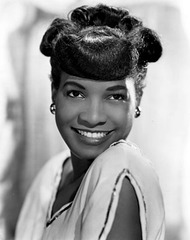
Carline Ray
| 17 Oct 2023 |
|
|
Carline Ray, one of the great jazz pioneers, an activist in women’s rights, a performer and educator. She died at Isabella House in Manhattan on July 18, 2013. She was 88 years old.
She was born on April 21, 1925, in New York City, Although her father, Elisha Ray, was a gifted musician, he had been unable to find steady employment in music. Even so, he played with James Reese Europe’s band and was also offered work with the New York Philharmonic. Carline herself sang and played piano, and at the age of 16 entered the Juilliard School of Music, from which her father had graduated in 1925. While at Juilliard, Ray studied composition and she also first played jazz, joining Edna Smith, a fellow student and bass player, gradually becoming adept on this instrument.
In 1946, upon graduating from Juilliard, she and Smith joined the International Sweethearts Of Rhythm. In addition to playing guitar with the band, Ray also sang. In 1948, after the Sweethearts disbanded, Ray joined Erskine Hawkins And His Orchestra as a singer but also played guitar rather than simply sitting idle between vocal numbers. After the Hawkins engagement, Ray and Smith teamed up with fellow Sweetheart Pauline Braddy to form a trio that played in New York clubs, including one managed by pianist and Orchestra leader, Luis Russell, whom Ray married in 1956. At this time, Ray added the Fender bass to her growing arsenal of instruments and she and Smith would sometimes switch instruments. In addition to working with the trio, Ray also played with various other bands, in particular a Latin band led by pianist Frank Anderson.
She continued to study, gaining a master’s degree in voice in 1956. Throughout the next two decades Ray worked constantly, singing and playing all the instruments upon which she was proficient, in a wide variety of musical settings. In 1981 she was awarded a grant to study the acoustic bass under renowned jazzman Major Holley. Comfortably adapting to the differing demands of jazz, popular music, classics, and choral works, Ray was a complete professional, finding in music a lifetime of challenge and fulfillment. Some of her performing credits as bassist include working with Sy Oliver Orchestra, Duke Ellington Orchestra directed by Mercer Ellington, pianist/composer Mary Lou Williams, trombonist-composer Melba Liston, and singer Ruth Brown. Nevertheless, Carline met her share of the prejudice that greets women in jazz. As she remarked to author Sally Placksin, ‘… I would rather be taken seriously as a musician, and the fact that I’m female – I just happen to be female, that’s all’.
In 2005, Carline was the recipient of the Kennedy Center’s Mary Lou Williams Women in Jazz Festival Award, and in 2008, she received an IWJ (International Women In Jazz) Award.
Carline is also featured in the documentary film ‘The Girls in the Band,’ directed by Judy Chaikin and in 2013 she released her debut recording produced by her daughter Catherine Russell (also a great musician), Carline Ray “Vocal Sides.”
Sources: Carline Ray Collection; wncu North Carolina Central University
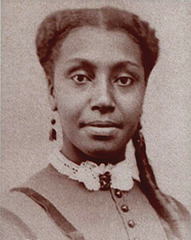
Sarah Lewis
| 18 Oct 2023 |
|
Sarah Anna Lewis (1846-1939), of Fall River, Massachusetts was admitted to Bridgewater State Normal School on February 19, 1867, and according to research compiled by Dr. Thomas Turner, professor of history at Bridgewater State College, Miss Lewis may have been the first African-American to graduate from the institution. She was a member of the Class of 1869.
Dr. Turner discovered the information about Miss Lewis in October 2006, while researching a book he is writing on the history of the college. Until Dr. Turner found a photograph of Miss Lewis in a college album, it was believed that Mary Hudson Onley, Class of 1912, had been the first African- American to graduate from Bridgewater.
Further research by Dr. Turner and by Mrs. Mabel Bates, special collections librarian in the Clement C. Maxwell Library, led to the discovery of Miss Lewis' application to Bridgewater. She was born on Feb. 20, 1846 and was a graduate of Fall River High School. She taught for three terms before coming to Bridgewater State Normal School, which, according to Dr. Turner, was not uncommon in the 19th century.
Subsequent information about Miss Lewis, uncovered by Dr. Philip Silvia, professor of history at Bridgewater State College, revealed that after her graduation she taught in Fall River for two years. She taught at the "1st Div. Intermediate" school level, commencing with her March 1869 appointment and continued teaching during the next academic year.
On May 11, 1871, she married Edward A.Williams and forfeited her teaching career because married women could not teach in public schools during this era. She subsequently became the mother of three children. Her husband was a cook and baker and established a catering business, but difficult economic circumstances in Fall River led the Williams family to move to Manhattan in the late 1870s. Later, they moved to the Boston area where Sarah helped support her family by working as a seamstress and dressmaker. She lived to the age of 92, passing away on Jan. 24, 1939.
Bio: Bridgewater State University
Photo: Fall River Historical Society
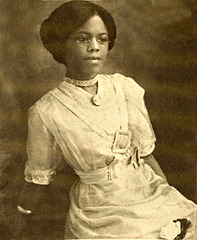
Clara Belle Williams
| 18 Oct 2023 |
|
Clara Belle Drisdale (1885-1994), was born in Plum, Texas in October 1885. She attended Prairie View Normal and Independent College (now Prairie View A & M University) in Prairie View, Texas beginning in 1903, and was valedictorian of her 1908 graduating class. She married Jasper Williams in 1917, and had three sons: Jasper, James, and Charles. Her husband died in 1946.
Williams took courses at the University of Chicago, and then enrolled at the New Mexico College of Agriculture & Mechanic Arts in the fall of 1928.
Taking courses only offered during the summer, while she worked as a teacher at Booker T. Washington School in Las Cruces, New Mexico, she graduated with a Bachelor’s Degree in English from NMCA&MA in 1937 at the age of 51.
During a time when Las Cruces’s public schools were segregated, Mrs. Williams taught at the Booker T. Washington School for more than 20 years.
Mrs. Williams’ three sons all went to college and graduated with medical degrees. Charles attended Howard University Medical School in Washington D.C., Jasper and James graduated from Creighton University Medical School in Omaha, Nebraska. They went on to found the Williams Clinic in Chicago, Illinois.
Clara Belle Williams went on to receive many honors during her lifetime. She succeeded despite significant obstacles of discrimination placed before her while pursuing her higher education. In 1961, New Mexico State University named Williams Street on the main campus in her honor. She received an Honorary Doctorate of Laws degree from NMSU in 1980.
Clara Belle Williams Day was celebrated on Sunday, February 13, 2005 at NMSU. Included in the festivities was the renaming of the NMSU English Building as Clara Belle Williams Hall.
Mrs. Williams passed away July 3, 1994 at the age of 108.
Panorama New Mexico State University Alumni Magazine
By Karl Hill
Jump to top
RSS feed- Kicha's latest photos with "Educator" - Photos
- ipernity © 2007-2026
- Help & Contact
|
Club news
|
About ipernity
|
History |
ipernity Club & Prices |
Guide of good conduct
Donate | Group guidelines | Privacy policy | Terms of use | Statutes | In memoria -
Facebook
X
