

Leo W's favorite photos


België - Kortrijk, Rozentuin
The Rozentuin (Rose Garden) is located in the historic garden of Kasteel 't Hooge . In 1959, a section of the garden was arranged as a rosarium.
The Rozentuin - covering an area of about one hectare - has two sections. The demonstration garden with some 200 hundred rose varieties that have proven to be successful and a historical garden that paints a picture of the rose's evolution through the centuries. The garden also comprises an experimental garden (PiP5), where more than a 100 new varieties of roses from European breeders are planted every year.

France - Abbey of Saint-Riquier
The Abbey of Saint-Riquier was founded around 625 and later came under royal protection with King Dagobert I. In 790 it became a major center of the Carolingian Empire when Charlemagne appointed his close friend, Angilbert, as abbot.
At the end of the 9th century, the abbey was destroyed by Norman invaders. Over the centuries, it suffered more than fifteen pillages and devastations. Yet, always rebuilt and enriched, the abbey remained an important religious and theological center.
After the Revolution, the convent buildings were for a time turned into quarries, then later housed hospitals or seminaries. The entire site was purchased in 1972 by the Department of the Somme and became a cultural center.
The church reveals a stylistic diversity, featuring elements of early, classical, and flamboyant gothic. The 15th-century façade - richly sculpted - is dominated by a central tower rising to 50 meters.
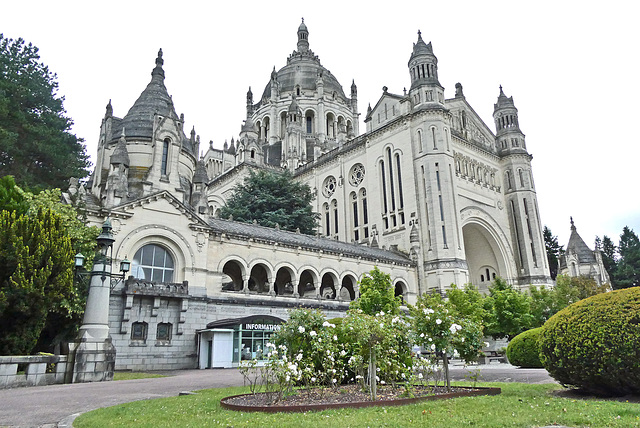
France - Basilique Sainte-Thérèse-de-Lisieux
The Basilique Sainte-Thérèse-de-Lisieux (Basilica of Sainte-Thérèse of Lisieux) was founded in Romanesque-Byzantine style in memory of Sainte Thérèsede l’Enfant Jésus. Construction of the church began in 1929 and it was consecrated in 1954.
The story of the Basilica of Sainte-Thérèse begins with the life of Thérèse of Lisieux, a young Carmelite nun who was canonised in 1925. Her popularity grew enormously and the need for a place of pilgrimage became apparent. In response, construction of the basilica began under the direction of the Bishop of Bayeux and Lisieux and architect Louis Marie Cordonnier.
The design of the basilica is a mix of neo-Byzantine and Romanesque styles, inspired by the Basilica of the Sacred Heart in Paris. The building is constructed of reinforced concrete and a local type of granite. The Basilica of Sainte-Thérèse has impressive dimensions: 104 metres long, 45 metres wide and a dome reaching a height of 97 metres. With an area of 4,500 m², it is the largest church built in France in the 20th century. The basilica can accommodate 4.000 worshippers.
The construction of the Basilica of Sainte-Thérèse-de-Lisieux faced many challenges, including financial constraints and the outbreak of the Second World War, but it was finally consecrated in 1954. Today, with more than 700,000 visitors, it has become the second most important place of pilgrimage in France.

France - Basilique Sainte-Thérèse-de-Lisieux
The Basilique Sainte-Thérèse-de-Lisieux was founded in Romanesque-Byzantine style in memory of Sainte Thérèsede l’Enfant Jésus. Construction of the church began in 1929 and it was consecrated in 1954.
The walls and ceiling of the basilica are largely covered with marble and mosaics. These vibrant works of art, created by Pierre Gaudin, depict scenes from the lives of Christ and Sainte Thérèse. The absence of columns in the immense interior provides an unobstructed view for 4.000 worshippers.

Nederland - Voorst, Kasteel De Nijenbeek
Kasteel De Nijenbeek - a defensive castle on the banks of the river IJssel - was first mentioned in 1266. At that time it was inhabited by knight Theodericus, also called Dirk, Lord of Nijenbeek. Its location on the banks of the river IJssel was very strategic, assuring control over the traffic on the river.
Over the centuries a lot has changed to the castle. The many different owners adapted the building to their own wishes and use. Later in the 18th century De Nijenbeek fell into disrepair, because the owners lived somewhere else and rented out the castle.
In 1945 - at the end of World War II - Kasteel De Nijenbeek was shelled from the eastern bank of the river IJssel by Canadian troops because it was used by the Germans as a lookout post. During the shelling, the tower of the castle lost its 19th century pyramid roof. The castle became more and more a ruin.
In 2016 the ruin was consolidated by a major restoration. The (consolidated) square tower is nowadays the only remaining part of the castle. Kasteel De Nijenbeek has very limited opening hours..

10 favorites
L’eclipse solaire avec ChatGPT
J’ai observé l’eclipse , hier soir , le soleil était très fort , j’ai observé avec des lunettes spéciales mais il ne faut pas observer plus de trois minutes à la suite même avec les lunettes . Je n’avais pas de filtre pour mon appareil photo , je n’avais pas envie ni d'abîmer mes yeux ni l'appareil photo . J’ai demandé à ChatGPT de me réaliser cette composition avec les heures de cette eclipse visible dans ma commune , à la plage de la Ville-ger. L’IA est utile selon l'utilisation des gens ........ Je me souviens de l’eclipse de 1999 , ........

12 favorites
Des mûres au jardin ......
Elles ne sont pas très sèches malgré la chaleur

20 favorites
Des pommes au bord de Rance (22)
Une spécialité de ma commune , le cidre du val de Rance , fabriqué à Pleudihen sur Rance . Vous le connaissez peut-être ? On le trouve dans les grands magasins aussi . Il est produit par les celliers associés depuis 1953 . Beaucoup de pommiers sont plantés le long de la Rance .
17 favorites
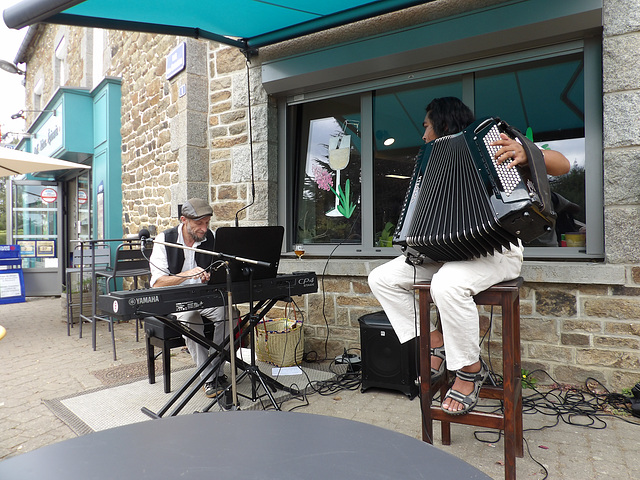
Concert , à l’aluette à Saint Helen , avec Gabriel Jego au piano et Glenn Mahé à l'accordéon
Jump to top
RSS feed- Latest favorites - Subscribe to the favorite docs of Leo W
- ipernity © 2007-2026
- Help & Contact
|
Club news
|
About ipernity
|
History |
ipernity Club & Prices |
Guide of good conduct
Donate | Group guidelines | Privacy policy | Terms of use | Statutes | In memoria -
Facebook
X
